How PredictX Is Helping Organisations Monitor Traveller Risk During Global Conflicts
Table of Contents
• Introduction
• Why Travel and Expense Management Data Is Critical for Traveller Safety
• What Is Corporate Travel Risk Management
• Why Companies Struggle to Track Travellers During Global Conflicts
• How the PredictX Global Conflict Module Works
• How PredictX Identifies In Country Traveller Risk
• How Repatriation Analysis Supports Crisis Response
• How Travel Data and Card Data Reveal Hidden Traveller Risk
• How This Strengthens Corporate Travel Risk Management
• Why Travel Data & Predictive Analytics Matter for Traveller Safety
• Conclusion
• FAQ
Introduction
Corporate travel disruption is becoming more frequent and complex. When geopolitical incidents occur, travel teams often struggle to quickly identify where employees are, whether they are exposed to risk, and who may require assistance returning home. Corporate Travel Risk Management has become a critical capability for modern travel programs.
Recent global events have highlighted how important real time traveller visibility has become. According to the GBTA global business travel spending research, business travel spending exceeded $1.48 trillion in 2024, while geopolitical disruptions affecting travel continue to increase.
To help organisations respond more effectively, PredictX has launched a new Global Conflict traveller risk module designed to help companies monitor traveller exposure, identify in country risk, and support repatriation planning using travel and expense data analytics.
The launch has already received industry attention, including coverage in The Business Travel Magazine report on the PredictX traveller tracking solution for Gulf travel disruption and Business Travel News Europe coverage of the PredictX Traveller Risk module.
Why Travel and Expense Management Data Is Critical for Traveller Safety
Modern Corporate Travel Risk Management depends on Travel and Expense Management data because it provides a complete view of employee travel activity across bookings, expenses, and corporate card transactions.
Traditional travel risk monitoring systems often rely primarily on travel management company booking data. While useful, this only reflects part of a traveller's journey.
By integrating T&E reporting, corporate card transactions, and travel bookings, organisations can achieve total trip visibility and gain a much clearer understanding of where travellers are located throughout their journey.
This level of data consolidation and insights enables organisations to detect unmanaged travel activity and respond more quickly when disruptions occur.
Key travel data sources include:
• T&E reporting systems
• Travel management company bookings
• Corporate card transactions
• Expense reports
• Hotel and airline booking data
When combined, these sources create consolidated travel and expense data, enabling organisations to monitor traveller exposure in near real time.
What Is Corporate Travel Risk Management
Corporate Travel Risk Management is the process of monitoring employee travel activity, identifying potential exposure to risk, and enabling organisations to respond quickly to safety incidents affecting travelling employees.
Corporate Travel Risk Management combines travel booking data, expense data, and corporate card activity to provide visibility into employee travel activity.
Modern travel programs increasingly rely on travel data & analytics and travel reporting & predictive analytics to understand traveller movement and anticipate disruption risks.
Core elements of Corporate Travel Risk Management include:
• Traveller location visibility
• Real time travel booking monitoring
• Risk classification by destination
• Incident response coordination
• Repatriation planning
Why Companies Struggle to Track Travellers During Global Conflicts
Many organisations lack full traveller visibility because travel bookings, expenses, and corporate card data are spread across disconnected systems.
When incidents occur, travel managers typically rely on booking data from travel management companies. However, this does not capture all travel activity.
Employees frequently book hotels directly, purchase travel through third party platforms, or use corporate cards independently. These behaviours create data fragmentation that limits traveller visibility.
A Deloitte corporate travel spend analysis found that 32 percent of corporate travel spend occurs outside managed travel programs, creating significant blind spots.
Common visibility gaps include:
• Direct hotel bookings
• Corporate card purchases outside policy
• Third party booking platforms
• Separate travel and expense systems
• Delayed supplier reporting
How the PredictX Global Conflict Module Works
The PredictX “Global Conflict – Traveller Risk” module consolidates travel booking data and corporate card transactions into dashboards that identify travellers in high risk regions and highlight employees who may require assistance.
The module introduces a dedicated Global Conflicts Dashboard that enables organisations to identify travellers potentially affected by geopolitical incidents.
PredictX consolidates T&E Reporting, travel booking data, and corporate card transactions into a unified layer of travel and expense data analytics, delivering a comprehensive view of the total trip.

Key capabilities include:
• Identifying employees travelling to high risk regions
• Monitoring travel routed through major transit hubs
• Detecting hotel bookings without corresponding flights
• Analysing corporate card transactions in risk areas
• Providing traveller location visibility
Keesup Choe, CEO of PredictX, said:
“Our Business Intelligence Analysis team worked around the clock over the weekend to design, build and deploy the module for every client – regardless of travel programme size – at no additional cost.”
The module was rapidly developed in response to the evolving situation in the Middle East and made available to all PredictX clients to help travel teams quickly monitor traveller exposure and respond to emerging risks.
The launch has already received industry coverage, including The Business Travel Magazine report on the PredictX traveller tracking solution and Business Travel News Europe coverage of the PredictX Traveller Risk module.
How PredictX Identifies In Country Traveller Risk
PredictX identifies travellers currently inside affected regions by analysing signals from travel bookings, hotel reservations, and corporate card transactions.
Traditional travel risk systems typically analyse flight bookings alone. While useful, this approach misses travellers who book hotels independently or travel outside approved channels.
PredictX improves visibility by analysing T&E reporting data and corporate card transactions, enabling organisations to identify traveller presence even when bookings occur outside the managed travel program.

Signals used to identify traveller location include:
• Flight segments
• Hotel bookings
• Corporate card transactions
• Transit routes
• Travel itineraries
This approach helps detect leaked travel, where bookings occur outside official travel channels.
How Repatriation Analysis Supports Crisis Response
Repatriation analysis identifies employees who may require assistance returning home during geopolitical incidents or travel disruptions.
When crises escalate, organisations must quickly determine which travellers may require evacuation or repatriation support.
The PredictX module analyses nationality data and travel itineraries to identify employees who may need assistance returning to their home location.

Repatriation analysis supports:
• Identifying stranded travellers
• Planning return travel routes
• Supporting employees abroad
• Coordinating crisis response teams
• Communicating with affected travellers
How Travel Data and Card Data Reveal Hidden Traveller Risk
Combining travel booking data with corporate card transactions reveals travellers who may be present in risk regions even when they booked outside the corporate travel program.
Corporate card data can reveal traveller presence when hotel bookings or purchases occur outside official booking channels.
PredictX assigns risk levels to destinations based on geopolitical monitoring.
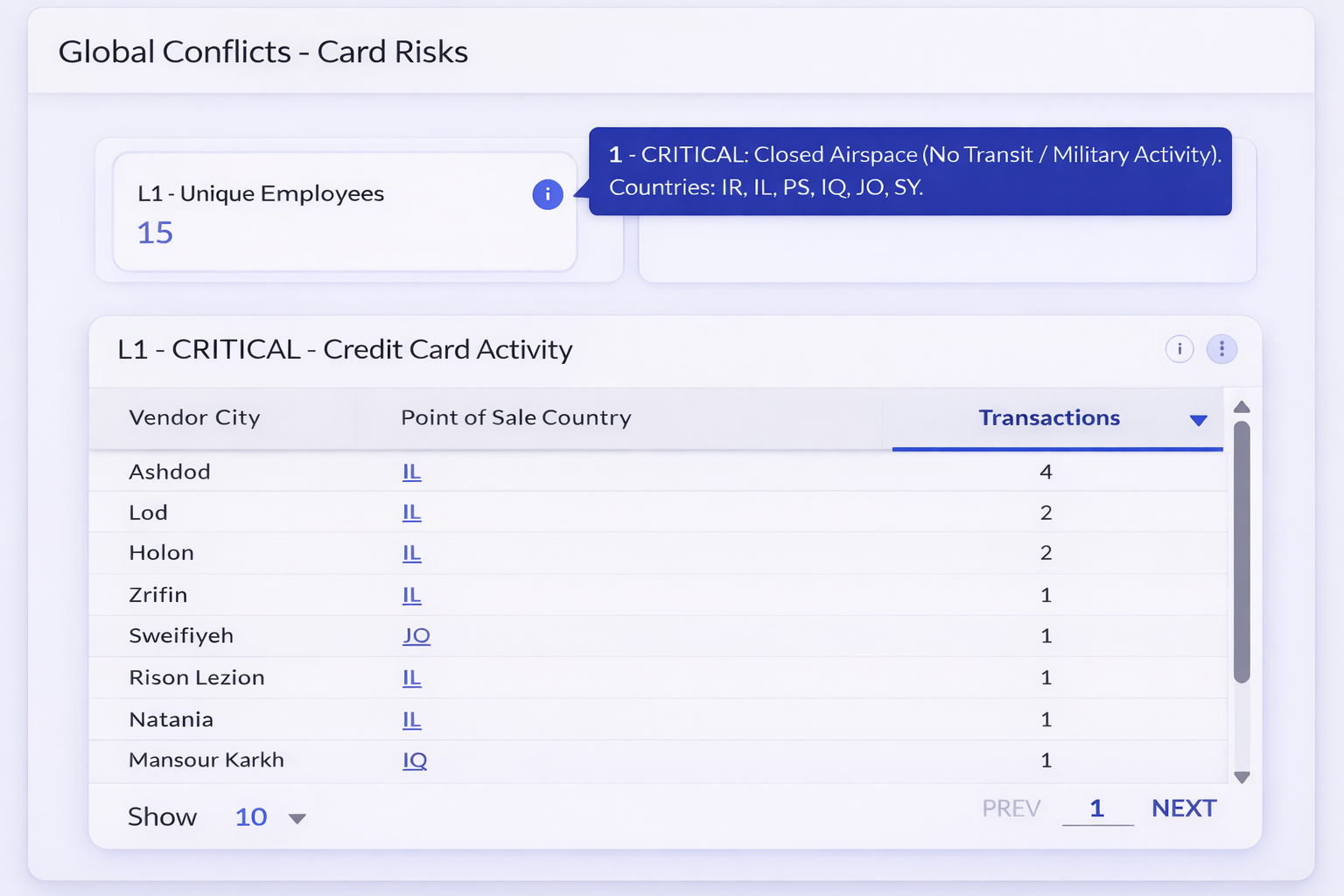
This approach helps organisations detect unmanaged travel activity that might otherwise remain hidden.
How This Strengthens Corporate Travel Risk Management
PredictX strengthens Corporate Travel Risk Management by delivering a unified view of traveller activity across booking data and expense transactions.
Travel managers gain a consolidated dashboard that improves visibility across travel systems and strengthens corporate travel compliance.
Key benefits include:
• Faster traveller identification during incidents
• Improved duty of care compliance
• Reduced travel risk exposure
• Stronger travel program governance
• Better traveller communication
According to International SOS travel risk outlook research, 65 percent of travel managers report increasing concern about geopolitical travel risk.
Why Travel Data & Predictive Analytics Matter for Traveller Safety
Travel data & predictive analytics help organisations anticipate disruption risks and identify traveller exposure earlier.
PredictX combines travel reporting & predictive analytics with trip analytics to identify patterns in travel activity that may signal increased risk exposure.
As travel technology continues to evolve, emerging technologies such as Agentic AI will further enhance how organisations monitor traveller risk and automate crisis response using real time travel intelligence.
Conclusion
Corporate travel risk management is becoming increasingly complex as geopolitical disruptions affect global mobility.
The PredictX Global Conflict Module helps organisations monitor traveller exposure, detect unmanaged travel activity, and support repatriation planning using consolidated travel and expense data analytics.
With improved visibility across travel bookings and corporate card transactions, companies can respond faster and better protect employees wherever they travel.
Learn more about how PredictX Travel Data & Analytics solutions help organisations transform travel and expense data into actionable insights.
FAQ
What is Corporate Travel Risk Management
Corporate Travel Risk Management refers to the systems companies use to monitor employee travel activity and protect travellers during safety incidents or geopolitical disruptions.
How can companies identify travellers in high risk regions
Organisations can identify travellers by combining travel booking data, hotel reservations, corporate card transactions, and T&E reporting within a unified travel data analytics platform.
Why is repatriation analysis important
Repatriation analysis helps organisations identify employees who may require assistance returning home during geopolitical crises or travel disruptions.
Unlock Your T&E Advantage: Subscribe to PredictX in Focus Newsletter
🔔 Stay Ahead! Follow Us on LinkedIn for the Latest Innovations and Feature Updates to Enhance Your Travel Management Experience!
Related Posts
.webp)
The New Gold Standard in T&E Reporting: PredictX Wins Major Business Travel Technology Innovation Award
.webp)
Cogent Wins 2025 BTS Europe Innovation Faceoff: Setting a New Benchmark for AI-Driven Travel & Expense (T&E) Solutions
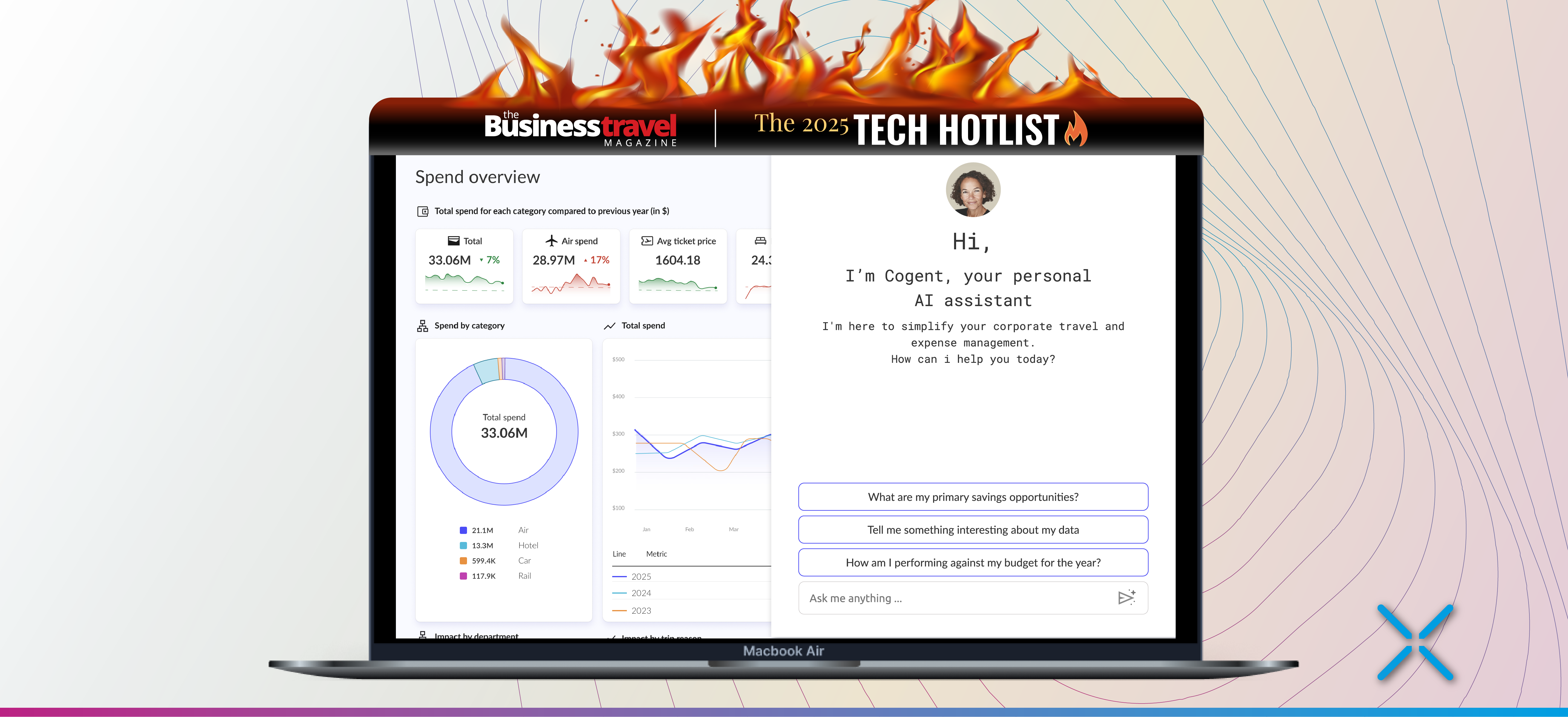
Hot List, Hot News: We've Been Named to the Tech Hotlist for Redefining Corporate Travel with Cogent Agentic AI