

Corporate Travel Leakage: What Causes It and Why Your Data Cannot See It
What is corporate travel leakage?
Corporate travel leakage is spend that occurs outside a company's managed travel programme, through unapproved booking channels, non-preferred suppliers, or transactions that never enter the managed travel data streams.
Introduction
It's not that your travellers are ignoring policy. It is that fragmented data across TMC, card, and expense systems makes accurate corporate travel leakage measurement impossible. Three months of off-channel hotel bookings on a single route compound into six figures of unrecoverable cost before a single compliance report flags it.
A programme reporting 82% TMC adoption looks competent. The board sees the compliance metric. Finance sees the adoption trend line.
But that figure is built entirely on what the TMC can observe. The bookings that bypassed it, the hotel charged to a personal card, the flight rebooked direct after a disruption, the ground transport filed under "miscellaneous expenses", none of those ever entered the denominator.
Euromonitor International research found that nearly two-thirds of global business travel spend remains unmanaged travel spend. The GBTA January 2026 poll of 571 travel professionals found that managing leakage is a top challenge for 39% of corporate travel buyers.
This post introduces the Three Layers of Travel Leakage framework. It explains where spend actually goes, why most programmes only see one layer of it, and what changes when you align all three. It is the foundation every T&E management team needs before investing in any leakage reduction initiative. Travel spend analytics built on a broken baseline produces confident answers to the wrong question.
In This Article
- What is corporate travel leakage?
- Why does corporate travel leakage happen?
- The Three Layers of Travel Leakage framework
- What is the difference between leakage and invisible spend?
- How does leakage affect supplier negotiations?
- How do you identify travel leakage in your programme?
- Which leakage approach captures what?
- Frequently Asked Questions
What is corporate travel leakage?
Corporate travel leakage is any travel-related spend that occurs outside a company's managed programme, through unapproved booking channels, non-preferred suppliers, or direct-with-vendor transactions that never enter the TMC data stream.
It includes the obvious cases. A traveller who books a hotel on a consumer site because it's faster. A flight purchased directly with the airline to preserve loyalty points.
But leakage also includes the cases most programmes never discuss.
- The hotel upgraded at check-in that never reconciles to the original booking
- The refund processed on a cancelled trip that is then rebooked directly
- The Uber receipts submitted under "miscellaneous" that belong in ground transport
- The contractor who travels on company business but sits outside the HR system entirely
The scope is consistently larger than most programmes estimate. Euromonitor research found that nearly two-thirds of global business travel spend remains unmanaged. Even among organisations with an active TMC relationship, approximately 10% of bookings still occur outside approved channels.
Why does corporate travel leakage happen?
Travel leakage has two distinct root causes: traveller behaviour and data fragmentation. Most programmes focus exclusively on behaviour and ignore the data problem, which is why leakage persists even in mature, well-managed programmes.
Keesup Choe, CEO of PredictX, puts it directly: "The questions that drive programme decisions are almost always answerable from data you already have. The cost is not missing data. It is missing access, at the moment it matters."
The behavioural causes
These are the ones corporate travel managers know well from spend analytics reviews:
- Booking friction. When the corporate booking tool is slower or harder to use than a consumer site, travellers choose the faster path. Friction is the single largest driver of off-channel bookings.
- Off-platform booking driven by loyalty conflicts. Travellers accumulating airline or hotel points have a direct financial incentive to book directly. Until the programme value clearly outweighs the personal benefit, off-channel behaviour continues.
- Policy gaps. Short-notice trips, disrupted itineraries, and destinations with thin preferred supplier coverage create legitimate grey areas where travellers make pragmatic choices.
- Lack of awareness. In organisations without consistent travel policy communication, a meaningful share of travellers simply do not know what the approved channels are.
The data causes: why behaviour alone does not explain it
Here is what the standard narrative misses. Even when a traveller books through the approved channel, leakage still occurs downstream.
The ancillary fee charged at check-in. The seat upgrade processed separately. The excess baggage added at the gate.
None of these flow back through the TMC. They appear, if they appear at all, in the expense system, weeks or months later, under categories that may or may not flag them as travel spend.
This is data leakage. It is not a behaviour problem. It is a connectivity problem between systems that were never designed to talk to each other. Policy changes cannot solve it. Only a unified data layer can.
As Keesup Choe has said: "The true potential for AI is not in taking over jobs people already do. It is in doing the work that is not being done, work that is too expensive or requires too much manpower." Data-layer leakage is precisely that work.
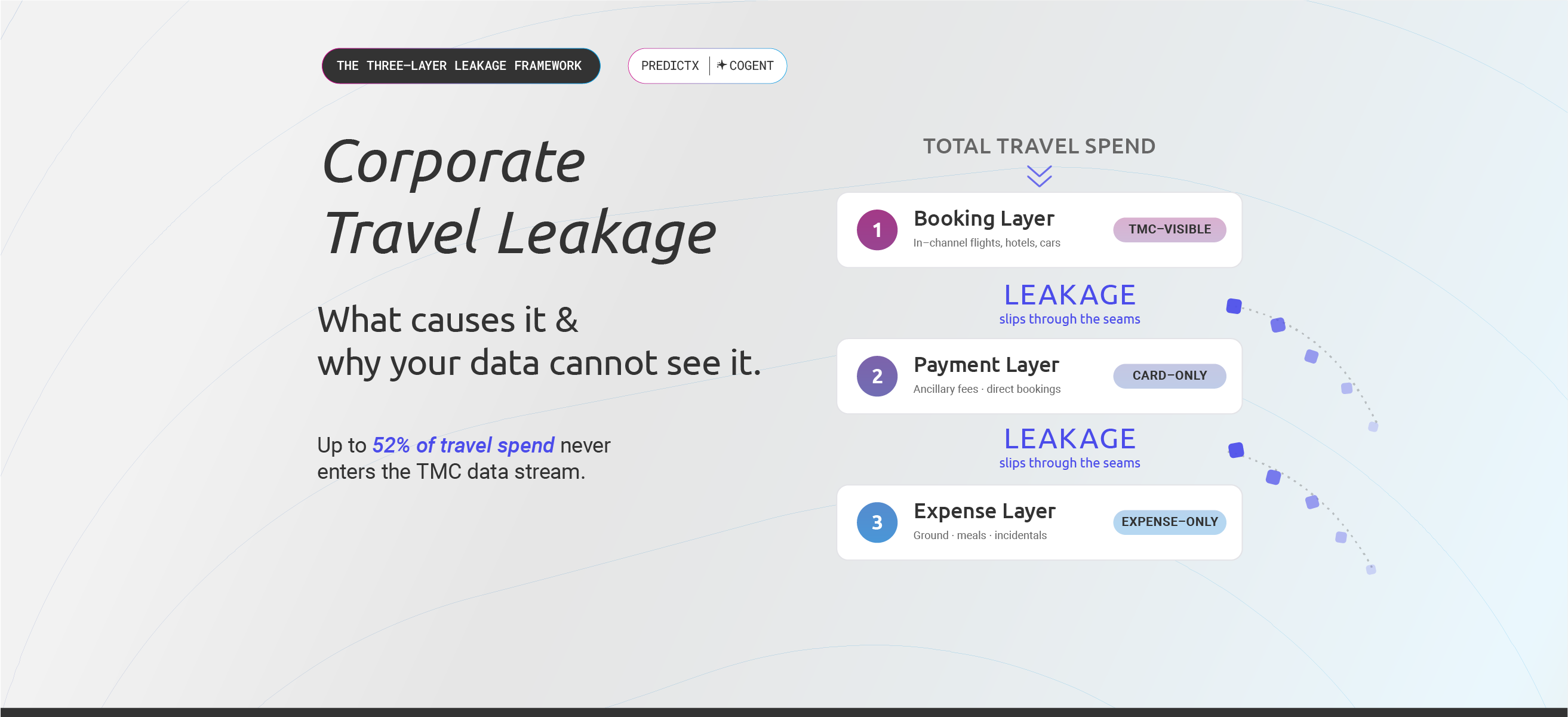
What are the Three Layers of Travel Leakage?
Most travel programmes have visibility into one layer of their spend data. True leakage measurement requires aligning all three layers simultaneously.
This framework is the difference between programmes that understand their leakage and those that guess at it.
Layer 1: The Booking Layer
What the TMC captures: flights, hotels, and car hire booked through approved channels. This is the layer most programmes report on. It typically represents 60% or less of actual travel spend.
Layer 2: The Payment Layer
What corporate card data captures: actual transactions, including ancillary fees, direct-with-supplier bookings, and any spend that bypassed the TMC. This layer is almost never aligned with booking data at the transaction level because bookings and payments are separated by days or weeks, and the two systems share no common identifier.
Layer 3: The Expense Layer
What the travel and entertainment expense system captures: out-of-pocket spend submitted for reimbursement, including ground transport, meals, and hotel incidentals recorded as "other." Much of this is legitimate travel cost that never appears in the TMC or card feed. Expense reporting systems operate on a different cycle from booking systems, and travel compliance frameworks rarely connect the two. T&E reporting tools that pull from only one of these layers produce a systematically incomplete picture of what travel expense management actually costs. Travel and expense data analytics requires all three. Connecting all three sources into a unified T&E data model is the only way to see the full picture. Travel data analytics across all three layers is what makes that model queryable rather than static. Without data consolidation, even the sharpest analyst is reading from an incomplete picture. Without it, corporate travel compliance monitoring is operating on an incomplete dataset.
The problem is the gaps between layers, not within them. A refund processed on a cancelled booking that is then rebooked directly becomes leakage the moment the rebook bypasses the TMC. It looks like a payment without a booking.
Without consolidated travel and expense data matched at transaction level across all three layers, it's invisible.
The PredictX platform built Trip Builder to address exactly this, and Cogent provides the agentic AI layer on top: any team member can ask, via a travel analytics layer that reads all three sources simultaneously, "what is our off-channel hotel spend in EMEA this quarter?" and receive a structured, finance-ready answer in seconds, without navigating a single dashboard or waiting for a data team.
What is the difference between leakage and invisible spend?
Leakage is spend that bypasses approved channels. Invisible spend is spend that bypasses your data, it may be policy-compliant but goes unrecorded, miscategorised, or unreconciled, and no compliance intervention can fix it.
The distinction matters because each type requires a completely different response.
Leakage is a compliance and channel problem. The fix involves policy, communication, and reducing friction in the approved tool.
Invisible spend is a data architecture problem. The transaction may be fully compliant. The data is wrong. Only a unified data layer addresses it.
The third category, true leakage, is what most programmes never reach. It requires removing false positives: the emergency rebooking that looks like leakage but was not, the supplier refund that was processed correctly and then rebooked through compliant channels. Only transaction-level matching can separate true leakage from legitimate exceptions.
How does leakage affect supplier negotiations?
Leakage directly reduces your negotiation leverage with preferred suppliers by understating your true volume. Most suppliers know their actual numbers better than you know yours.
When you negotiate an airline or hotel contract, you present volume data drawn from your TMC. If 30 to 50% of your travel spend bypasses the TMC, you are presenting a fraction of your actual volume and negotiating as though the fraction is the whole.
Unquantified leakage is also a corporate travel risk management failure. The supplier's revenue management team sees the full picture. They know exactly how much of your company's spend flows through non-preferred channels. They factor it into the deal.
You are negotiating with incomplete information against a counterpart with complete information.
The Industry business travel benchmarks show the gap between corporate negotiated hotel rates and open market rates has widened to 22.6%. That discount is only realised when bookings flow through the managed channel. Every percentage point of leakage erodes it.
The second-order effect is equally damaging. Consistent leakage signals to preferred suppliers that your programme lacks enforcement. Over time, this erodes the goodwill and preferred treatment that strong compliance generates.
Suppliers offer their best terms to buyers who demonstrably deliver volume. Leakage quietly undermines your ability to be that buyer.
Learn how PredictX addresses travel programme leakage, including the supplier-side intelligence that helps organisations negotiate on complete data, not partial reporting.
How do you identify travel leakage in your programme?
Identifying travel leakage requires comparing booked data against payment and expense data at the transaction level. Summary-level or category-level comparisons cannot distinguish true leakage from legitimate exceptions.
The standard approach, pulling a booking compliance report from the TMC, only shows you what the TMC knows. It can't show you bookings that never entered the TMC. It can't show you expense claims representing travel spend categorised under something else.
It cannot show you the timing gap between a cancelled booking and a direct rebook.
With Cogent by PredictX, the identification process doesn't require a data team or a custom report request. A travel manager can ask directly: "Show me all card transactions in Q2 that look like hotel spend but have no corresponding TMC booking." Cogent queries across all connected data sources, applies the logic, surfaces the anomalies, and flags the root cause, all in under 10 seconds.
This is what the shift from reporting to agentic intelligence actually means for leakage. It's not that the data was missing. It was always there. It's the access that was missing. Predictive analytics and agentic AI are what make that access continuous rather than episodic.
The total trip cost analysis is the broadest measure; the hotel attachment rate is the clearest single metric for surfacing this kind of invisible spend. PredictX's analysis of hotel attachment rate as a signal of missing T&E spend shows how the metric reveals leakage that compliance reports never flag.
Modern travel programmes are moving away from siloed reporting toward continuous agentic intelligence. Cogent itself is not a chatbot or a reporting tool. As Keesup Choe describes it: "Cogent is not just an AI application. It is an entire platform, a framework from which all of our apps are built." That distinction matters for leakage, because what closes the gap between TMC reporting and true measurement is not a faster dashboard. It is a framework of autonomous agents operating across all three data layers continuously.
For a full technical view of the framework, PredictX publishes its agentic AI corporate travel and expense management whitepaper, which covers the platform architecture and the use cases it supports.
As Keesup Choe has observed: "While corporate travel has surged, many teams have not been able to expand to meet this demand, amplifying the need for scalable, autonomous solutions like Cogent that can address these gaps efficiently."
Cogent was recognised as the 2025 BTS Europe Innovation Faceoff Winner, named the Business Travel Technology Innovation Data and Reporting award winner, and featured on the BTN Europe Hotlist 2026. It deploys in seconds, not months, requires no BI configuration, and is queryable by any team member in plain language.
Also worth reading: how leakage and invisible spending influence your travel programme, a deeper look at the financial and compliance consequences of unmanaged leakage.
Which leakage approach captures what?
Before deciding how to address leakage in your programme, it helps to understand what each approach actually surfaces and where each one stops.
The top three approaches are not wrong. They are incomplete. Each one sees a different slice. Only transaction-level matching across all three layers produces a number you can act on.
Frequently Asked Questions
What is corporate travel leakage?
Corporate travel leakage is spend that occurs outside a company's managed travel programme, bypassing preferred booking channels, approved suppliers, or both. It results in lost negotiated savings, fragmented travel data, and expense compliance failures that go undetected for months. Payment and expense-layer leakage typically add a further 10 to 20% on top of booking-layer figures.
What are the main causes of travel programme leakage?
The main causes fall into two categories: behavioural (booking friction, loyalty conflict, policy gaps) and structural (data fragmentation across TMC, card, and expense systems). Most programmes only address the first category, which is why leakage rates rarely fall below 15% even after policy tightening. The structural causes require data infrastructure investment, not policy changes.
What is the difference between leakage and invisible spend?
Leakage is spend that bypasses approved channels. Invisible spend is compliant spend that disappears into data gaps, miscategorised, unmatched, or recorded under the wrong cost code. The practical difference is that leakage shows up as a compliance problem; invisible spend does not show up at all. Programmes that focus solely on compliance metrics are typically recovering less than half of their true financial exposure.
How does travel leakage affect supplier negotiations?
Leakage understates your true volume when you present data to preferred suppliers, which directly weakens your commercial position. Suppliers see the real numbers through their own revenue management systems. The typical gap: a programme presenting 70% of its true hotel volume in an RFP is effectively negotiating on behalf of a smaller company than it actually is, and the rates reflect that.
How do you identify true leakage versus legitimate exceptions?
True leakage is identified by matching all bookings, payments, and expenses at the transaction level, then removing approved exceptions including disruption rebookings, policy-approved out-of-channel situations, and refunds followed by compliant rebooking. The final residual is your true leakage figure. Without this exception-removal step, programmes routinely overstate leakage by 15 to 25%, which distorts investment cases and programme benchmarking.
Can agentic AI identify travel leakage automatically?
Yes. Agentic AI platforms like Cogent by PredictX continuously monitor for leakage patterns across connected TMC, card, and expense data, flagging anomalies proactively without waiting for a monthly report cycle. Gartner projects 40% of enterprise applications will feature task-specific AI agents by end of 2026, up from less than 5% in 2025. Detection moves from a monthly report to a real-time flag.
Key takeaway Most programmes are solving the wrong version of the leakage problem. They are treating it as a traveller behaviour problem, measuring it with tools that only capture one of three data layers, and then wondering why the number does not move. The uncomfortable reality is that a programme with excellent policy compliance can still have catastrophic data-layer leakage, and that spend will never show up in a TMC compliance report no matter how well-designed the policy is. The Three Layers framework is the map. Transaction-level matching is the methodology. Trip analytics and agentic AI are what make that methodology continuous and accessible to teams without a data analyst available before every decision.