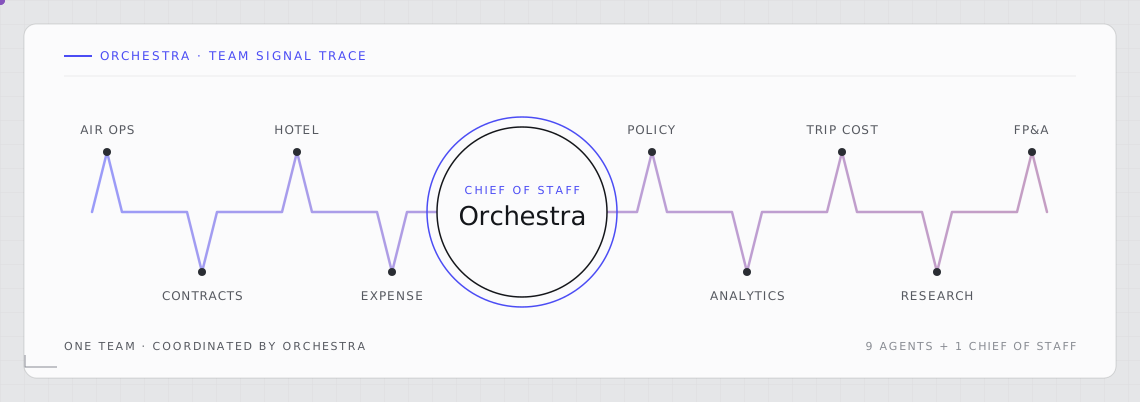
As AI reshapes work, the travel and procurement manager stops running travel and starts running the programme, as its CEO. Orchestra is that CEO's team: your project manager, and a team of specialist agents. You still steer.
The team you could never hire, built for you.
You → your project manager → nine specialists → a finished, cited deliverable.
4 of the 6 largest global T&E programmes run on PredictX.
The depth of work a programme actually needs has always been rationed, because the old ways of getting it are expensive and slow.
Travel managers want depth and continuity, not periodic, expensive snapshots. The work you never had the team to do is exactly the work Orchestra exists to run.
Automation does a task. A copilot helps a person. Orchestra owns an outcome: tactical work delegated, your judgement freed for strategy.
“Plan ready. Dispatched 5 specialists, gathering in parallel.”
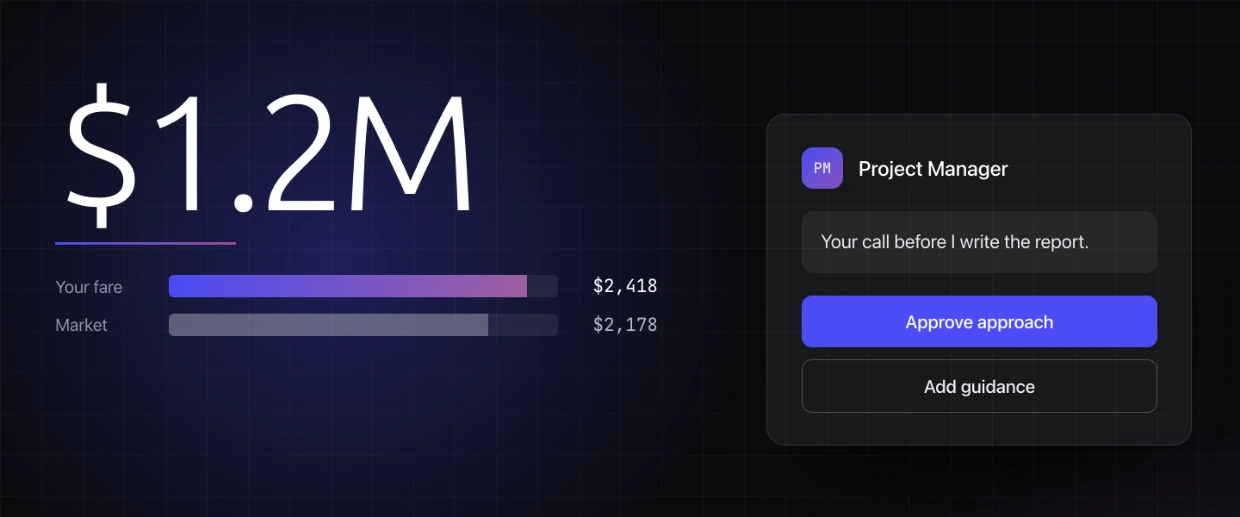
Every team needs one. The project manager runs the project, and flags anything that needs your judgement before it ships.

Owns the operational data: routes, properties, bookings, segments and rates.
Market intelligence and policy benchmarks on demand.
Tracks savings, KPIs and compliance.
Budgets, forecasts and spend visibility.
Stakeholder updates that keep everyone aligned.
Bookings, itineraries, the detail behind every trip.
Procurement analytics, sourcing and contract execution.
AI fraud detection and continuous auditing: enforces compliance, recovers leakage, surfaces exceptions.
Traveller tracking, travel disruption and duty of care.
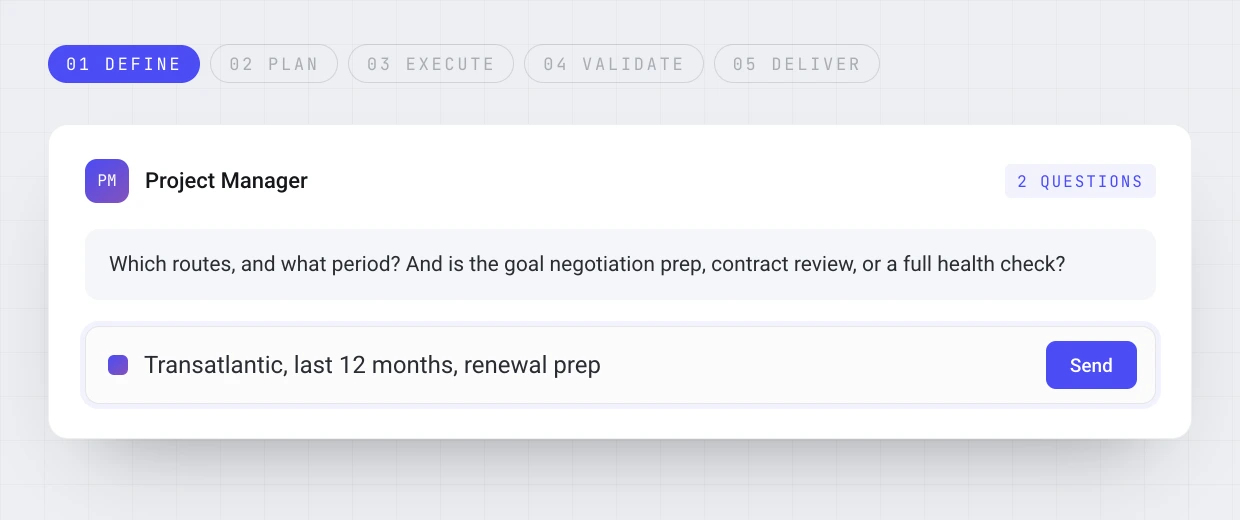
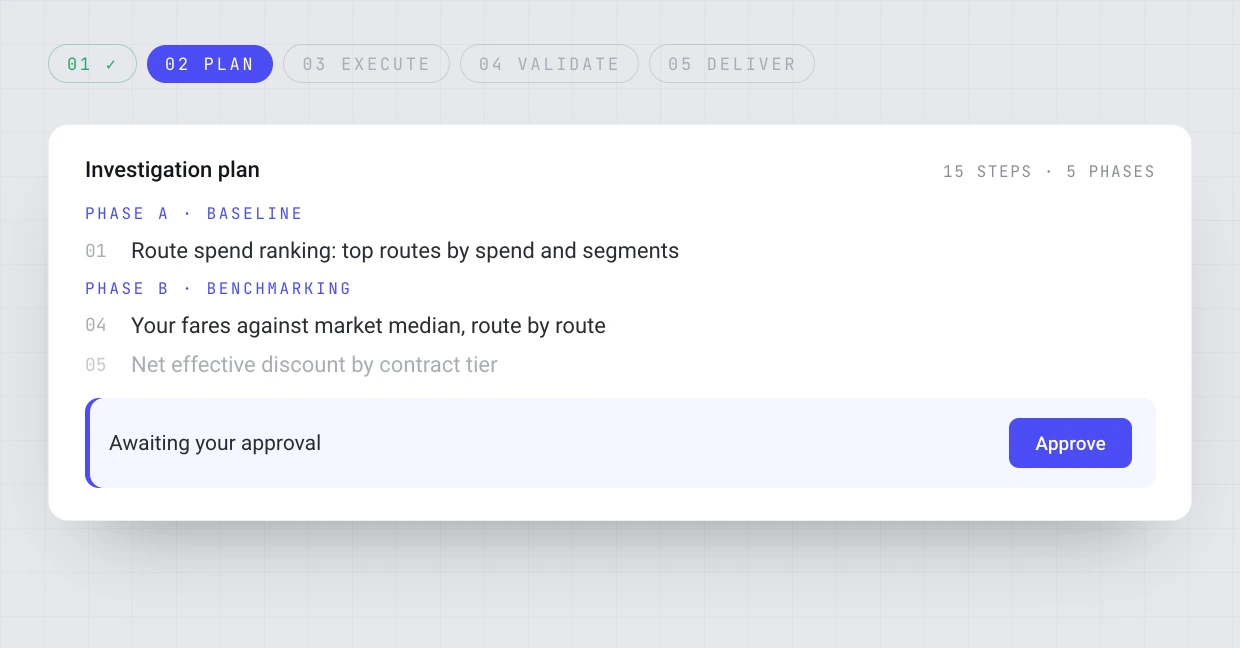
Every Orchestra project runs through five gates, in order. Delegation this deep only works under human oversight, with control built into the workflow itself.
You set the goal in natural language. Orchestra asks two to four scoping questions.
A numbered plan you edit and approve. Nothing runs until you do: the step no chatbot has.
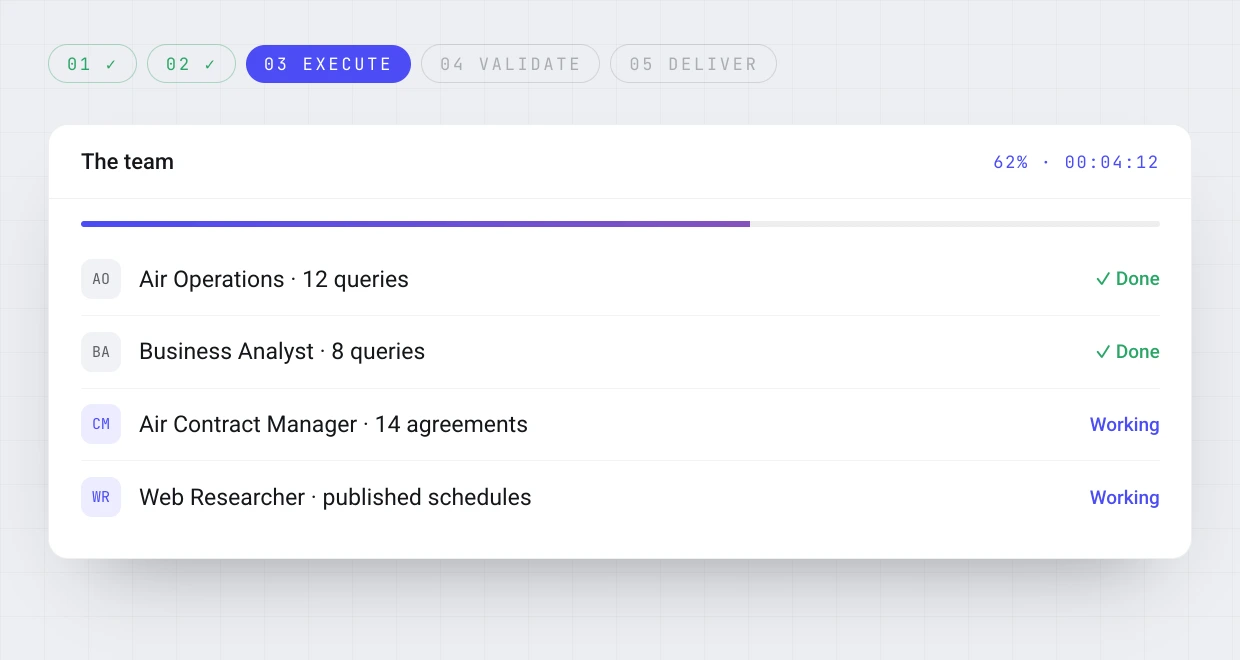
Specialists work in parallel across your data and market intelligence, in full view.
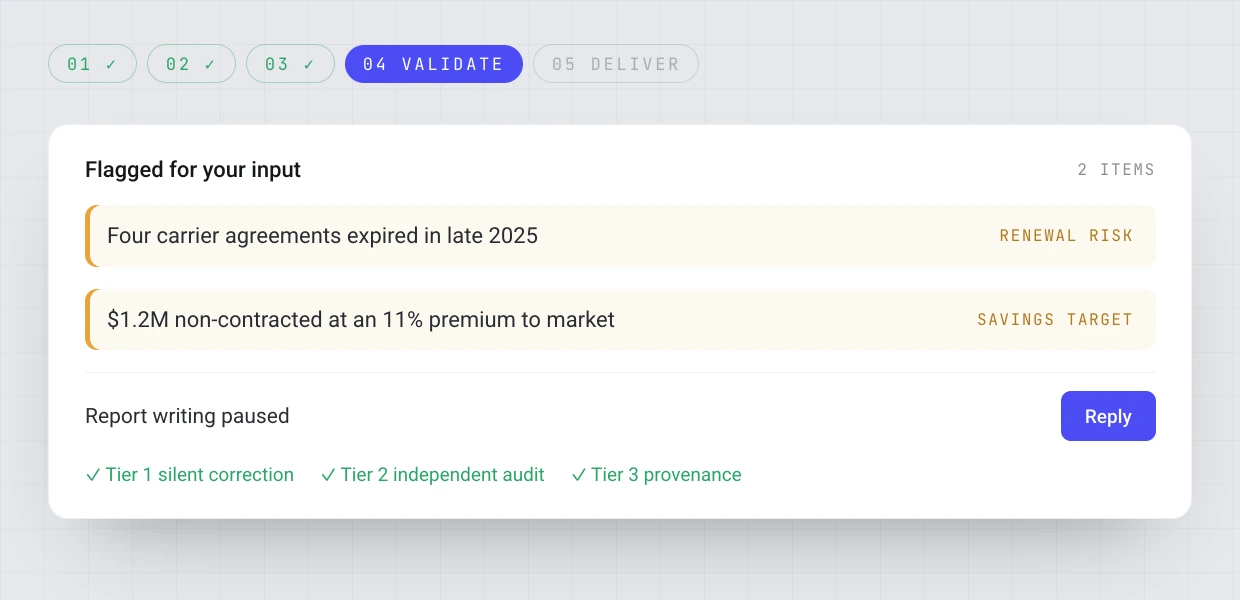
Surprising findings pause for your review. A validation agent audits everything.
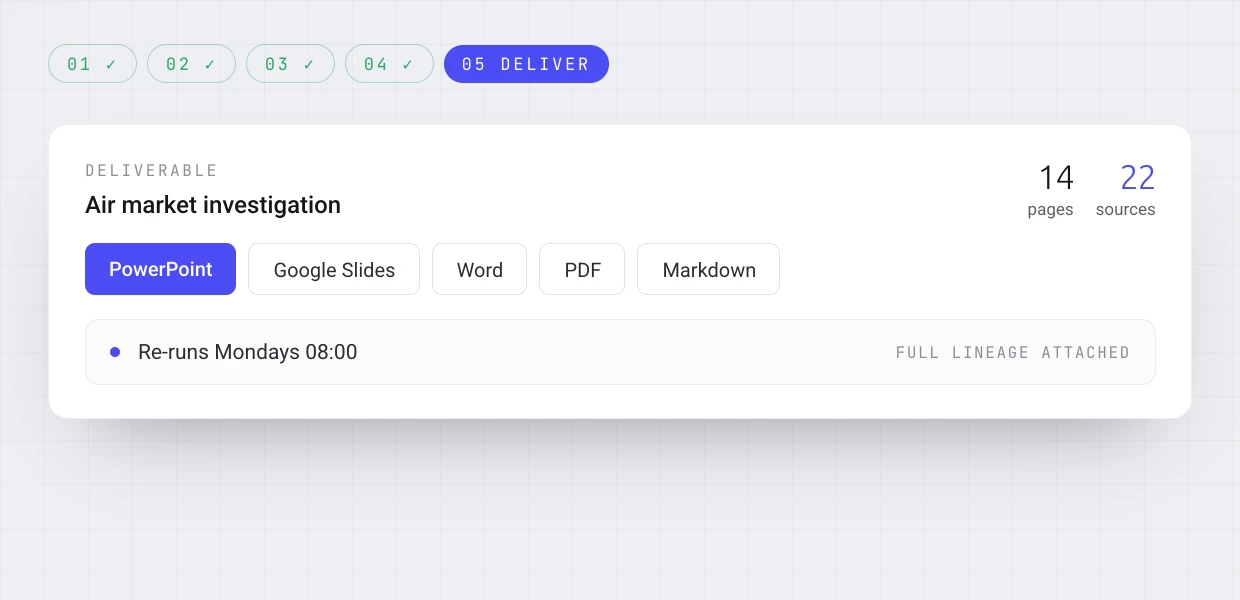
A cited, editable report in PowerPoint, Google Slides, Word, PDF or Markdown. Re-runs on your schedule.


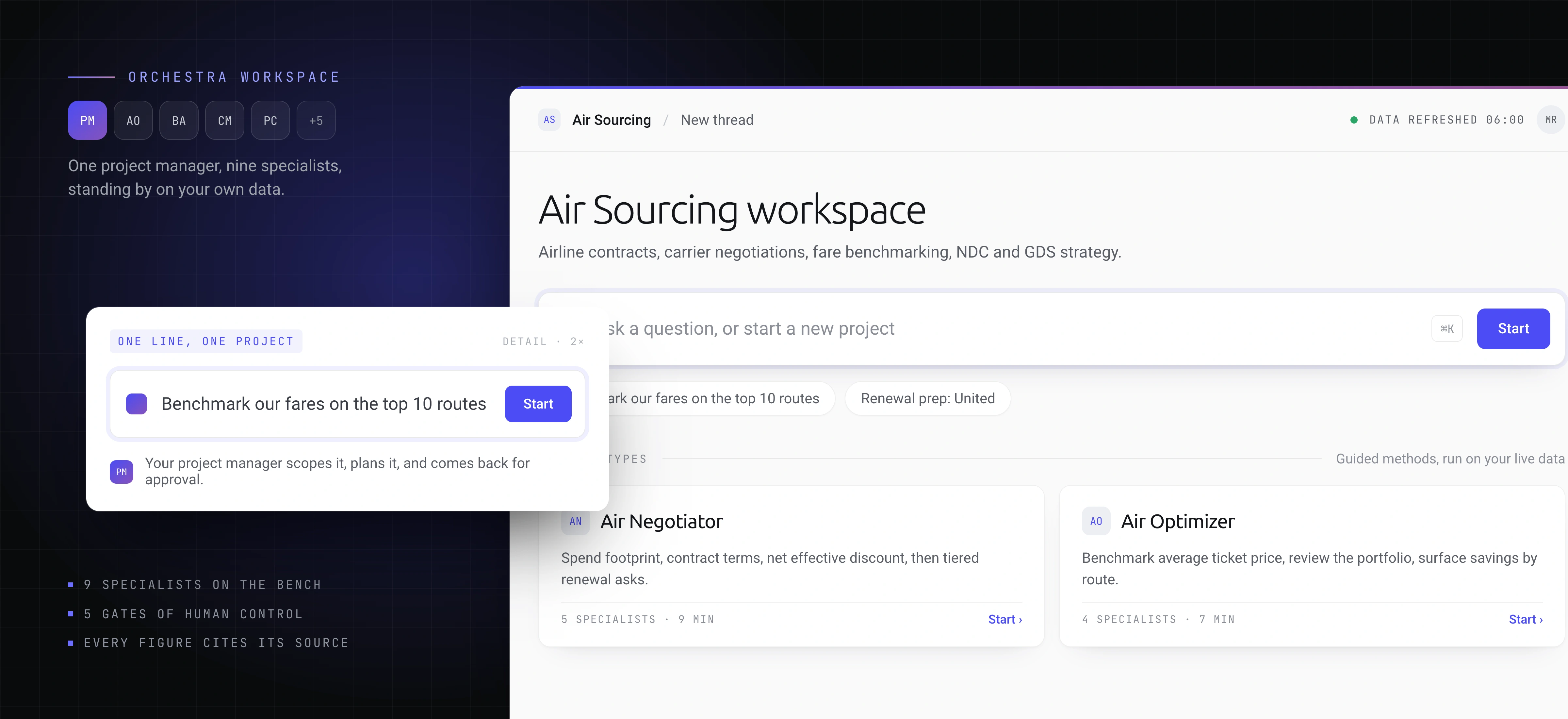
One air market project, recreated from the Orchestra workspace.
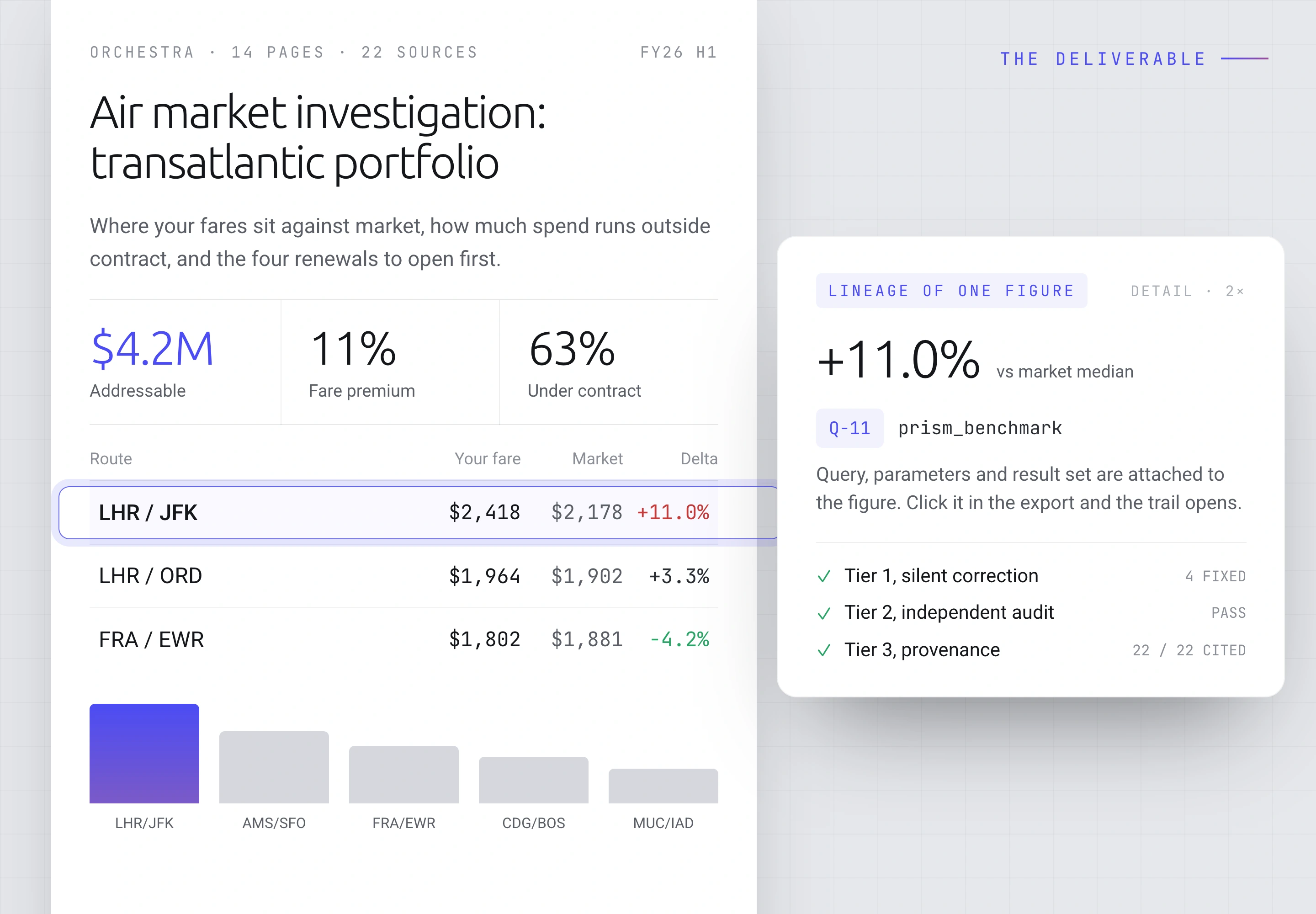
Before writing a single line of the report, the team flags findings for your input: four carrier agreements expired in late 2025 and are marked as immediate renewal priorities; and one transatlantic route carries $1.2M in non-contracted spend at an 11% premium to market, the primary target for a new volume deal.

This is AI governance as product behaviour: the team declares what it cannot verify, surfaces what surprised it, and hands you the decision before the report exists.
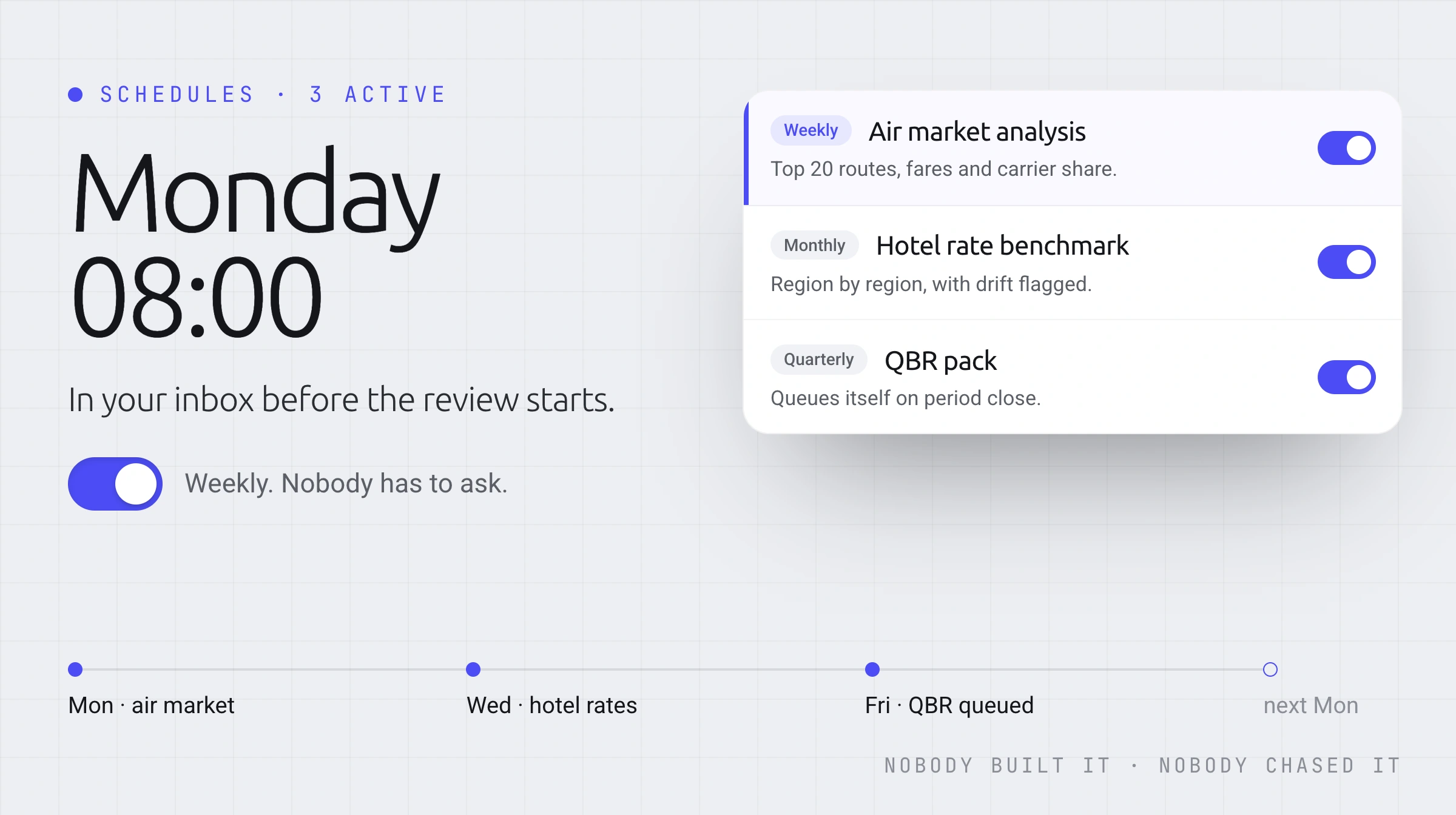
See Orchestra run on your dataAsk once, or never ask again. Orchestra runs in team-scoped workspaces and delivers on a schedule.
That is Orchestra.
Air Sourcing (carrier negotiations, fare benchmarking, route strategy) · Hotel Sourcing (hotel RFPs, rate compliance, chain portfolio) · FP&A (budget cycles, variance attribution, spend forecasting) · General (cross-domain, full bench).

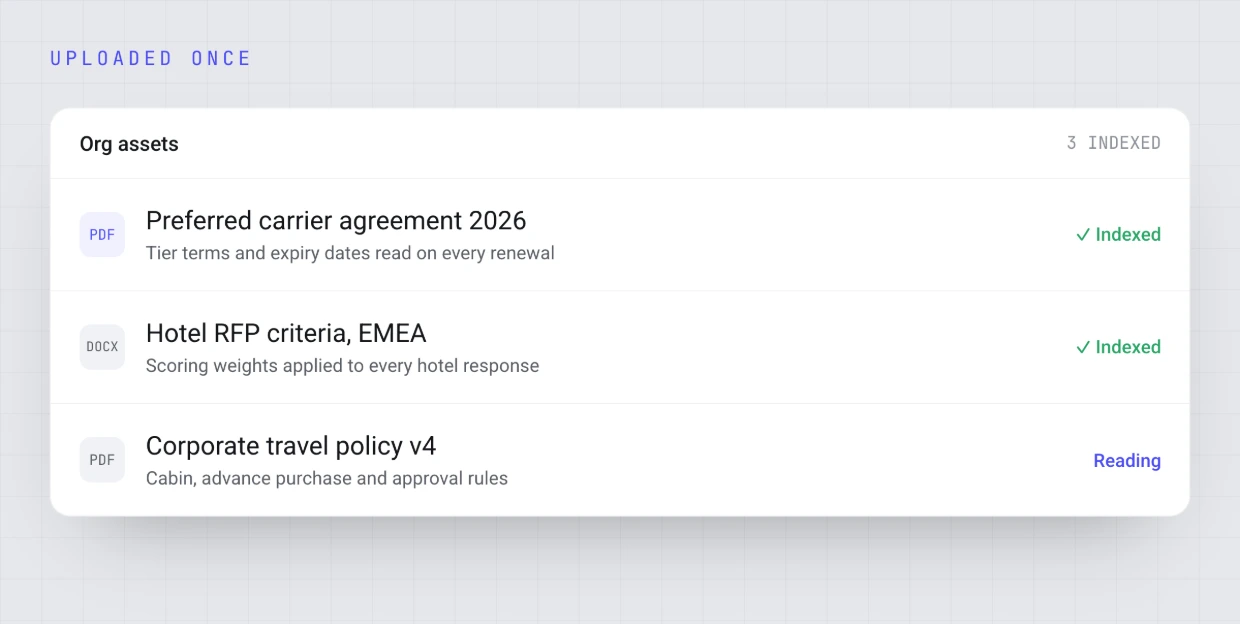
Upload contracts, RFP criteria and policies once; every project draws on them.

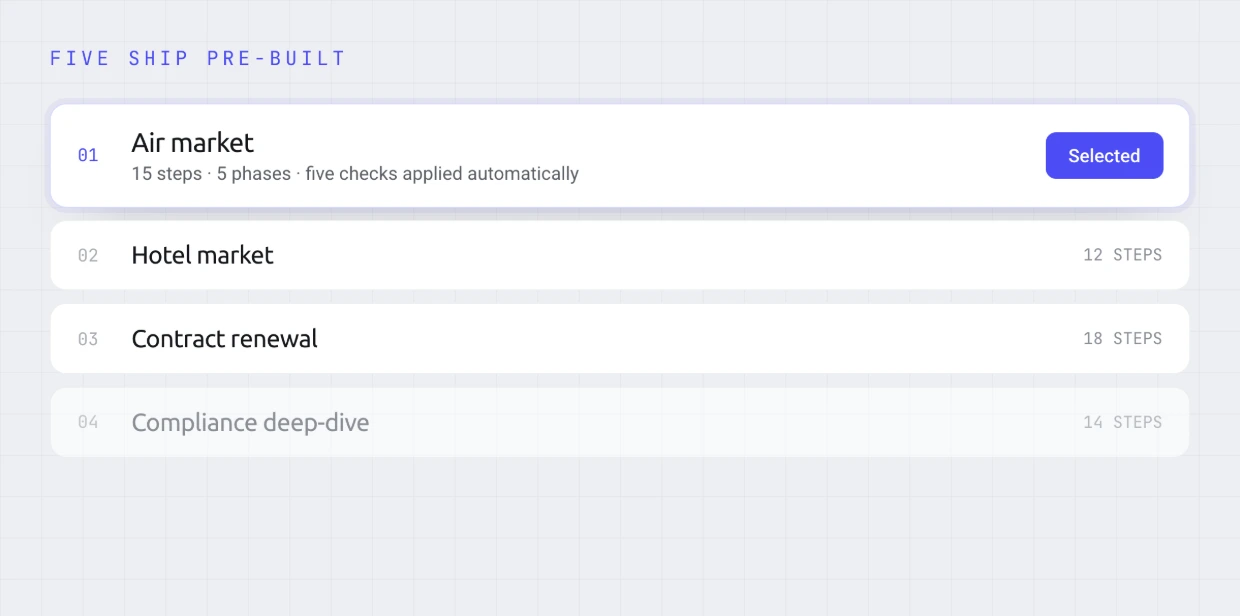
Five ship pre-built and curated: air market, hotel market, contract renewal, compliance deep-dive and QBR pack.

Weekly, monthly and quarterly cadences, plus event-triggered runs when new data lands, with alerts when things shift.

Every deliverable exports to PowerPoint, Google Slides, Word, PDF or Markdown, with full audit lineage on every thread.

An automated layer detects and corrects its own errors before the draft ever reaches you.
A separate agent audits the data health behind every deliverable.
Explainable by design: a full citation trail backs every claim, tying every figure to its source query.
Flagship project types like these ship pre-configured; the launch set is being shaped with alpha clients.
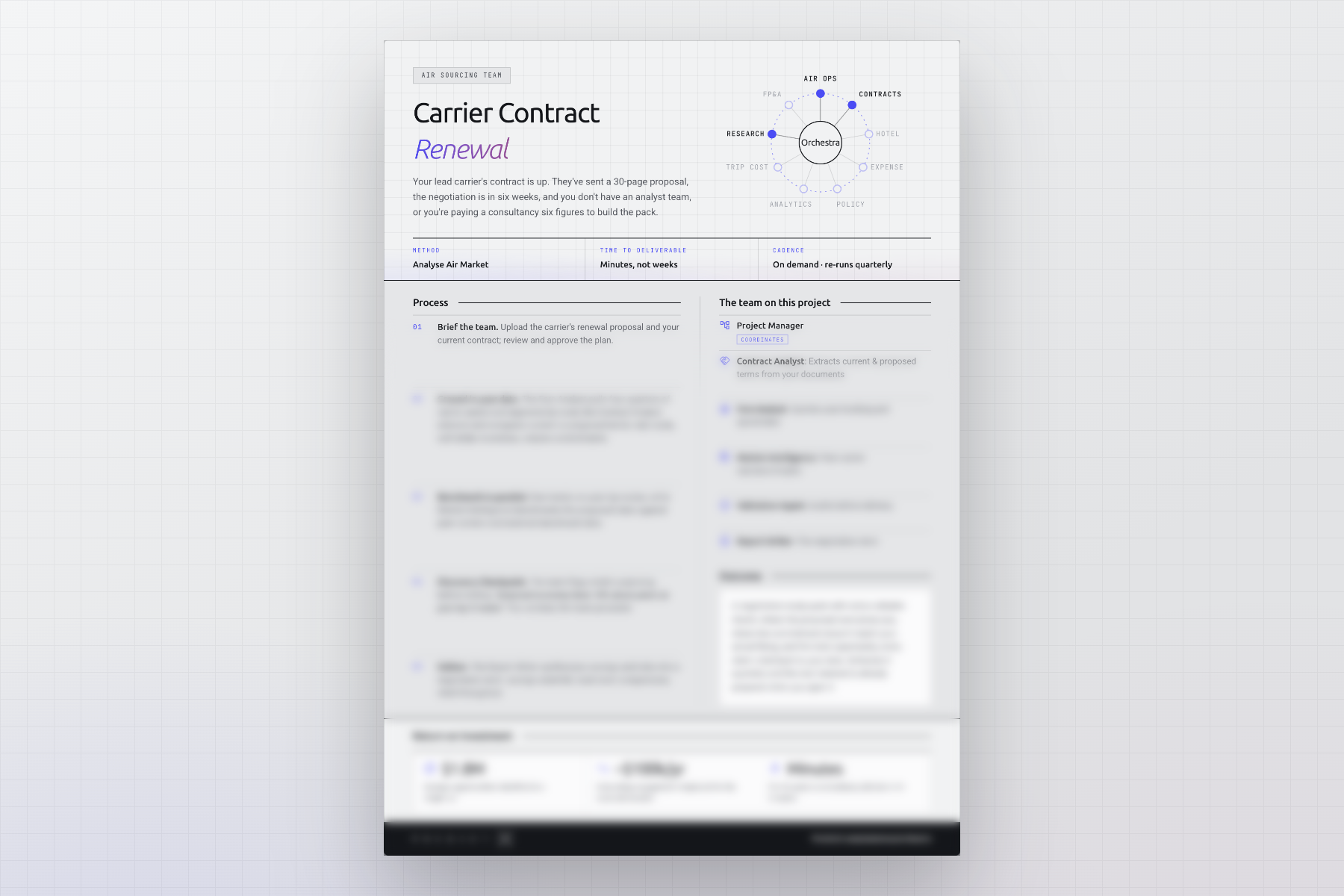
The negotiation pack a consultancy builds in four to six weeks, cited to your own data.
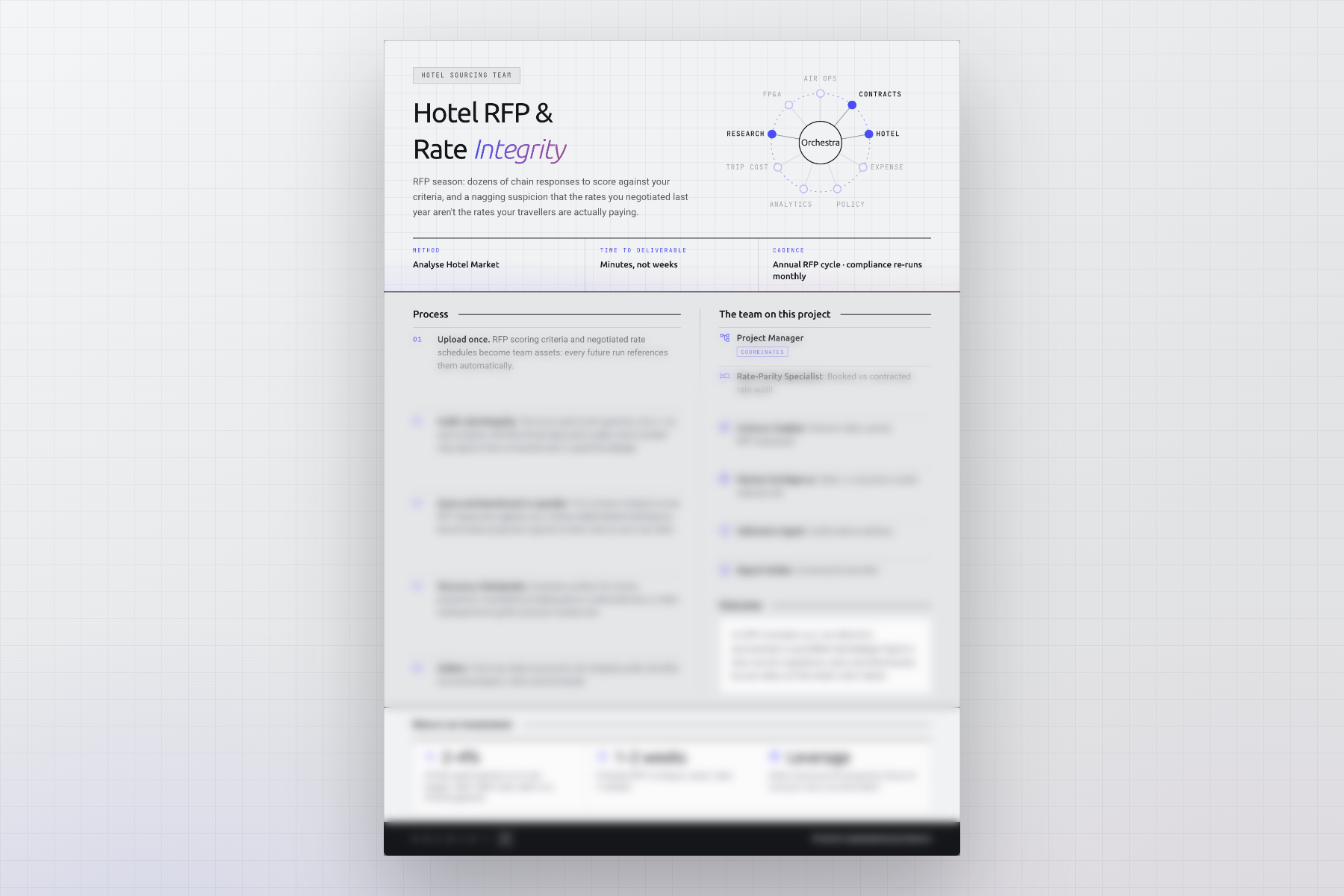
Airline contract negotiation, prepared in minutesRFP automation and RFP scoring: every response graded against your criteria, every booked stay audited against the contracted rate. Leakage made visible.
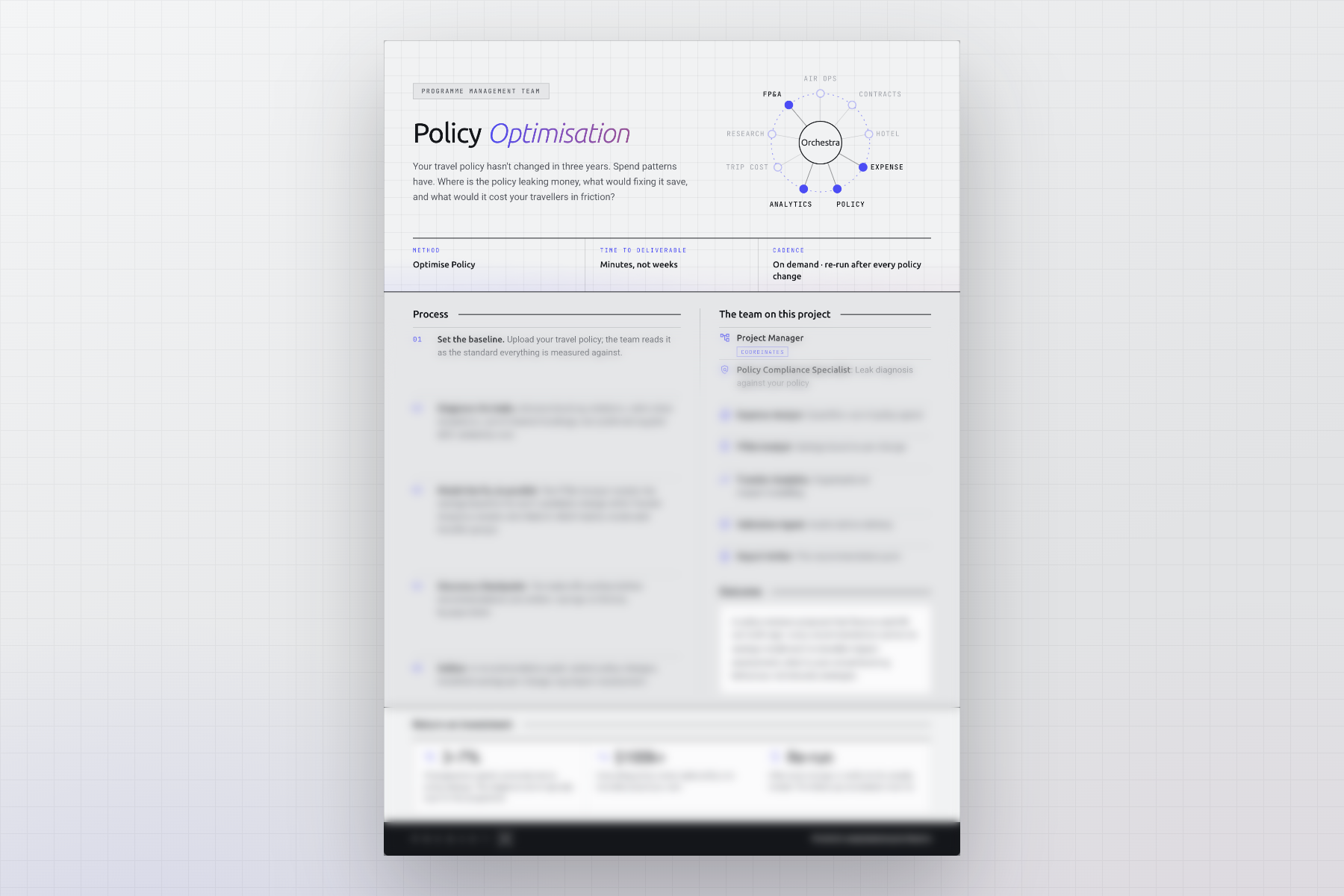
Hotel RFP scored, rate integrity auditedRanked policy leaks, scenario-modelled savings per change, and the traveller-friction impact of each fix.
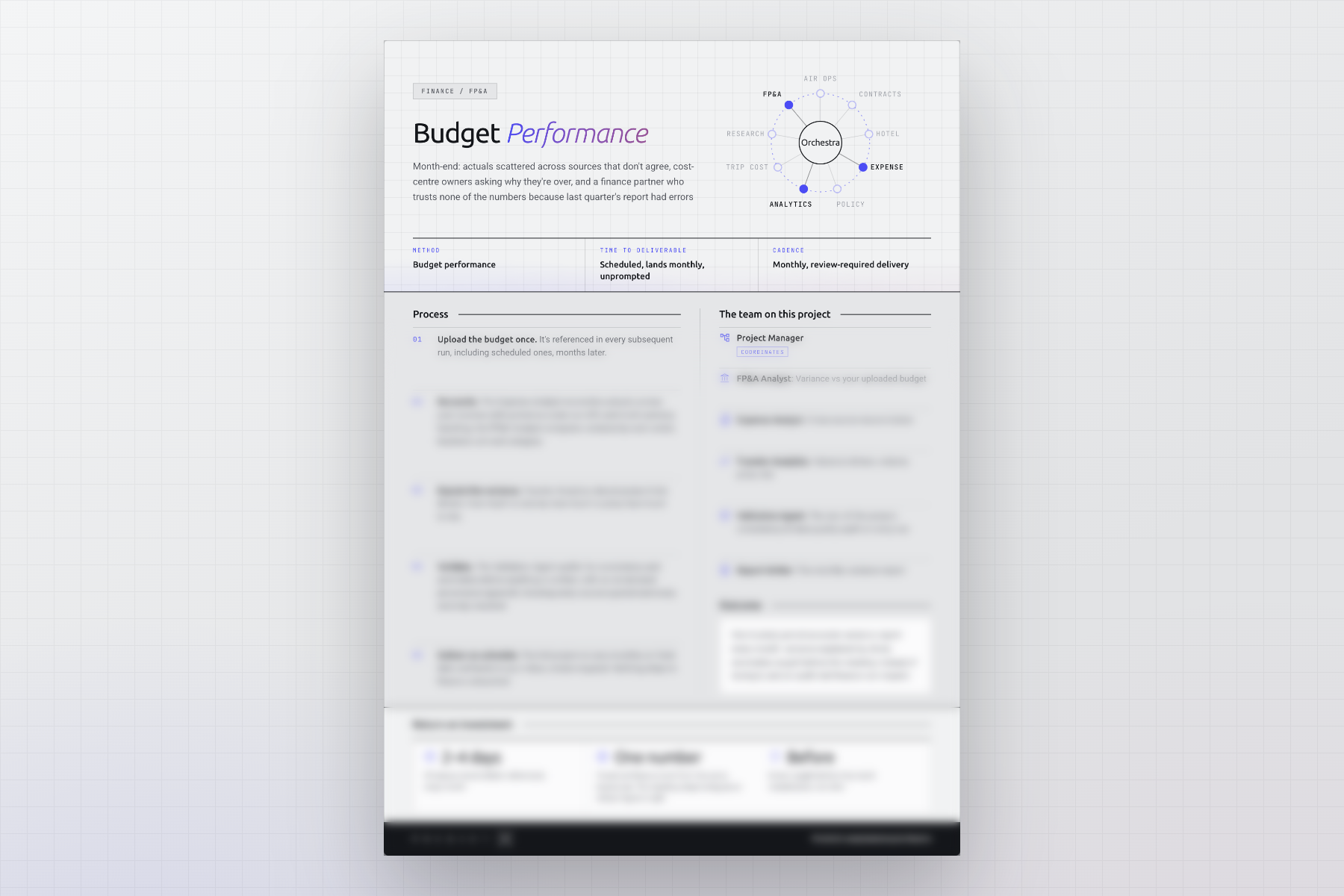
Travel policy optimisation: an Orchestra projectBudget variance analysis, period-accurate by cost centre, decomposed into volume, price and mix. Saved per month.
Budget variance analysis, monthly and unpromptedThe full bench rebuilds your quarterly business review deck every quarter, unprompted. You review, edit and release.
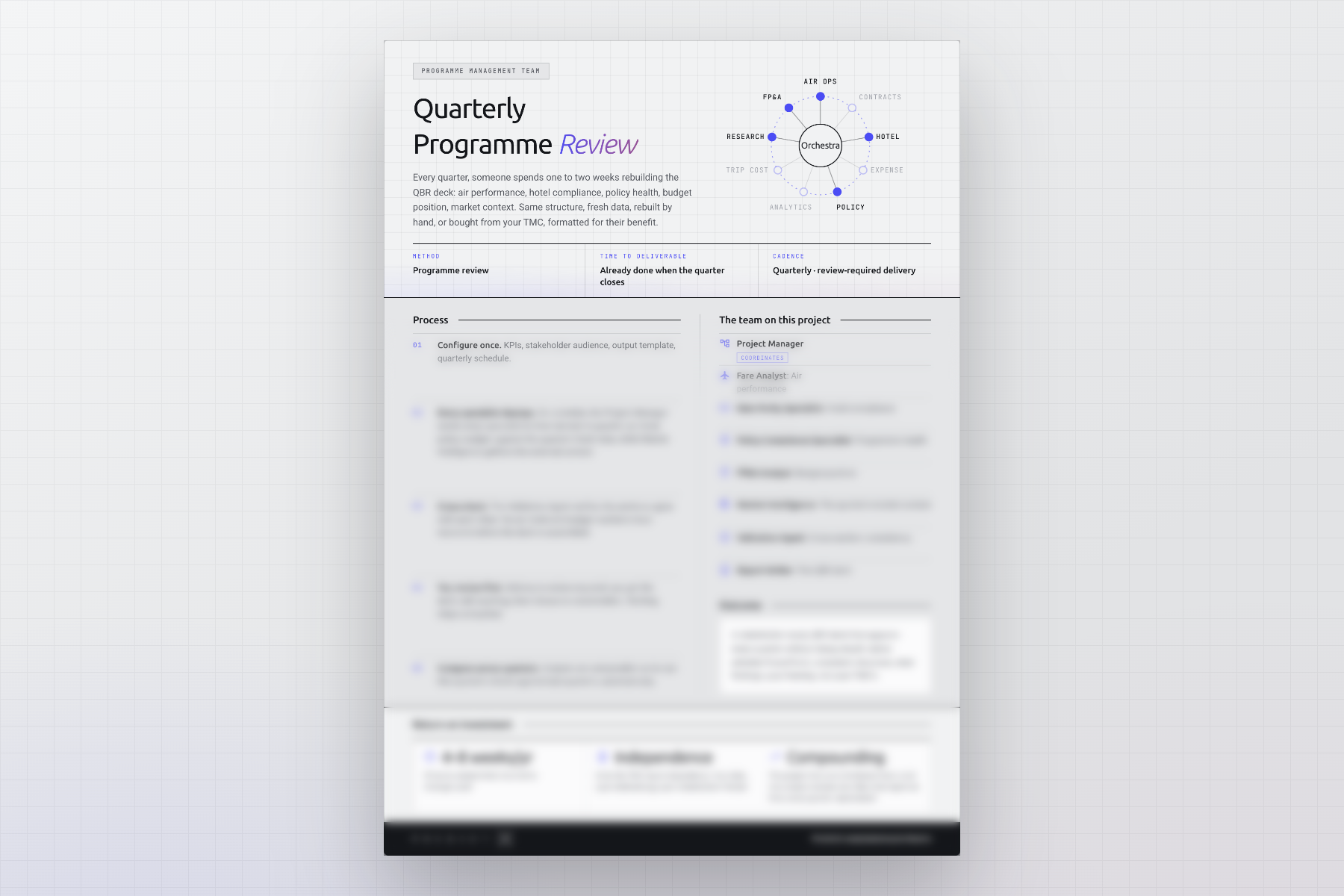
Quarterly business review for corporate travelThe QBR deck is already rebuilt when you open it. And Orchestra closes the “now what?” gap: the recommendation and the stakeholder communication arrive in one flow.
Orchestra runs on the Cogent AI Framework, so the team you stand up inherits enterprise security, traceable answers, and the accuracy and reliability the framework is engineered to deliver.
A multi-agent system: a routing agent plans, specialists execute in parallel, and results consolidate into one deliverable.
Q&A answers in seconds; full projects in minutes, not weeks; 100,000+ data points per query; targeting a 99%+ acceptable response rate.
ISO 27001:2017, PCI-DSS, Cyber Essentials and GDPR posture, permissions to row and field level, every action logged.
For day-to-day questions on the same framework, see Cogent, the workspace. For the era shift behind all of this, read the travel manager of tomorrow.
Orchestra is best understood through four terms. Each describes something it does today, and each is a category buyers already search for by name.
An AI project manager plans a piece of work, splits it across specialists, tracks execution and assembles the finished deliverable.
A supplier scorecard rates a vendor against agreed criteria over a defined period, producing a comparable score for reviews and negotiations.
Expense management software captures, approves and reimburses employee claims.
Self service analytics lets a business user answer their own question without a BI ticket; AI business intelligence adds a model that interprets it.
Orchestra is the AI agent team for travel and expense: an AI project manager coordinating nine specialist agents that investigate, analyse and execute complete T&E projects from start to finish, returning finished, cited, editable work. It runs on the Cogent AI Framework, launched in June 2026, and every project passes five human-governed gates. You direct. The team executes.
Autonomous in execution, human-gated in decision. Once you approve the plan, the specialists run without supervision: they query your data, cross-check each other's findings, and hand results to the project manager, which synthesises the report. What they never do is decide alone. The plan waits for your approval before anything runs, surprising findings pause at a discovery checkpoint, and nothing commits spend without a named human. Autonomous AI agents are only useful in enterprise T&E if the autonomy is bounded, and Orchestra's is.
Workflow automation executes a path you designed in advance: if this, then that, every time. An AI agent team decides the path. Give Orchestra a goal and the project manager scopes it, drafts a plan specific to that question, dispatches whichever specialists it needs, and adapts when the data surprises it. Automation does a task. A copilot helps a person. Orchestra owns the outcome, and brings you the decision rather than the busywork.
Define, plan, execute, validate, deliver. You set the goal and Orchestra asks two to four scoping questions; a numbered plan waits for your edit and approval before anything runs; specialists execute in parallel in full view; surprising findings pause at a discovery checkpoint for your review; and a cited, editable deliverable lands in PowerPoint, Google Slides, Word, PDF or Markdown, re-running on your schedule.
Pre-built, curated templates ship at launch, with the catalogue being finalised with alpha clients; the air market analysis ships first. Each encodes a proven analytical workflow, so nobody has to become a prompt expert and every run follows the same structure. Any methodology can run on demand, on a weekly, monthly or quarterly cadence, or on event triggers when new data lands.
Three tiers run on every deliverable: silent validation detects and corrects errors before the draft, an independent audit checks data health, and a provenance appendix traces every claim to its source query. Surprising findings pause at a discovery checkpoint for your judgement before the report is written. The full validation architecture is documented on the Cogent AI Framework page.
For recurring analytical work, largely yes: market analyses, renewal benchmarks and QBR packs that cost $50K to $200K per engagement and arrive in weeks now run in minutes on your own data, on your cadence. Strategic advisory built on human relationships remains complementary. The practical shift is economic: depth and continuity replace periodic, expensive snapshots, and your team reviews finished work instead of commissioning it.
It changes what they build. In-house analytics teams spend most of their capacity servicing requests: the deck, the pull, the one-off question. Orchestra absorbs that queue, which frees your analysts for the modelling, data engineering and judgement work only they can do. On build versus buy, the model layer is not the hard part. The hard part is the consolidated T&E estate, the validation rail and the methodology library, and that is years of work specific to travel and expense. The honest comparison is usually not Orchestra versus a build, but Orchestra now versus a build in eighteen months.
Yes. Orchestra launched in June 2026 and is deploying across enterprise travel programmes. Because it runs on the Cogent AI Framework, organisations already on PredictX add it without new integration work: connectors and certifications carry over. Onboarding configures your workspaces, methodologies and schedules, and the first project runs on your own programme data during the walkthrough.
BUILT ON THIS FRAMEWORK
Orchestra is one of two products built on the PredictX agentic AI framework. Here is the framework itself, the other product, and the free prompt library.
The agentic AI layer Orchestra runs on
Specialist agents plan, execute and validate
200+ governed data sources
Auditable to row and field level
AI T&E reporting and analysis
Ask in plain language
Every figure cited to source
Suggested next steps with every answer
50 AI prompts for travel and expense
Ten categories, copy and run
Starter pack for your first week
Free, no gate
“Every programme has a list of work it never had the team to do. Orchestra is that team. It plans, it executes, it shows its working, and it brings you the decision.”Keesup Choe · CEO, PredictX
Yesterday, you managed reports. Tomorrow, you manage a team. Pick one project you never had the capacity to run properly, and put the team on it: the first project runs on your own programme data during the walkthrough.
Nothing runs until you approve the plan.
4 of the 6 largest global T&E programmes run on PredictX