What should a corporate travel policy include?
A corporate travel policy, sometimes written as a business travel policy or company travel policy, sets the rules employees book and spend against: advance-booking windows, cabin class by route and seniority, approved booking channels, preferred suppliers and expense thresholds. It only works while it matches how people actually travel. When spend patterns move and the policy stands still, the gap shows up as leakage: advance-booking violations, cabin-class exceptions, out-of-channel bookings and drift to non-preferred suppliers.
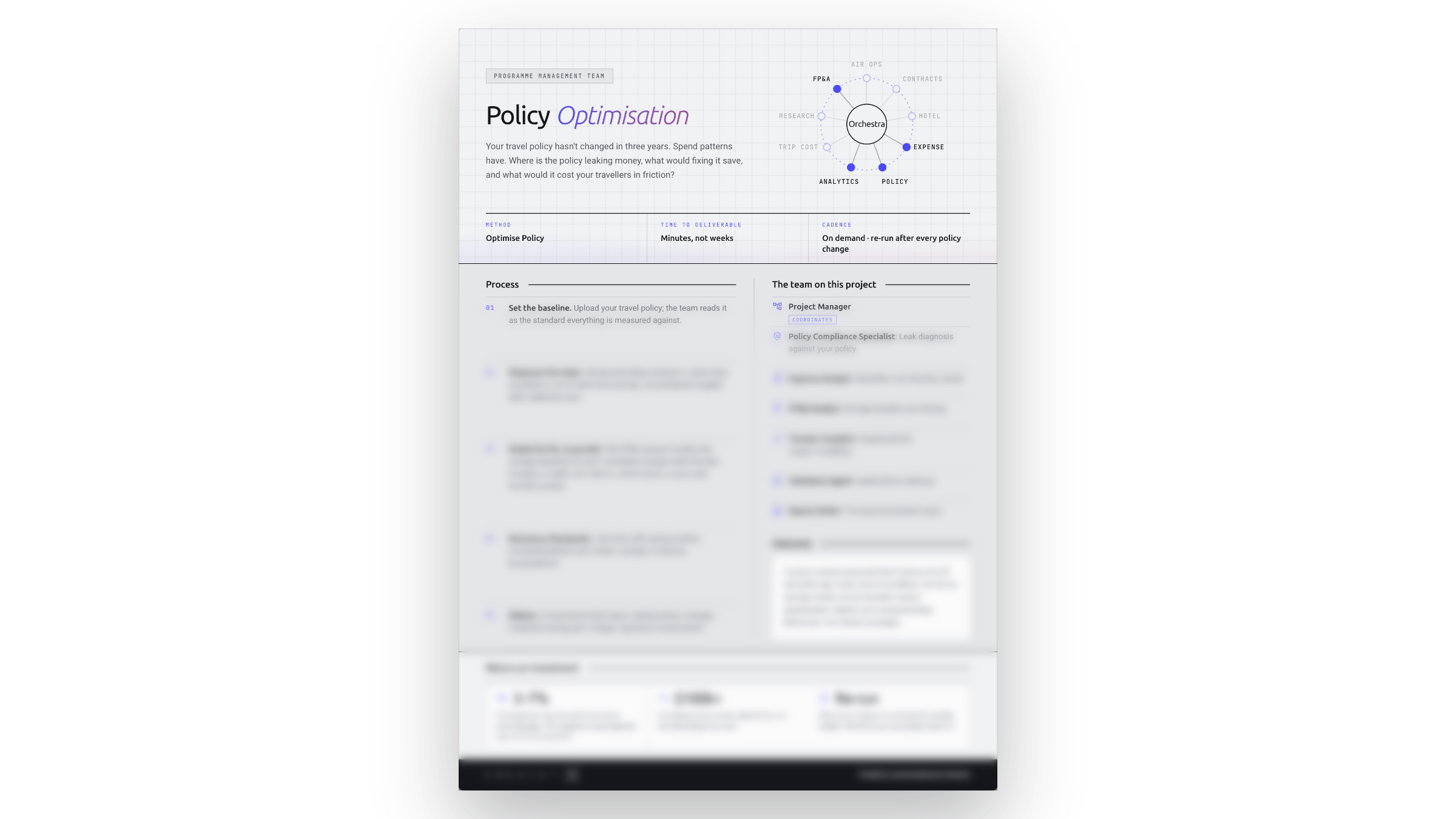
This page holds the sheet for Policy Optimisation, the Orchestra project that finds that gap in your travel policy and prices it.
Compliance reporting counts the exceptions. It cannot price the fix.
Your travel policy has not changed in three years; spend patterns have. Travel policy compliance reporting will tell you the exception rate is climbing, and a travel policy template will tell you what a good policy contains. Neither tells you which leaks cost most, what each fix would save, or which traveller groups would carry the friction. Producing that is weeks of analyst work or an external review, which is why the policy stays as written. Policy optimisation is one of five example projects on the multi agent orchestration one-pager.
What is on the sheet
The five steps
Set the baseline, diagnose the leaks, model the fix in parallel, the Discovery Checkpoint, deliver. It starts with an upload: the team reads your travel policy as the standard everything is measured against.
The team, by role
A Project Manager coordinating six specialists: the Policy Compliance Specialist on leak diagnosis against your policy, the Expense Analyst quantifying out-of-policy spend, the FP&A Analyst on the savings baseline per change, Traveler Analytics on organisational impact, the Validation Agent auditing before delivery, and the Report Writer assembling the recommendation pack.
The Discovery Checkpoint
The trade-offs surface before recommendations are written: savings versus friction, by population. You see who pays for each saving before anyone proposes it.
The return
3% to 7% of programme spend is commonly lost to policy leakage; the diagnosis alone typically pays for the programme. A consulting policy review costing $100k or more is replaced by a re-runnable project you own. And it re-runs after every change, to verify the fix actually landed. Figures are based on enterprise deployment patterns, individual results vary.
What does travel policy optimisation with agentic AI involve?
Optimising a travel policy with agentic AI means treating the policy as a testable baseline rather than a document to redraft. An agent team reads the policy, diagnoses leaks against actual booking behaviour, ranks them by cost, then models every candidate fix twice: once for savings, once for traveller friction. In Orchestra, PredictX's AI agent team, the FP&A Analyst builds the savings baseline for each change while Traveler Analytics models which teams, routes and traveller groups feel it, and a Validation Agent audits the pack before delivery.
Time to deliverable is minutes, not weeks, and the cadence is the real difference from a consulting review: on demand, re-run after every policy change.
Who this is for
- Travel managers and programme owners who suspect out-of-policy bookings and stale thresholds but cannot rank the damage
- Heads of travel taking a travel and expense policy revision to finance and HR, and needing both to sign it
- Finance and FP&A leads who want the saving modelled before the rule changes, not argued after it
- Teams paying for an external policy review who would rather own a project that re-runs
Frequently asked questions
How do you find the leaks in a travel policy?
Measure every booking against the policy as written, then rank the violations by cost. In this project the Policy Compliance Specialist diagnoses advance-booking violations, cabin-class exceptions, out-of-channel bookings and non-preferred supplier drift, while the Expense Analyst quantifies the out-of-policy spend behind each one. The behavioural side is covered in the out-of-policy travel spend audit.
How do you model the savings of a travel policy change before making it?
Model each candidate change against your own booking behaviour, not industry averages. In this project the FP&A Analyst builds the savings baseline for each change while Traveler Analytics models who feels it: which teams, routes and traveller groups. The two run in parallel, so every recommendation arrives carrying both its saving and its friction cost.
What percentage of travel spend is typically out of policy?
Between 3 and 7% of programme spend is commonly lost to policy leakage, based on enterprise deployment patterns, individual results vary. The diagnosis alone typically pays for the programme. The sheet ranks leaks by cost rather than quoting an average.
How often should a company review its travel policy?
After every policy change, at minimum, to verify the fix actually landed; consultants who review a policy once rarely return to check. Because this project re-runs on demand, review stops being a three-year event: change a rule, re-run the diagnosis, confirm the saving arrived and the friction stayed acceptable.