Logo
Departments
Resources
About Us
Contact Us

Overture · Executive reporting for corporate travel

Your travel programme's executive reporting, already written

Executive reporting is how a travel programme reaches the people who fund it. Overture writes that executive briefing every month from your own data: what changed, what it cost, and what needs a decision. Nobody on the travel team assembles it.

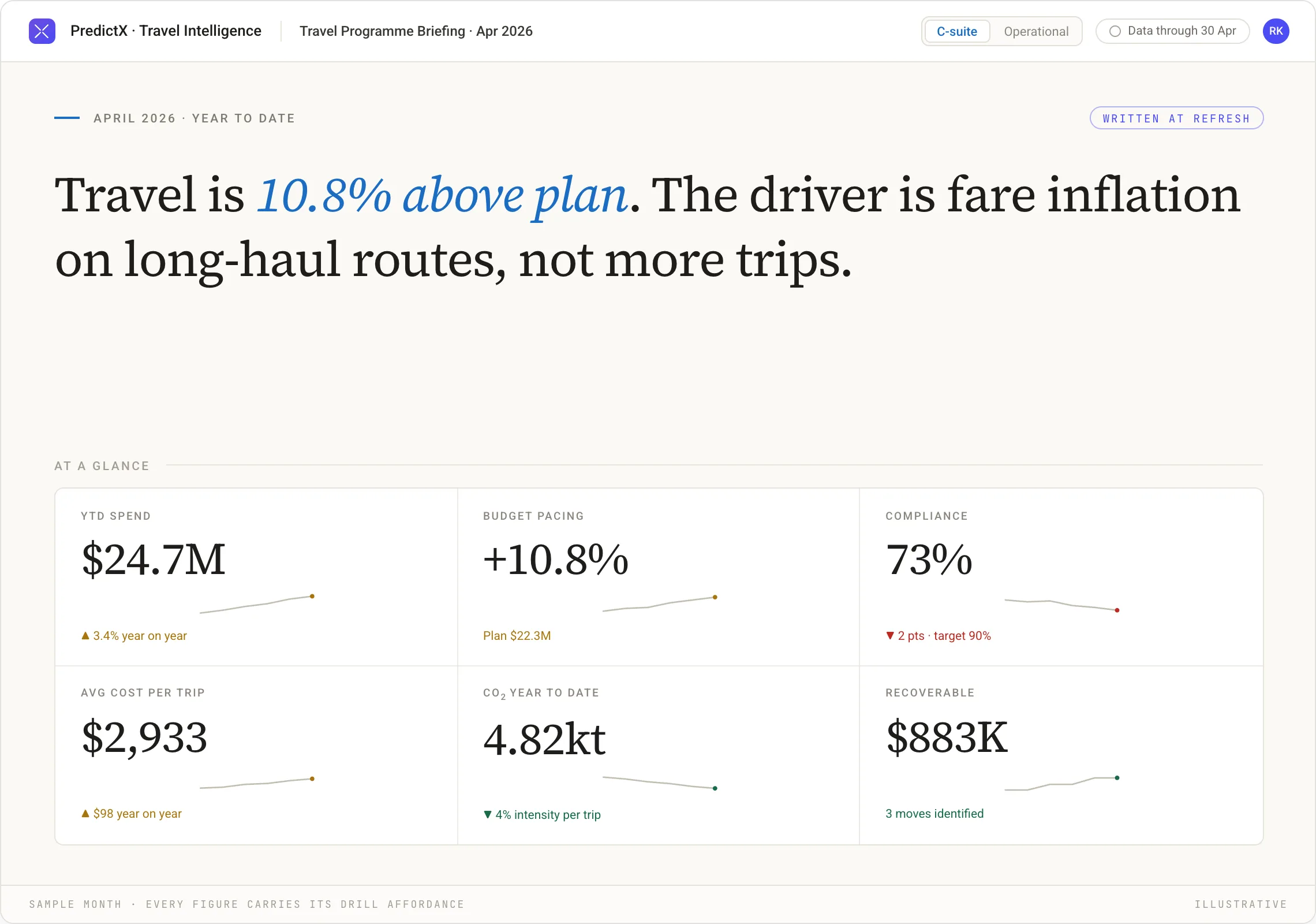
Monthly travel programme briefing: travel 10.8% above plan on long-haul fare inflation, above six KPI tiles. Illustrative.

The month is explained before anyone asks you to explain it.

Authority
Covered at launch by
THE PROBLEM · EXECUTIVE ATTENTION

Why do executives stop reading travel dashboards?

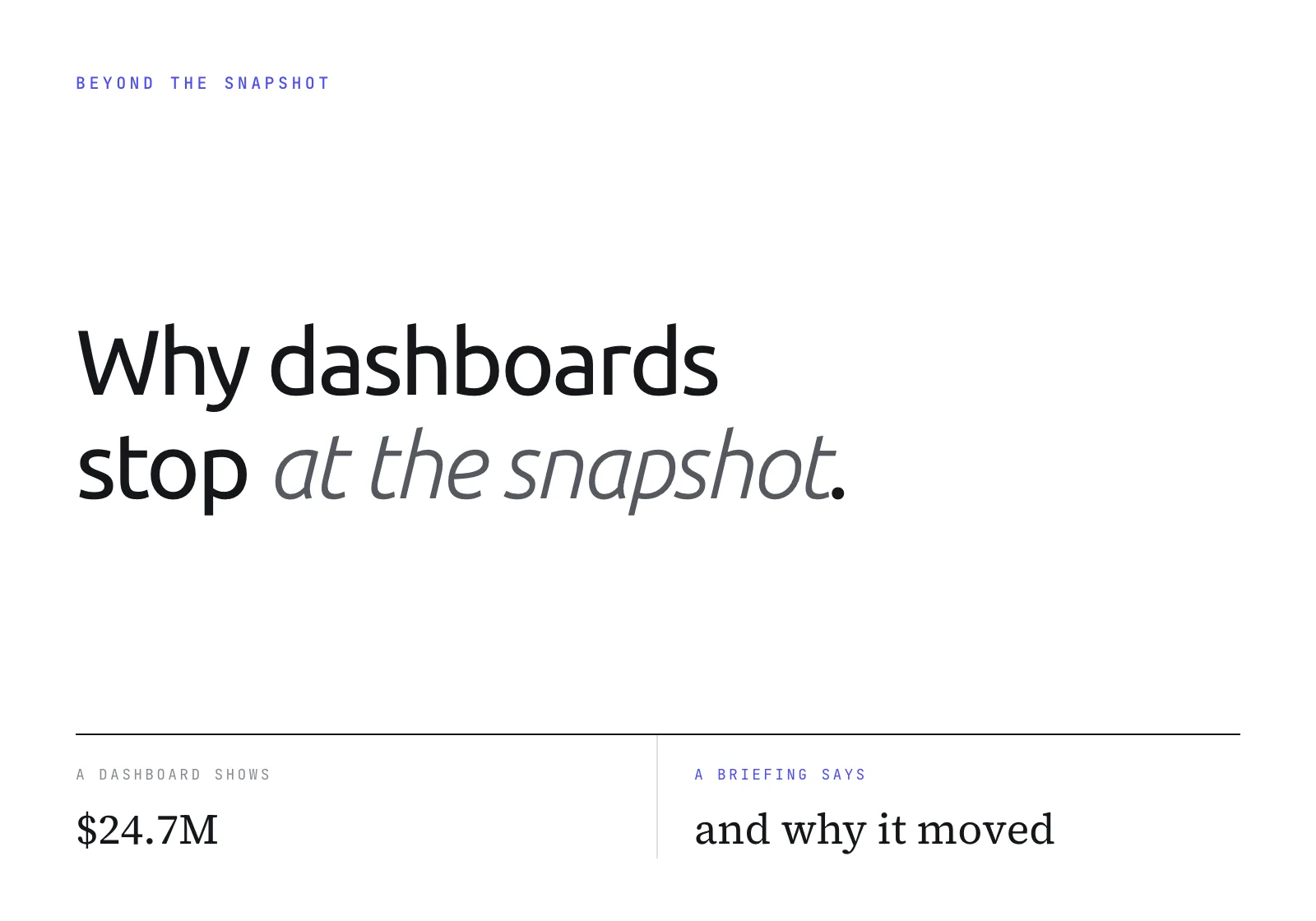
Executives stop reading travel dashboards because a dashboard hands them homework. It shows the figures and leaves the comparison, the interpretation and the conclusion to a reader for whom travel is one line in a much longer brief.

One landing page shows every role the same screen. Each of them needs a different one.

3x
Narrative-driven reports achieve around three times the engagement of a traditional dashboard.
PredictX internal data
01

The travel manager

A corporate travel manager working at a laptop in a glass-walled office, a printed report on the desk beside him.
01
The travel manager

Rebuilds the "what changed" story by hand every month, because the platform waits to be asked.

02

The finance VP

A finance VP holding a tablet by an office window, the executive audience for a monthly travel briefing.
02
The finance VP

Gets a data dump where a narrative should be, stops logging in, and travel loses its seat at the table.

03

The procurement lead

A procurement lead working at a laptop in an open-plan office, programme paperwork on the desk beside her.
03
The procurement lead

Cannot see leakage at her own scope without commissioning a custom report.

04

The team lead

A team lead standing beside a meeting room table in an open-plan office, mid-conversation with colleagues.
04
The team lead

Is shown sourcing levers he has no authority to pull. "Renegotiate the hotel rate" reads as blame.

Thank you! Your submission has been received!
Oops! Something went wrong while submitting the form.
"It's kind of like if the New York Times had the same stories every day, you'd kind of stop reading it, right?"

Every figure leadership needs is already in the platform, unread. The problem is the reading.

IN PLAIN TERMS

What is executive reporting for a travel programme?

Executive reporting presents performance to senior leaders in a format built for decisions, not analysis. For a corporate travel programme: one monthly read of spend against plan, policy compliance, savings, market conditions and actions.

ONE DETECTION RUN

Overture is the surface that produces it.

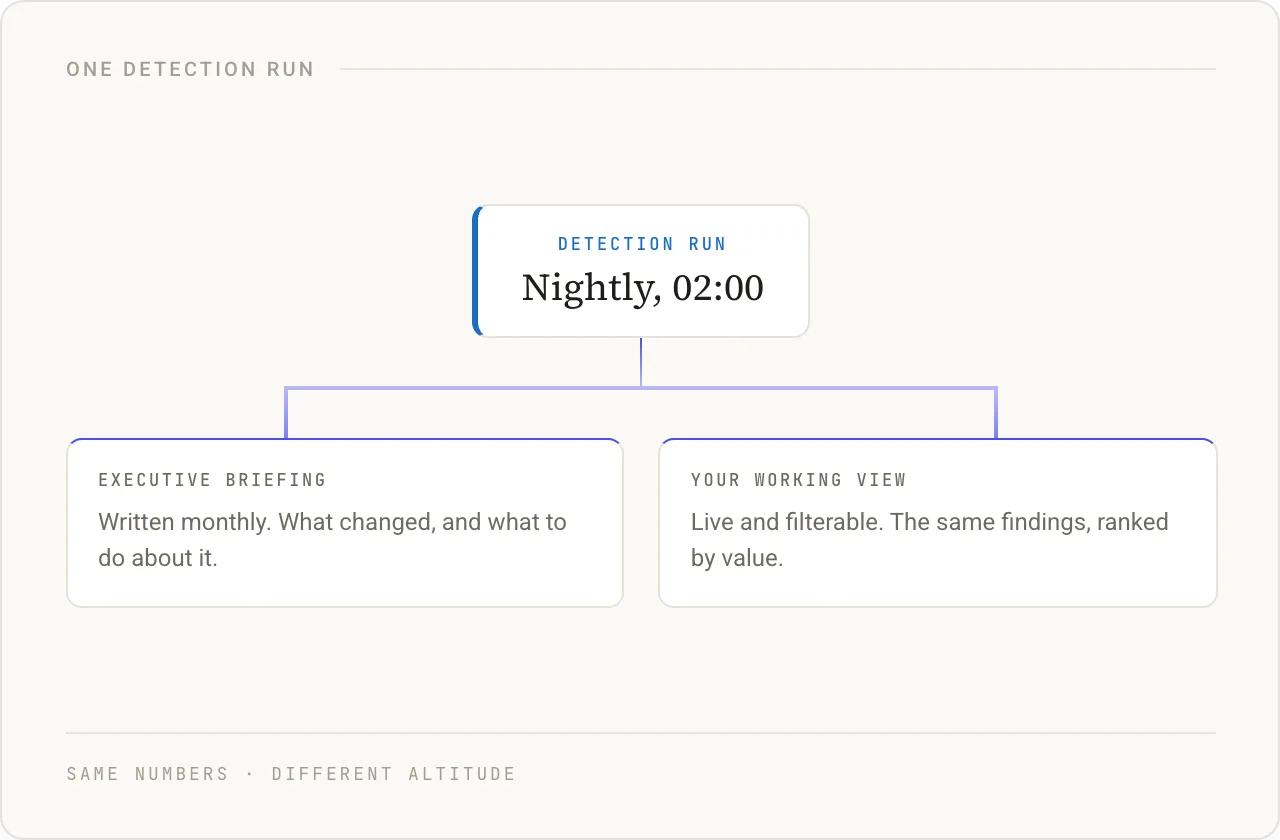
It replaces the landing page your travel platform opens on, and composes what each person sees from their role and data scope: an executive gets a briefing, a travel manager gets a working view. Both read from one detection run, so the number the CFO quotes is the number the travel manager is working from.

A nightly detection run at 02:00 branching into two surfaces: a monthly executive briefing and a live working view.
INSIGHT TO ACTION

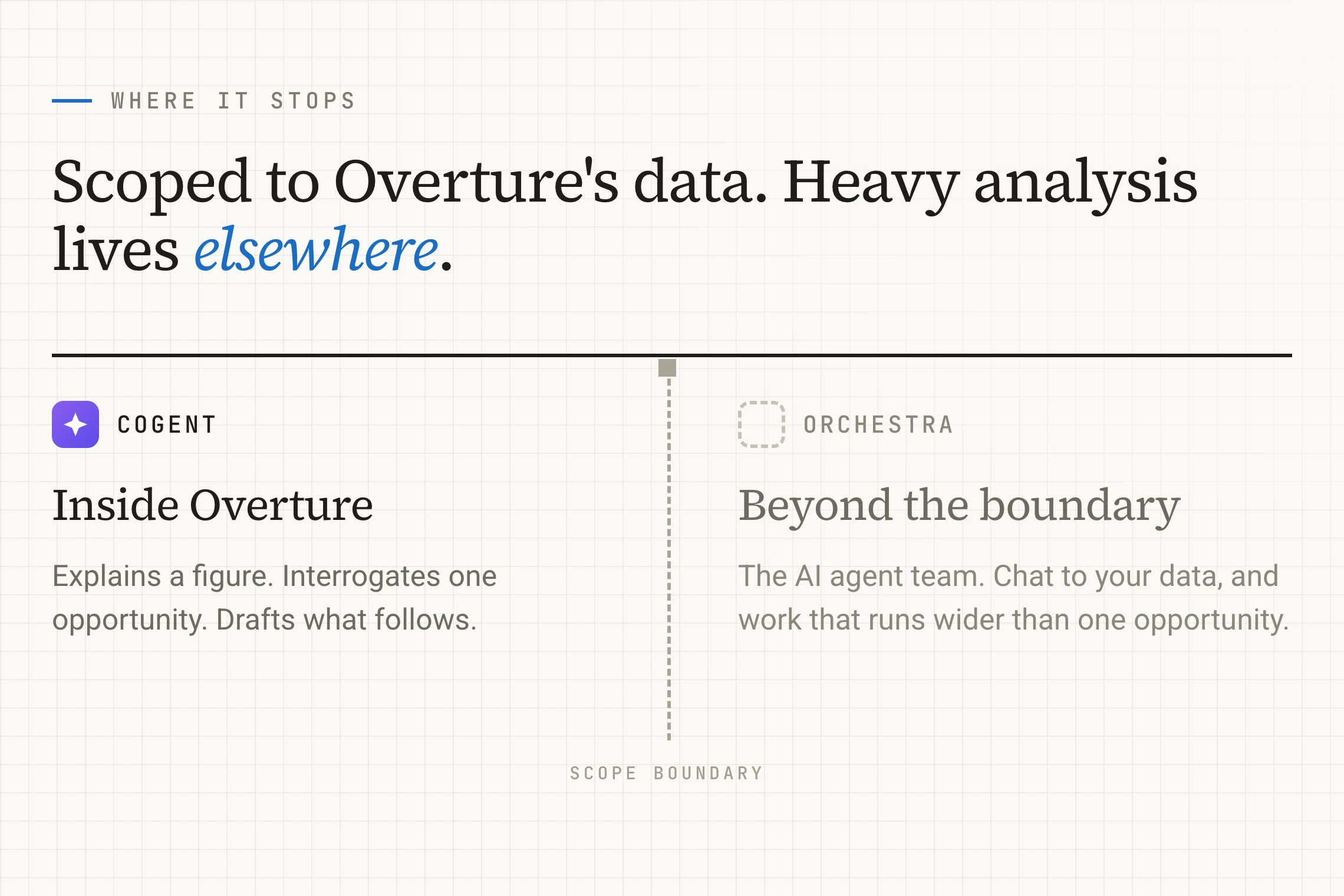
Overture is deliberately narrow.

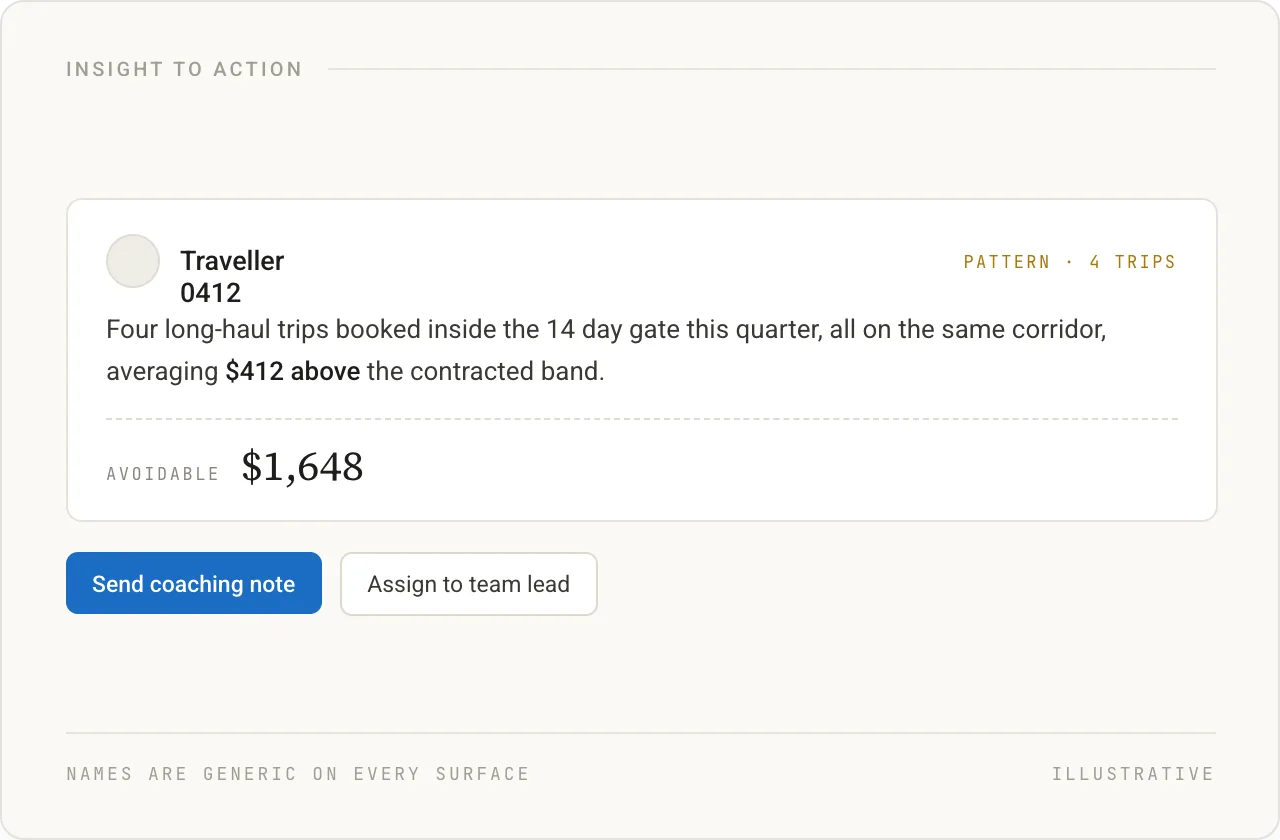
It carries you from an insight to an action: "one employee booked three out-of-policy trips in 30 days, go and coach them" arrives as a card with a name on it, not a chart to interpret. Open-ended analysis lives in the wider platform.

Insight card: four late long-haul bookings by an anonymised traveller, $1,648 avoidable, with two actions. Illustrative.
HOW IT WORKS · DETECT, THEN NARRATE

How does Overture build the briefing?

Overture builds each month's briefing in five steps, and every one of them finishes before you log in.

01

Detect

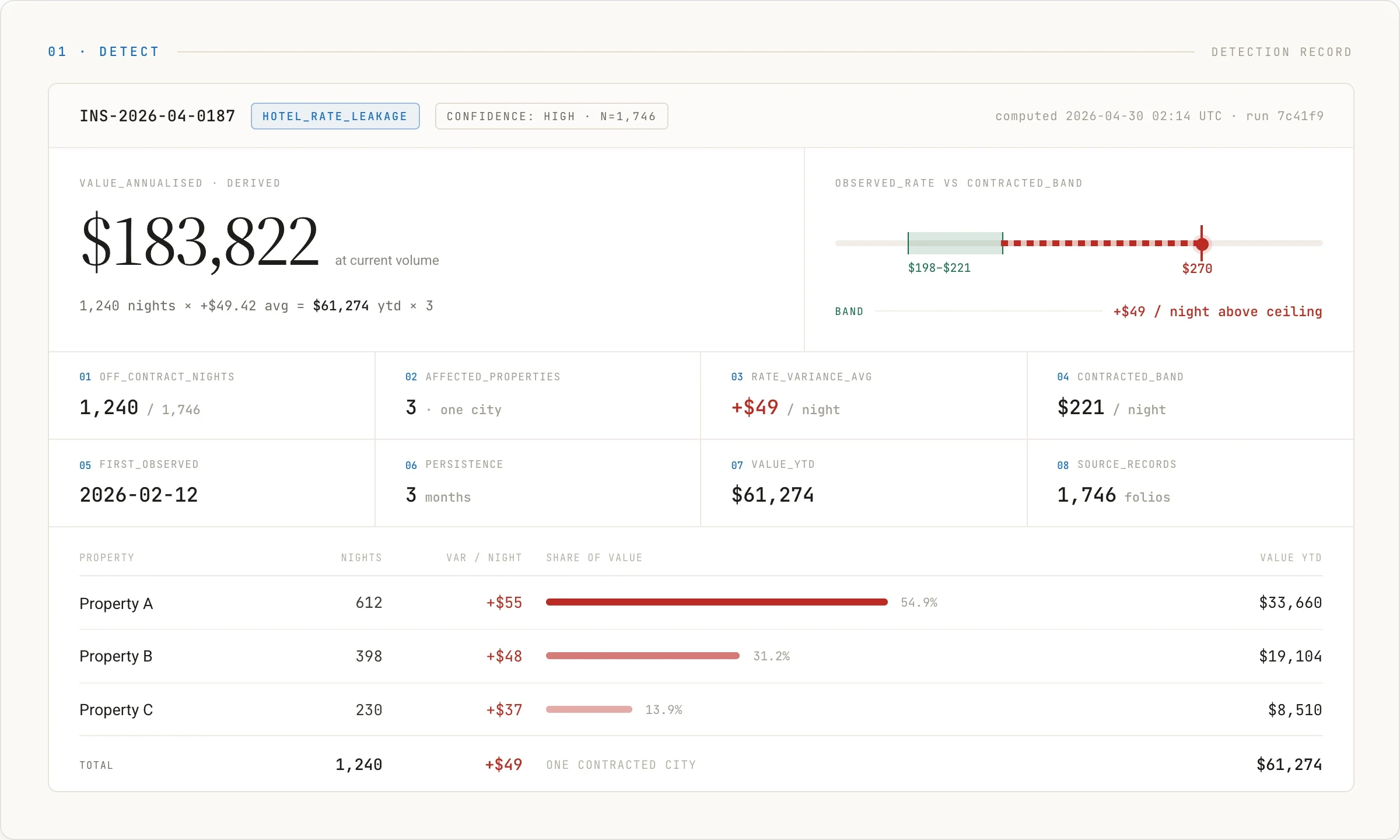
Bounded detection runs over the data warehouse on a scheduled refresh. Insights arrive as computed facts with the evidence attached.

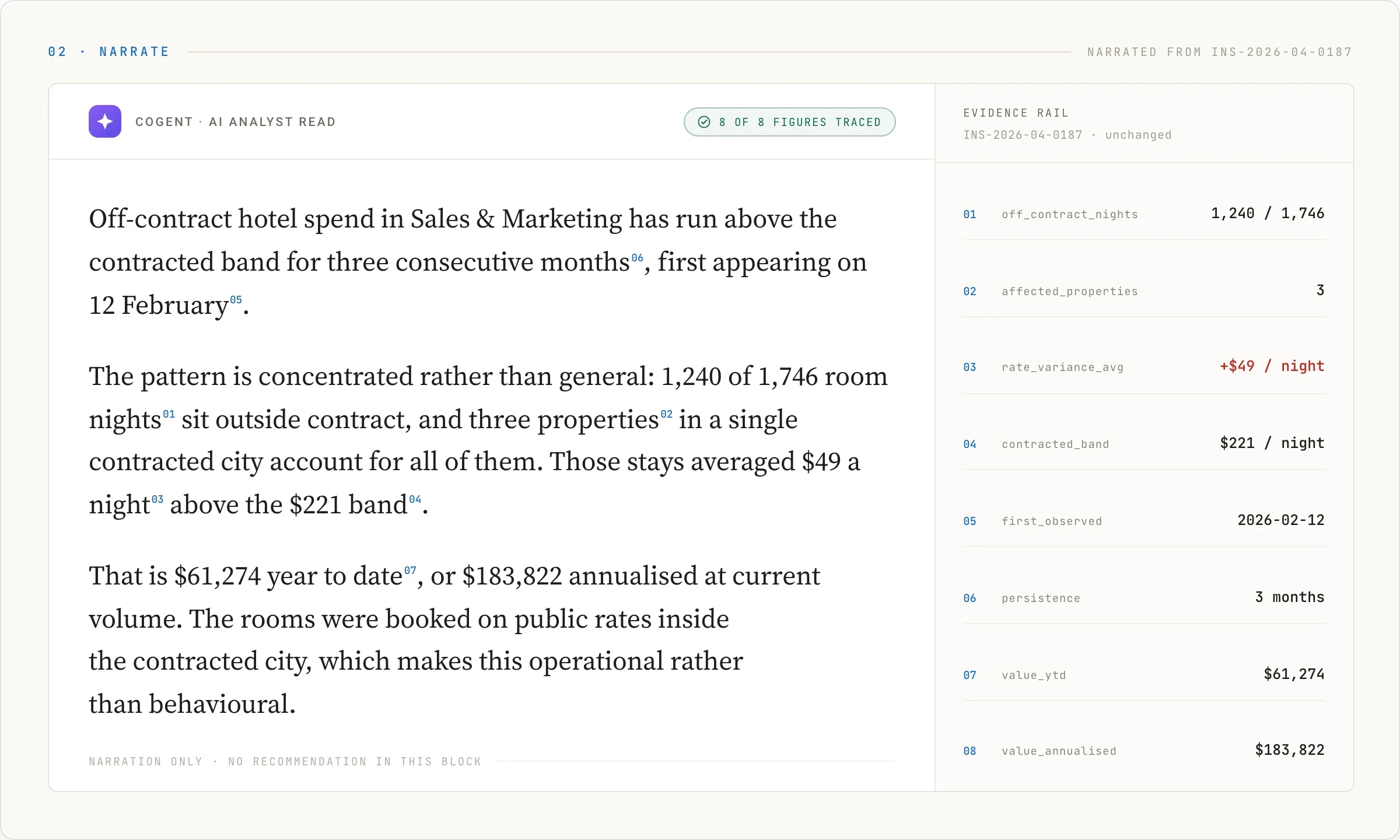
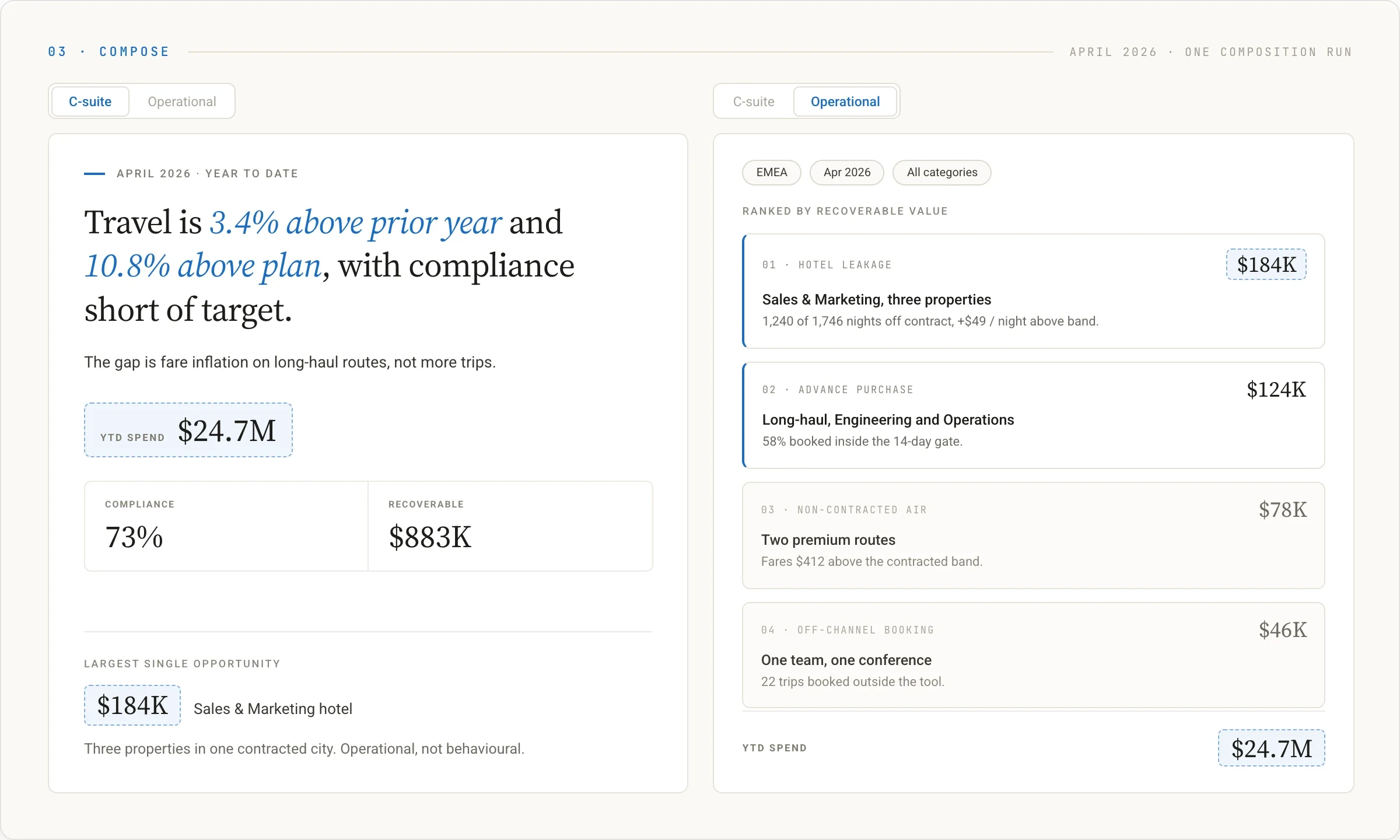
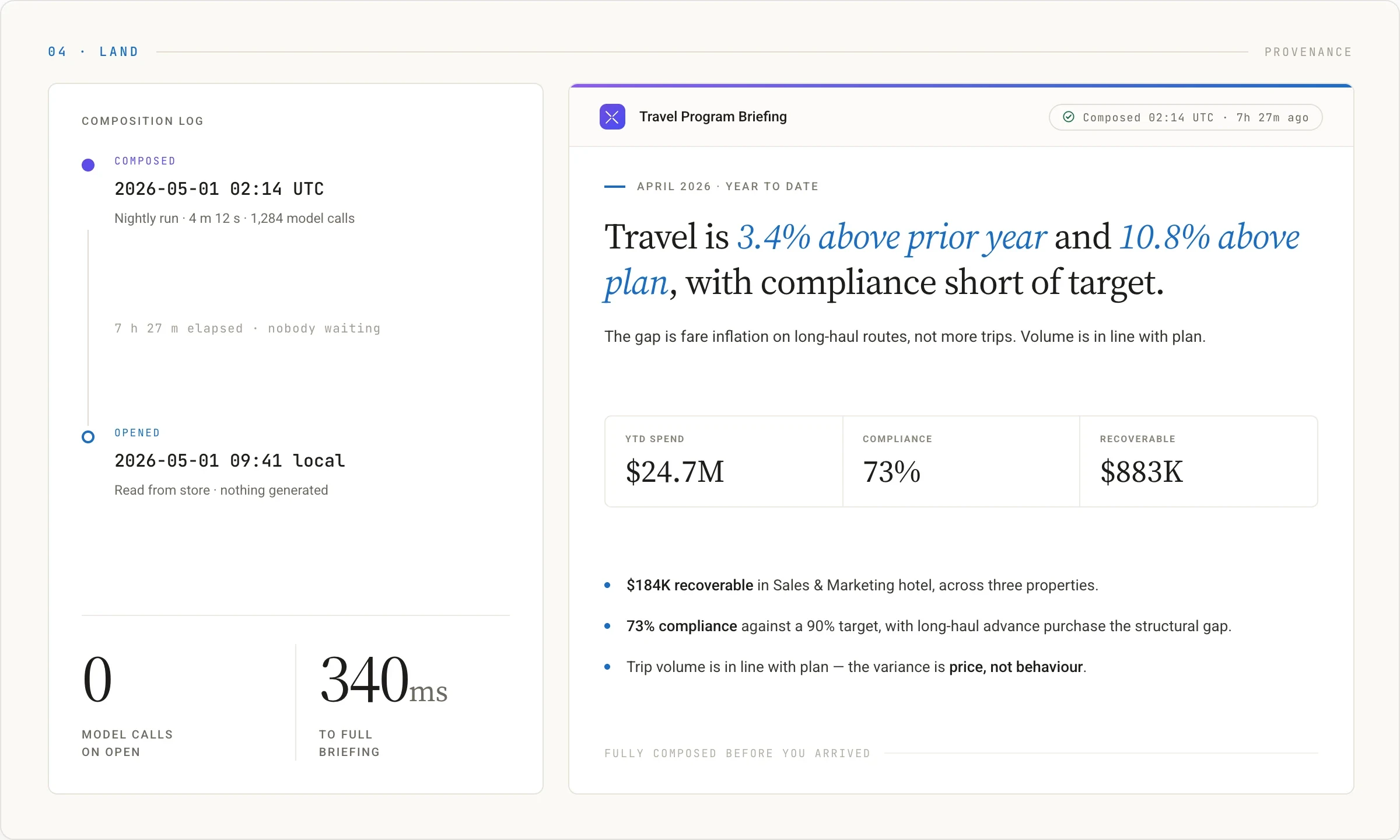
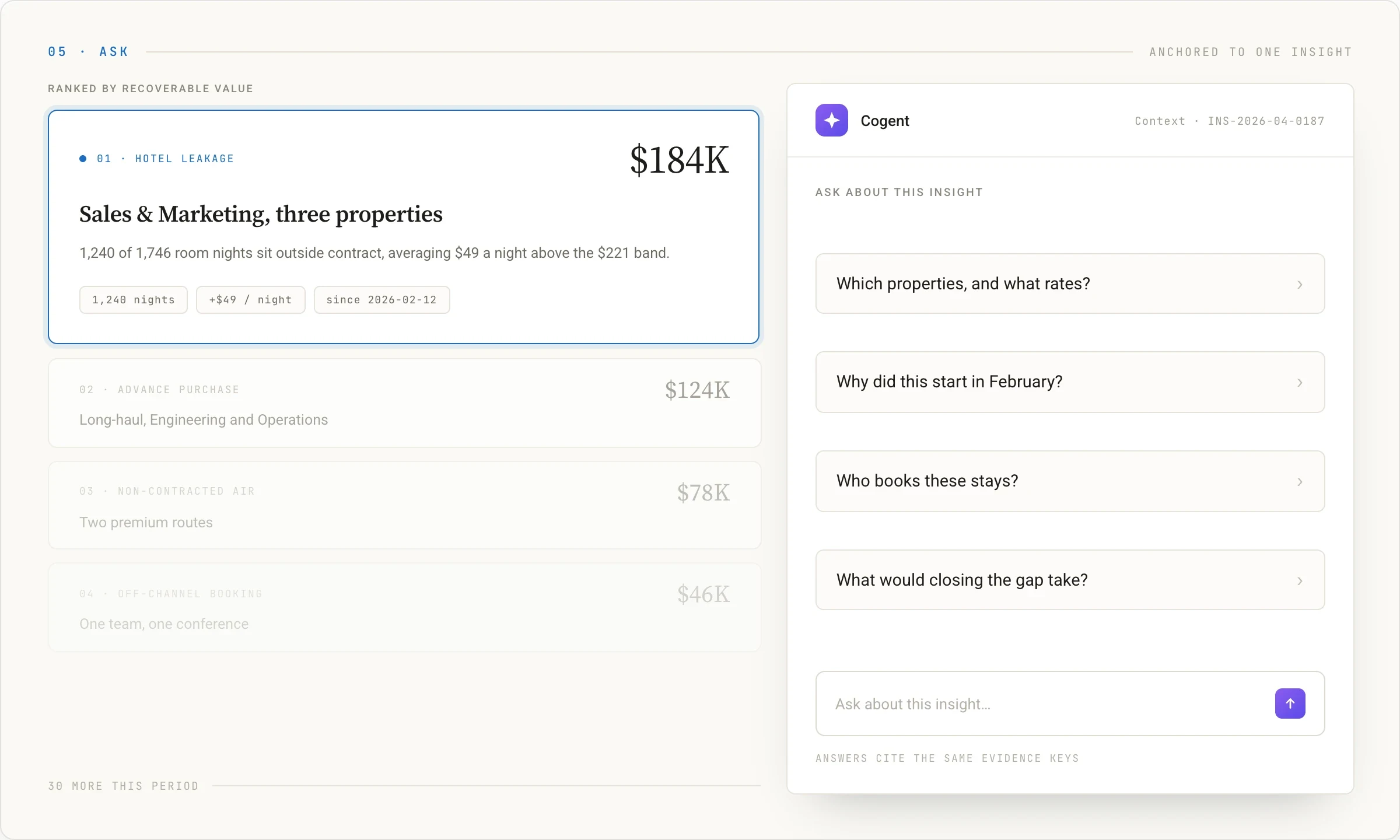
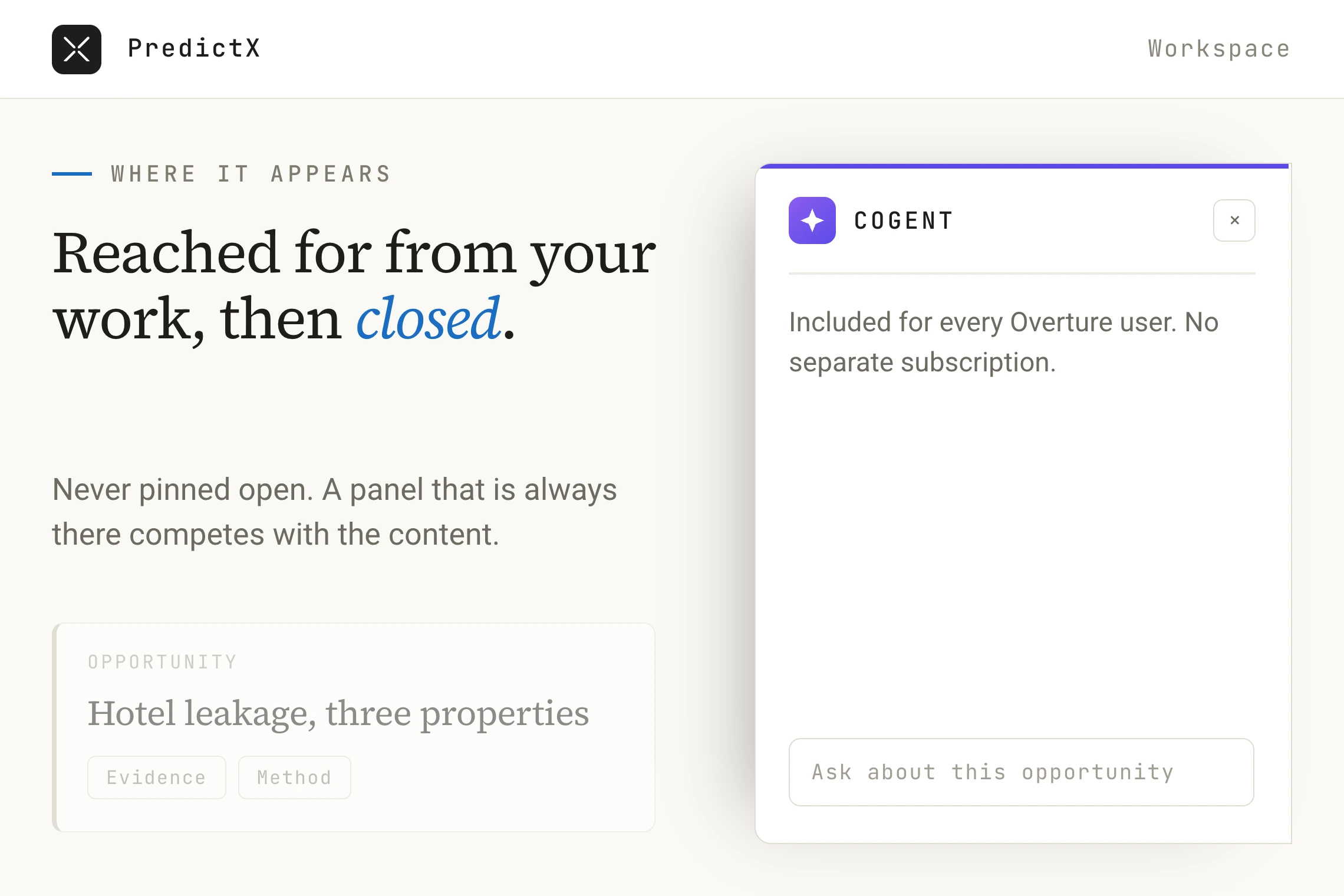
Hotel rate leakage INS-2026-04-0187: 1,240 of 1,746 nights off contract, $183,822 annualised. Figures illustrative.Cogent analyst read of INS-2026-04-0187 beside its evidence rail, badged 8 of 8 figures traced. Figures illustrative.$184K hotel leakage tops both views of one April run: a C-suite summary and an operational ranking. Figures illustrative.Composition log: 0 model calls on open, 340ms to full briefing, read from store, nothing generated. Figures illustrative.Cogent on the $184K hotel leakage card, with four seeded questions: which properties, and what rates. Figures illustrative.

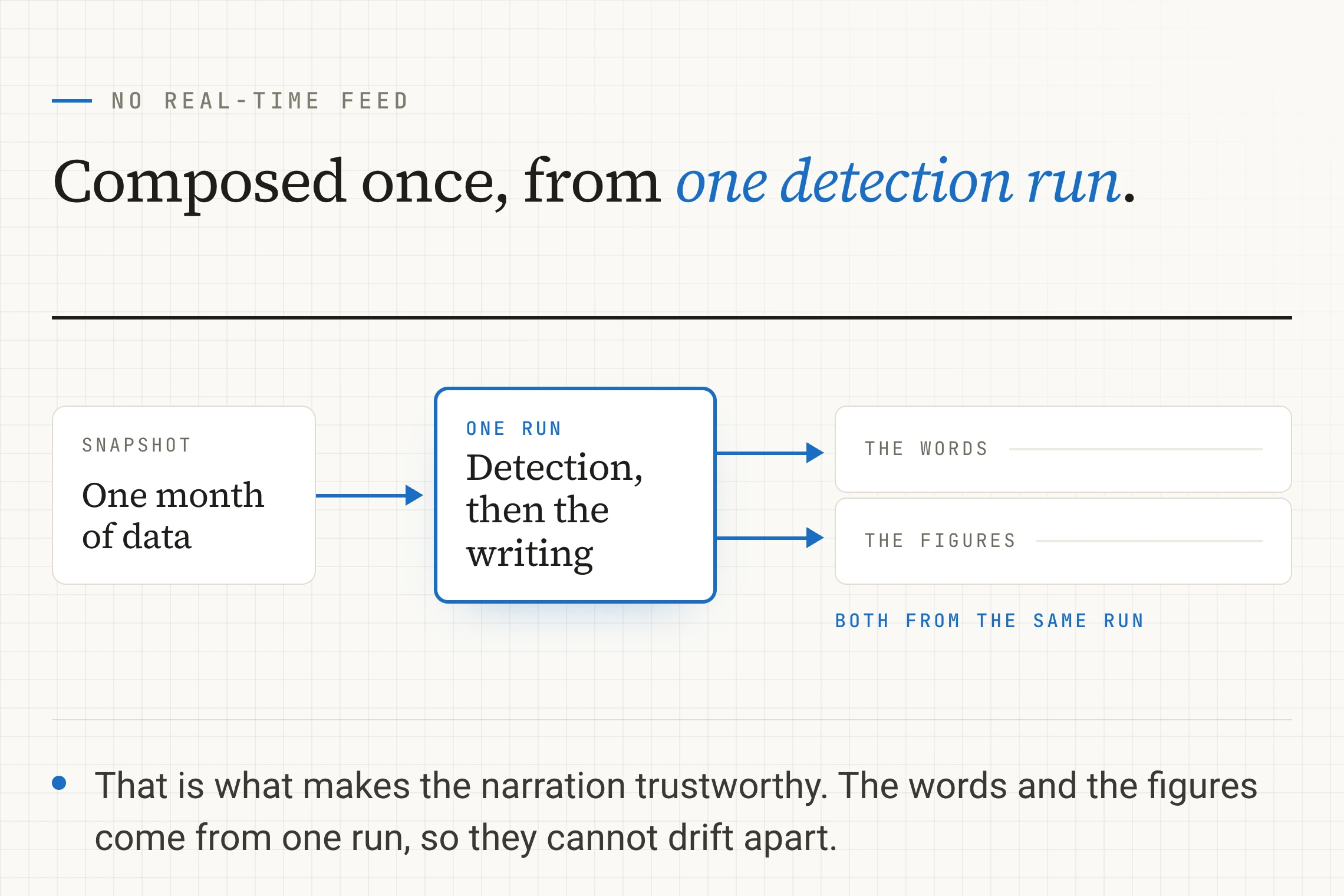
Overture reads a monthly snapshot. Re-run the pipeline mid-month and it still shows the month that closed, so the words and the numbers stay locked together. Consistency beats currency here, by design.

SURFACE 01 · THE MONTHLY BRIEFING

What does the monthly executive briefing contain?

The monthly executive briefing is a written account of the travel programme, composed from configurable modules and arranged for whoever opens it. It reaches the business unit owner as a short email first: spend against prior year, position against plan, identified savings and the low-effort subset of them, with a link into the full read. One month of an Overture briefing is published in full on a demonstration tenant, with every figure illustrative.

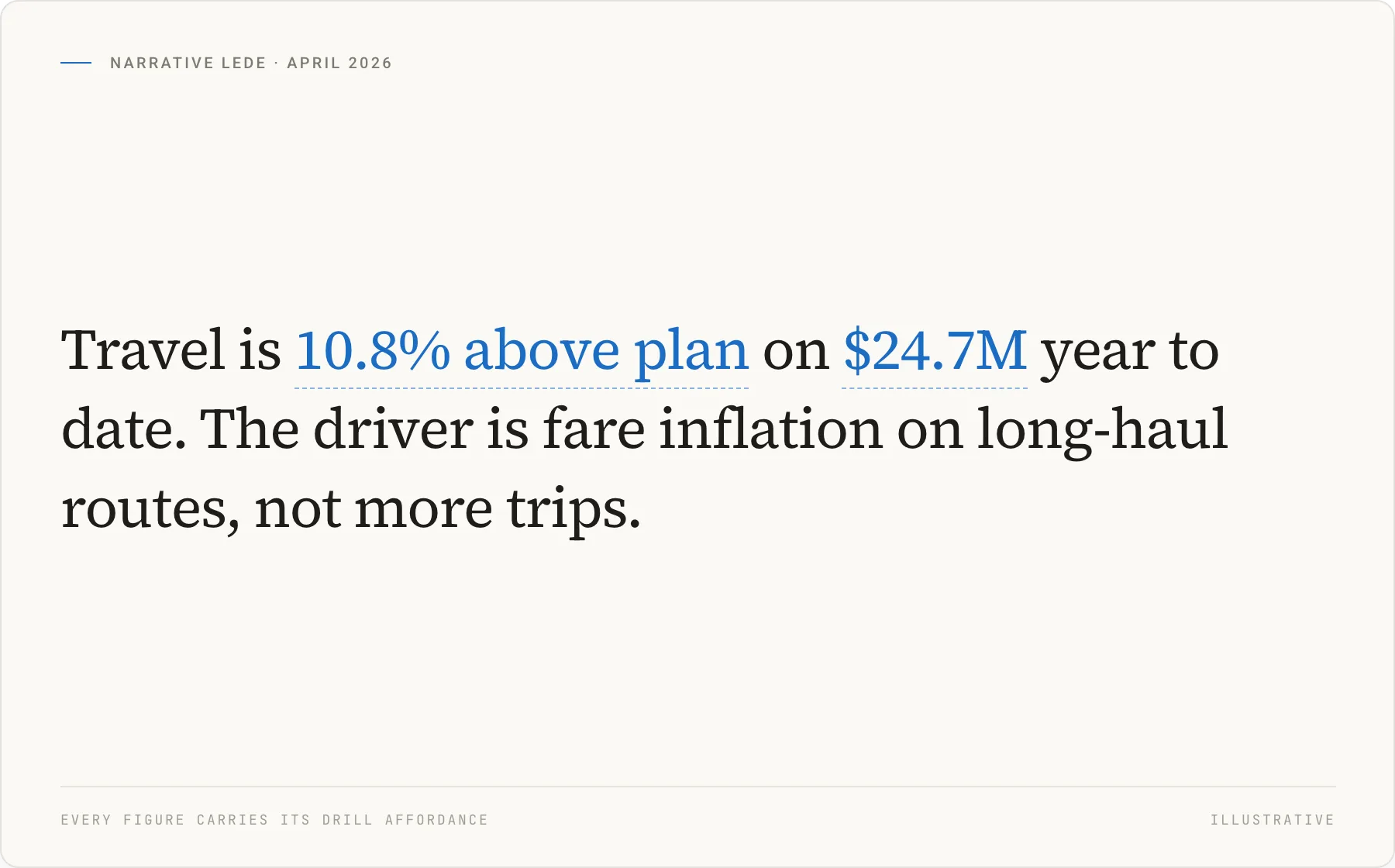
Narrative lede: travel 10.8% above plan on $24.7M year to date, every figure underlined as a drill link. Illustrative.

A narrative lede

The month in a few sentences, what changed and why it matters. Every figure inside the prose carries its own drill affordance.

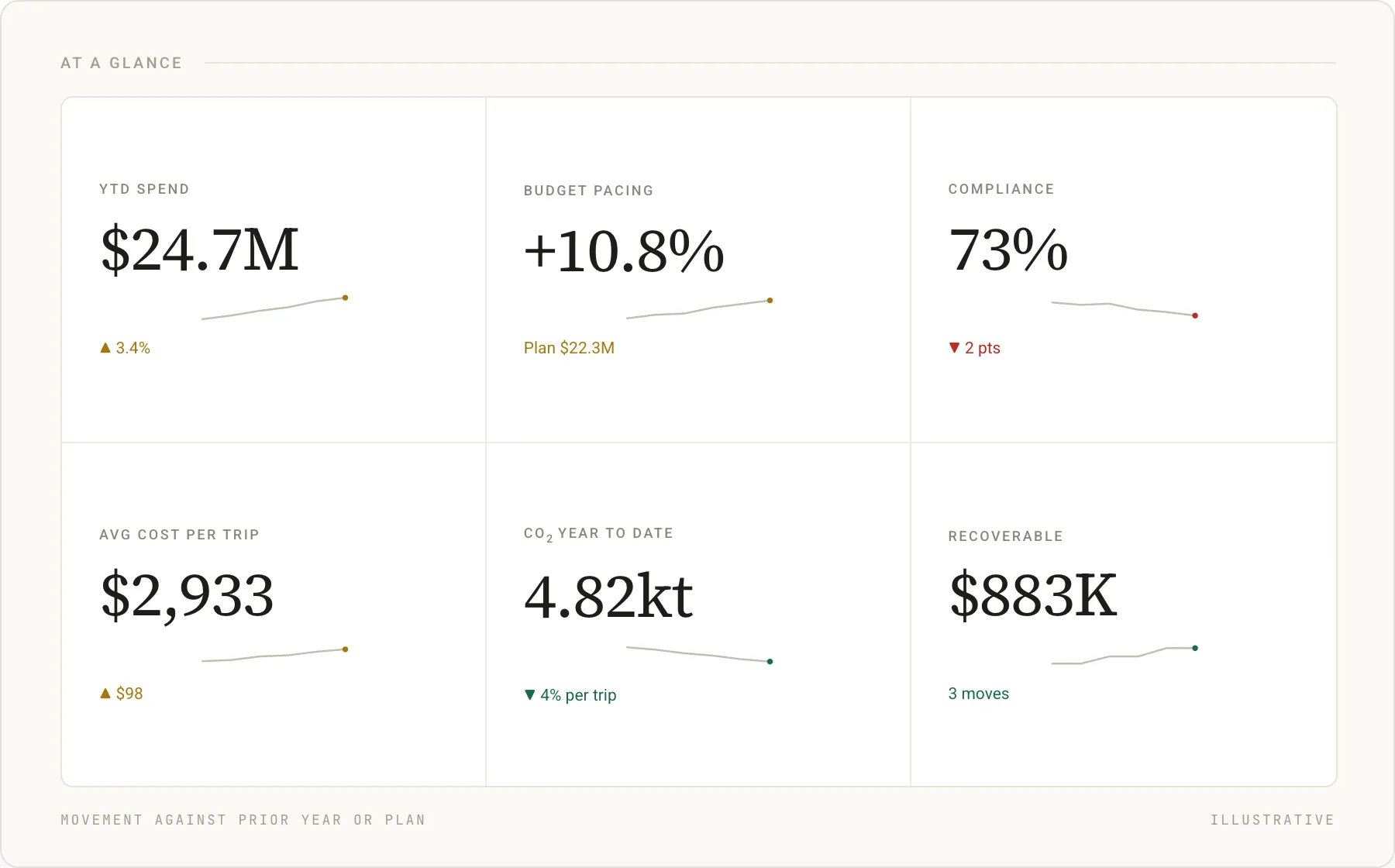
At a glance: $24.7M spend, 10.8% over plan, 73% compliance, $2,933 a trip, 4.82kt CO2, $883K recoverable. Illustrative.

At-a-glance KPIs

Year-to-date spend, budget pacing, compliance, average cost per trip, CO2 year to date and recoverable opportunity, each showing its movement against prior year or plan.

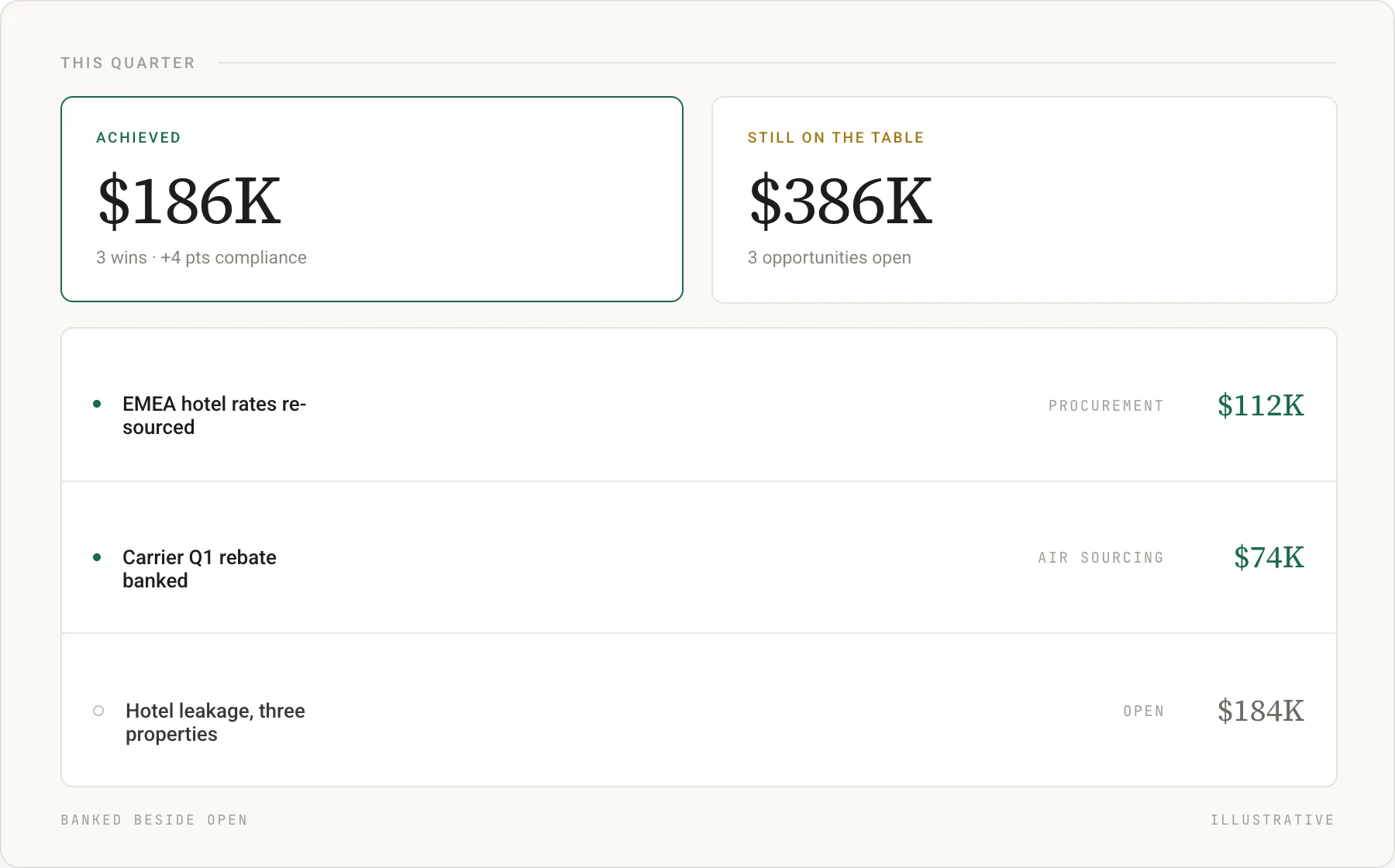
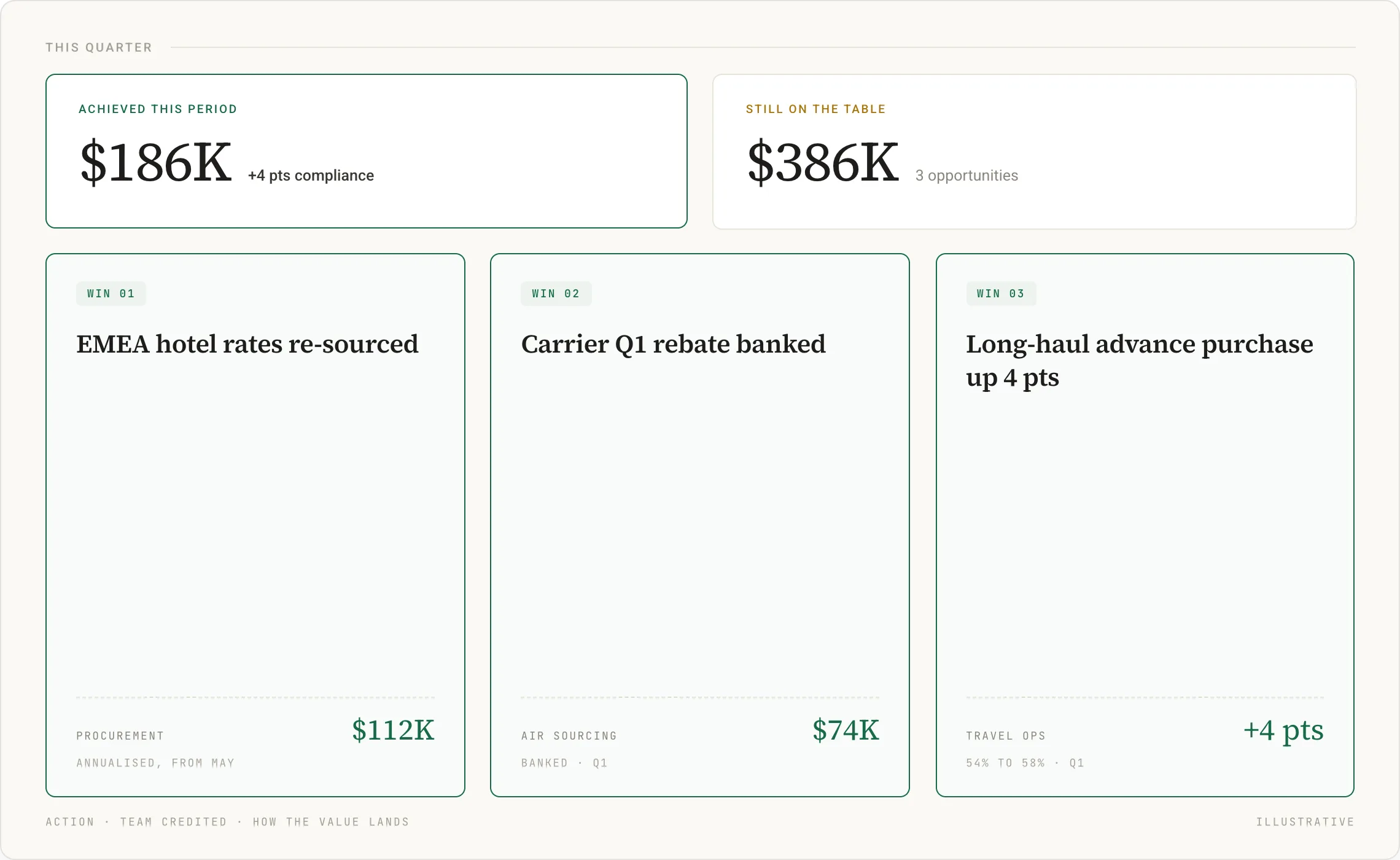
Wins module: $186K achieved this quarter beside $386K still open, including a $184K hotel line. Illustrative.

Wins and opportunities

What the programme banked this period, sitting beside what is still on the table.

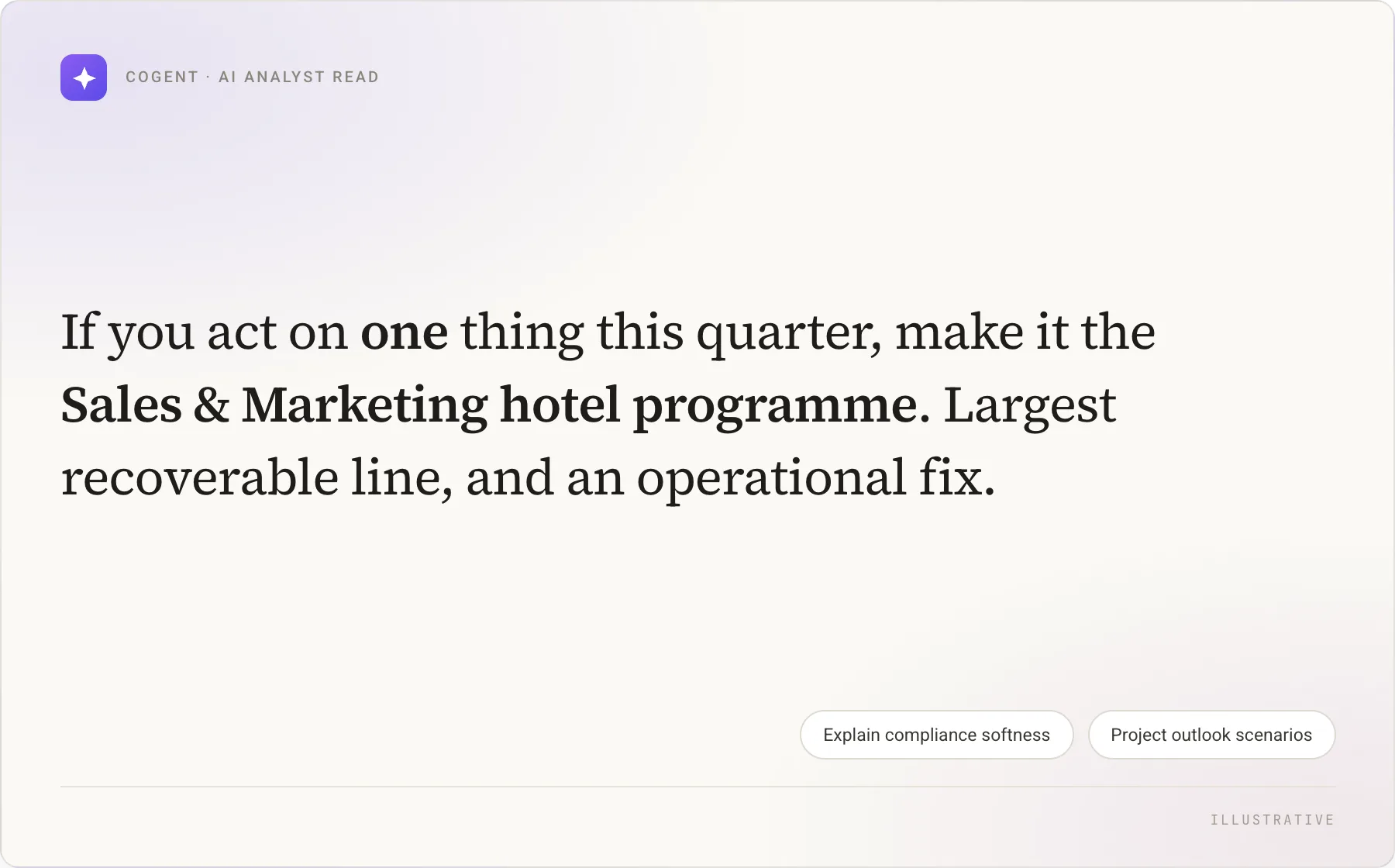
Cogent analyst read: act on the hotel programme this quarter, the largest recoverable line, with two chips. Illustrative.
Cogent

A Cogent analyst read

The one thing worth doing this quarter, written for an executive reading at a glance, with follow-up questions seeded as one-click chips.

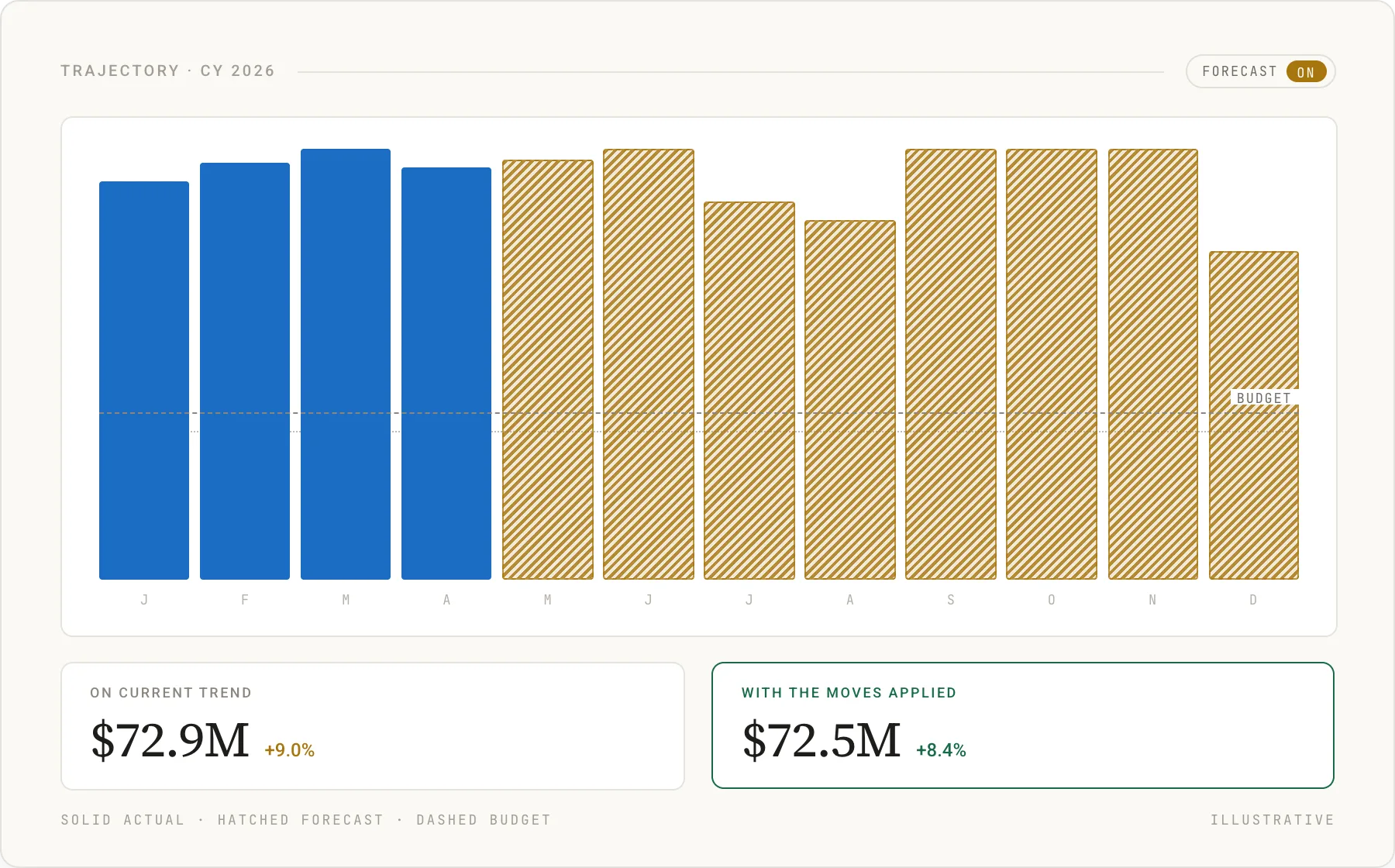
CY 2026 spend by month, four actual and eight forecast against budget, closing $72.9M on trend or $72.5M. Illustrative.

Trajectory

Monthly spend against budget and prior year, forecast on a toggle, and a year-end outlook that gives both numbers: where the year closes on current trend, and where it closes with the recommended moves applied.

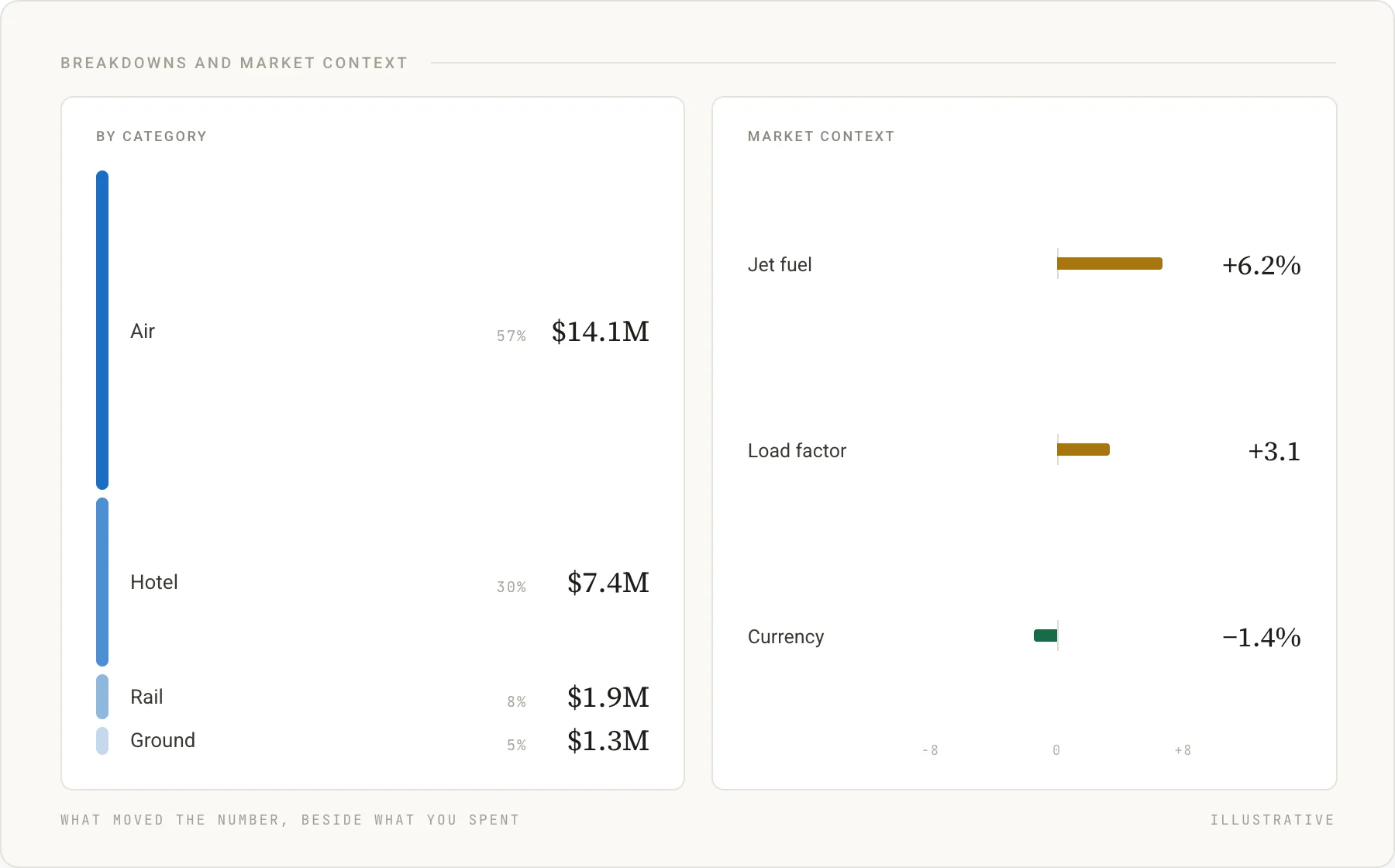
Spend by category, air 57% at $14.1M down to ground at 5%, beside jet fuel, load factor and currency moves. Illustrative.

Breakdowns and market context

Category and segment splits, each carrying its own compliance position, plus the external drivers: jet fuel index, carrier load factor and currency basket.

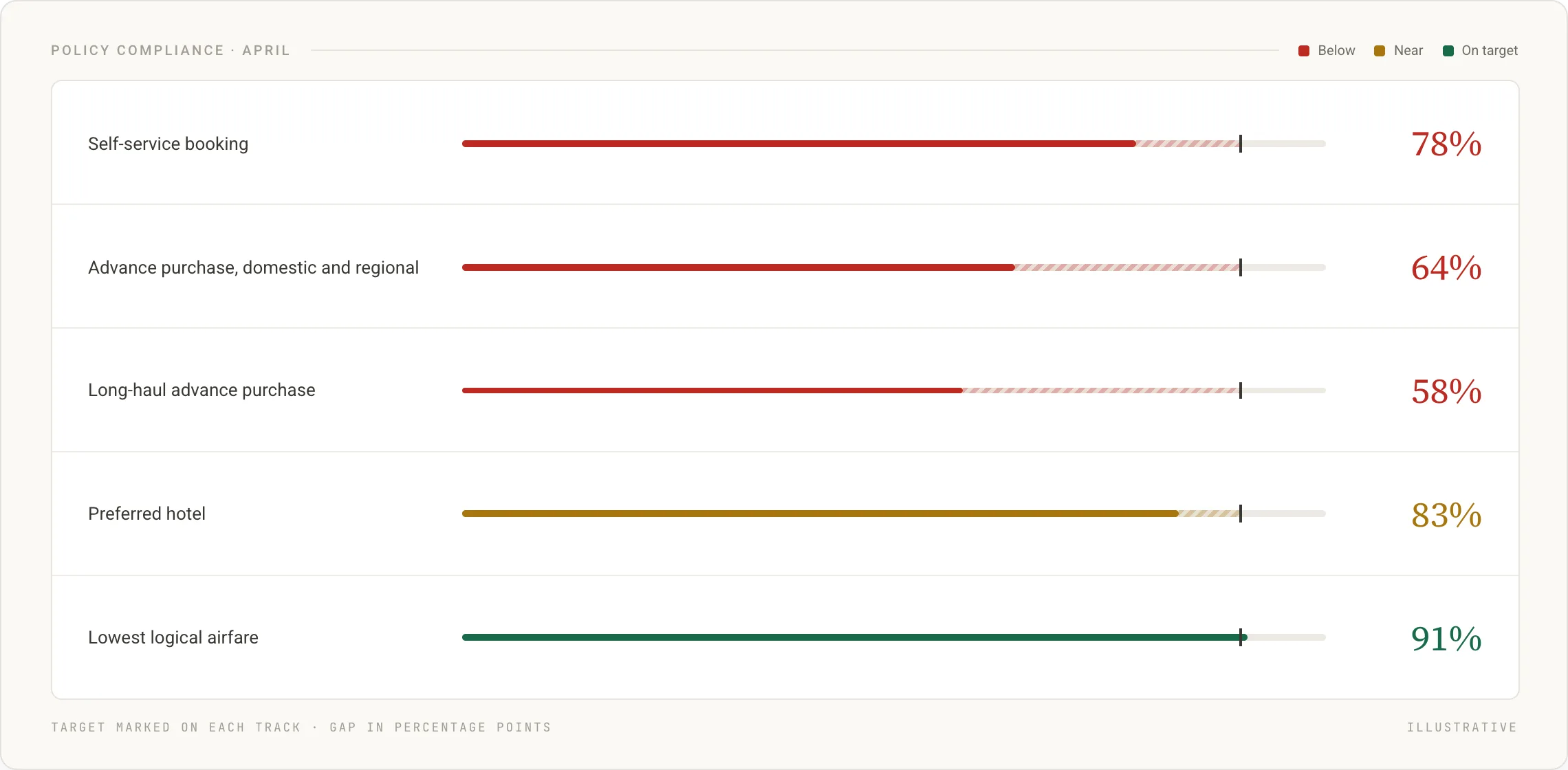
Five policy KPIs against April target, from long-haul advance purchase at 58% to lowest logical airfare at 91%. Illustrative.
Drill-downs

That second number is what turns a forecast into a decision.

Every drill-down does the same work, explaining the driver behind the number: open the compliance tile and the panel names the gap to target, the components dragging it down, and what would move it. Segment comparisons carry explain popovers, so the surface holds up when somebody interrogates it live in the room.

The briefing arrives every month, already written. The quarterly business review still happens; this is what it is built on. Three months of writing done and evidenced, waiting for the meeting.

The executive report format Overture uses

The order never changes, so the reader learns the travel programme briefing once and then reads it in minutes every month. What sits inside that order does change, because layout is templated per client and the data contract can rearrange modules.

WHAT IT COVERS

What belongs in business travel reporting?

Business travel reporting belongs to the programme, whatever tool renders it: spend against last year and against plan, travel policy compliance, savings identified and the subset that is easy to take, supplier and category breakdowns, and the market conditions moving the cost base.

Compliance

Compliance arrives as five named KPIs, each scored against the target you set and each showing how many points short it sits, or that it is on target

Self-service booking
Advance purchase on domestic and regional trips
Long-haul advance purchase
Preferred hotel
Lowest logical airfare
The conversation starts at the gap.

One artefact, both numbers.

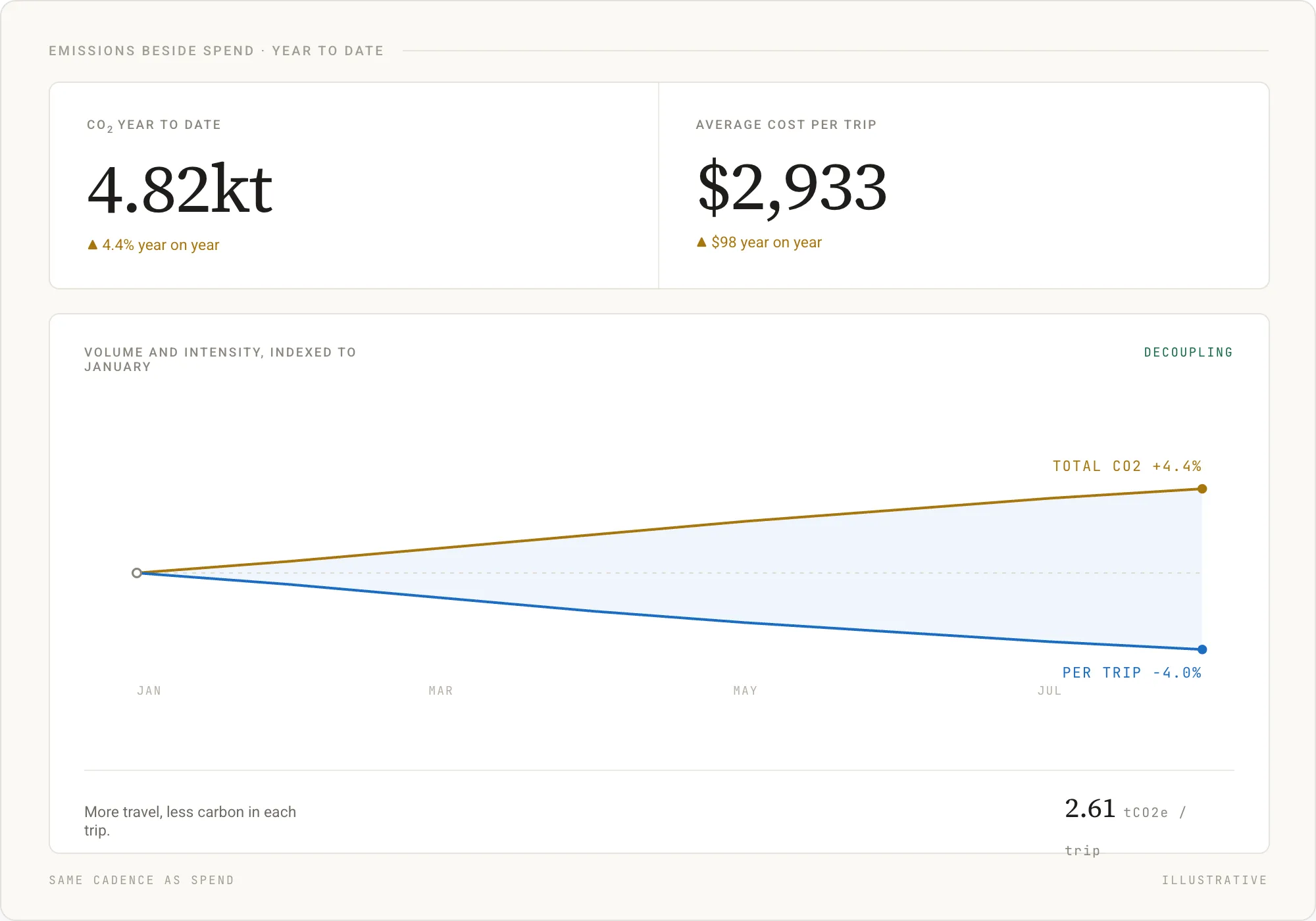
Emissions report on the same cadence as spend: CO2 year to date sits beside average cost per trip, and intensity per trip moves as carrier mix changes.

CO2 4.82kt year to date, up 4.4% while carbon per trip falls 4.0%, beside average cost per trip of $2,933. Illustrative.

One further module does work most reporting leaves out.

01 · Market

Driving Factors

Puts the market next to your own spend. When air spend rises because carrier load factors on your routes rose, the briefing says so, and what that means for fares. That decides whether the next conversation is about how your travellers booked or about what the market charged, and those are two very different meetings.

Reporting for a UK business unit sits inside the same briefing. Currency is configured per cut, so that unit reads its own figures with no conversion step.

BY ROLE AND SCOPE

Who reads what: three surfaces, one set of numbers

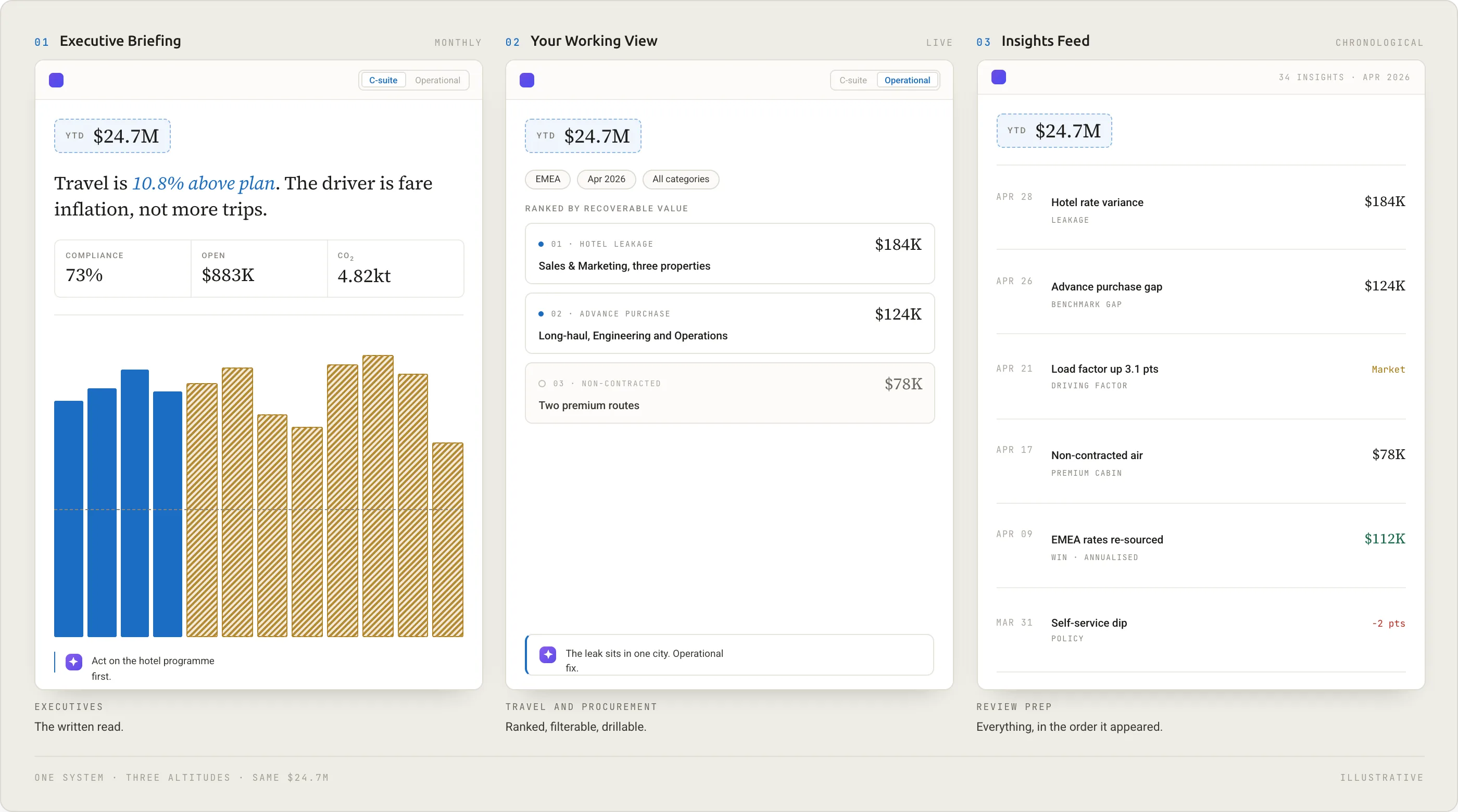
Overture renders one insight system at the altitude each reader works at. One detection run sits behind all three, so two people reading two surfaces quote the same figure. For a reader entitled to both, the two altitudes are one toggle apart in the header.

Stakeholder reporting at three altitudes

Surface
Who opens it
What it is
Executive Briefing
Who opens it
Executives and business unit owners
What it is
The monthly written read, in the platform and as an email with a deeplink back
Your Working View
Who opens it
Travel and procurement managers, team leads at their own scope
What it is
Insight cards ranked as savings opportunities, filters, drill-downs, forecast toggle and the Cogent panel
Insights Feed
Who opens it
Anyone preparing for a review, analysts checking data quality
What it is
The chronological ledger of every insight detected in the period, so you can see when a pattern started

Travel and procurement managers

Your Working View has already done the "what changed" job: leakage, benchmark gaps and non-contracted bookings at your scope, each one narrated, each carrying a read or unread state that marks what is new. Filters narrow the lens without re-running detection, so the numbers hold steady when you drill.

Team leads

The same detection, framed for what you can act on this week: out-of-policy trips, off-channel bookings, spend variation, your own top travellers. Sourcing language is stripped out, because those levers sit above their authority.

Walk through a live briefing
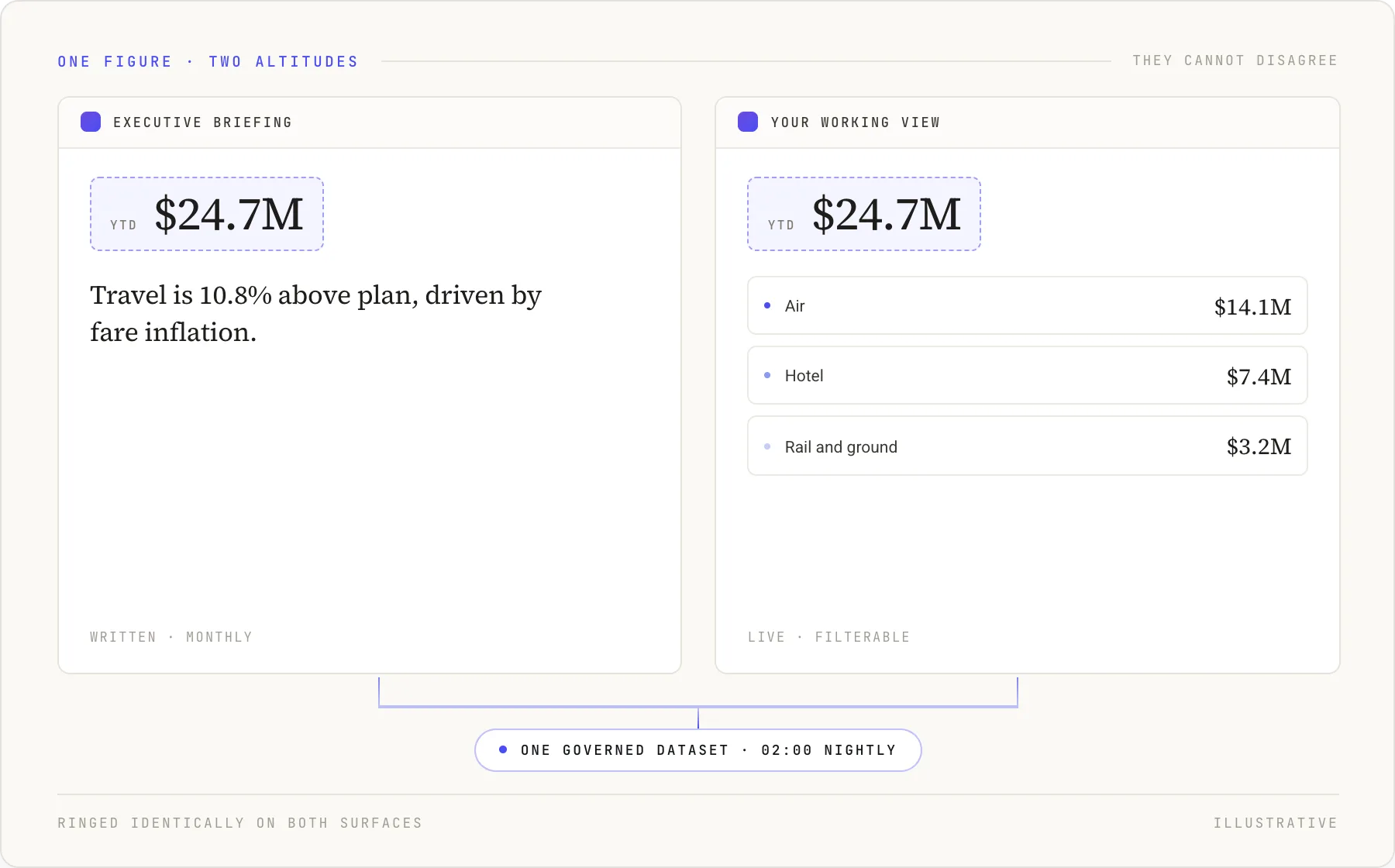
Executive briefing, working view and insights feed side by side, three altitudes on the same $24.7M. Illustrative.
THE TRAVEL TEAM'S CASE

How do travel managers evidence the value of the programme?

Overture records what the travel team achieved in the period and attributes it, so the contribution is documented by the reporting itself.

Each win names the team that delivered it, carries the value achieved, and says how the value lands, written up beside the spend figures by the system that detected them.

The value a travel team adds is the hardest thing in the programme to quantify in a form that can be logged as an accomplishment.

Stakeholder management is why this surface exists. When leadership understands what the travel function does, it treats that function as a strategic partner rather than a transaction desk, and the team gets more of what it asks for.

Three credited wins this quarter: $112K on hotel rates, a $74K rebate, and advance purchase up four points. Illustrative.

FULL TRANSCRIPT

Keesup Choe, Founder and CEO of PredictX, on stakeholder management, storytelling and what AI changes about the monthly travel report. Interviewed at The Studio @ GBTA, GBTA Convention 2026, Chicago. Running time 4:10.

0:00 - 1:00

Stakeholder management and communications is extremely important for travel managers, mainly because it's individuals who are travelling. And also, even if your goal is to save money, the biggest impact on that is actually the behaviour of your travellers. As an example, a 5% discount on a hotel is good, and you should try to achieve that. But a traveller staying at the most expensive hotel or even booking outside the programme is massively more impactful in spend. Also, because stakeholder management is incredibly important as well, so senior management understands what the travel manager does, understanding the value that the travel manager brings, it just elevates the function to be a strategic consultant and a partner rather than someone they look at as transaction-based.

1:00 - 1:53

Overture was designed really to enable better stakeholder management.

It does that in several different ways. One, it's beautifully designed. It's fantastic.

And it tells a story. And the reason storytelling is so important is because that's how human beings developed. The evolution of humankind was based on humans telling stories around the campfire, et cetera.

And then there's studies that says only a small fraction of humans are numbers first. So telling a story is really key, especially to stakeholders who are not living and breathing travel. So you want to explain the programme, what's going on, what they might need to do to make savings and set the stage to engage with them to discuss how to achieve it.

1:53 - 2:36

And where AI comes into being is several fold. One is that tomorrow's story is different from today's. I mean, yet most corporate reports tend to be a certain platform, a certain template that's repeated over and over again.

It's kind of like if the New York Times had the same stories every day, you'd kind of stop reading it, right? So the story has to be germane to something that's going on, something that's new, something people should be alerted to, something they could act on. So that's one. And then the story themselves, it's generated in a way that fits the culture and the language of the organisation. And all of this would be extremely difficult, if not impossible before AI.

2:36 - 3:38

So one of the challenges travel managers have sometimes is to quantify the value they're adding, especially in a way that can be logged as accomplishments. So one of the things about Overture is we do that with a section that highlights the achievements of the travel manager and the team. If they've negotiated a new deal with United, what did they achieve? If they found new vendors, how did they do that? What's the impact of that? So it's a key component to really put the activities of the travel manager and the team first and elevate their achievements in a way that's supported by data and being generated by a third party. Because it's always better to have third-party validation than trying to trumpet your own achievements, right? So we feel like it's an important part because the more respect that the travel manager and the team have, the more they can actually accomplish in terms of strategic goals.

3:38 - 3:38

Okay, so here we are.

The question is, what is: “ Your must-have item that you can't leave home without?”

It's a little bit too simple, right? The must-have item, obviously, for leaving home these days is the phone, unfortunately. And then the must-have item, if you're packing for travel, is the multi-country power bank.

Keesup Choe, Founder and CEO, PredictX · The Studio @ GBTA, GBTA Convention 2026 · Transcribed verbatim

TRUST · WHY THE NUMBERS HOLD

How do you know the AI did not make it up?

Because detection and writing are separate steps, and only the writing is done by AI. Detection is deterministic and runs at the data warehouse. The model narrates what detection found, from templated prompts that require the evidence behind each claim. Take the AI away and every number on the page is unchanged. You lose the writing, not the figures.

The model is a renderer, not a detector.

Insights are computed facts. AI narrates them.

The model is a renderer, not a detector.

What it means.

Insights are computed facts. AI narrates them.

Why it holds.

Detection runs at the data warehouse and hands over computed facts with their evidence already attached. The narration is written from templated prompts that require that evidence, so the model describes what was found rather than deciding what was found. The writing step cannot introduce a figure the detection step did not produce.

Narration is pre-generated and cached.

Written at refresh time from templated prompts, before anyone opens the page.

Narration is pre-generated and cached.

What it means.

Written at refresh time from templated prompts, before anyone opens the page.

Why it holds.

The briefing is built by a scheduled pipeline: metrics are computed at the warehouse, the narrative is written from those metrics, and the page is cached. The model never runs on page load, so nothing is composed while you read and two people opening the same briefing get the same words. Re-run the pipeline mid-month and it still shows the month that closed, so the words and the numbers stay locked together.

Scope and freshness are visible.

Every reader sees which slice of data they are on, and the header carries a dated stamp for the period the briefing covers.

Scope and freshness are visible.

What it means.

Every reader sees which slice of data they are on, and the header carries a dated stamp for the period the briefing covers.

Why it holds.

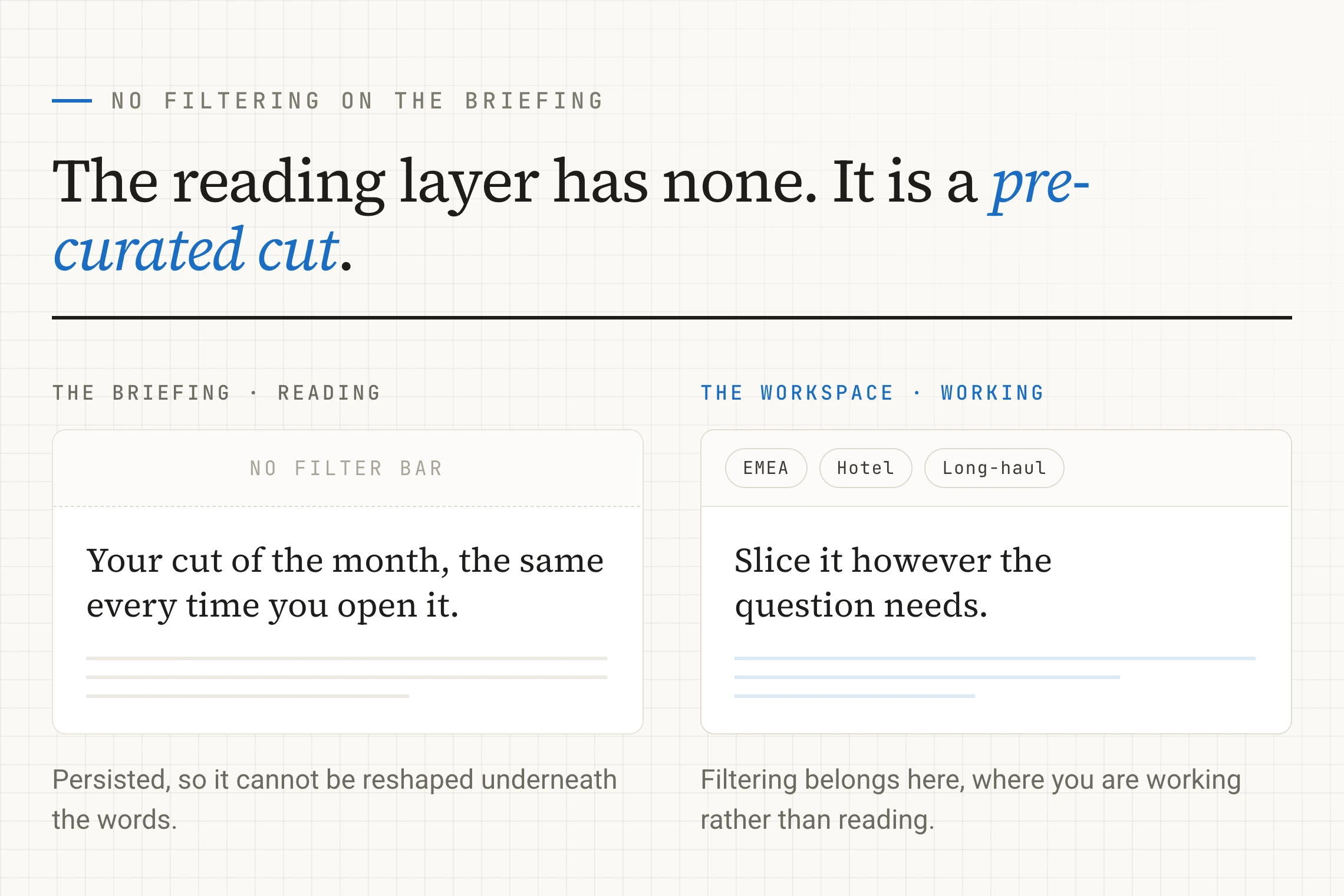
Filters narrow the lens without re-running detection, so changing scope changes the view and never the source of truth. One detection run sits behind all three surfaces, which is why two people reading two different surfaces quote the same figure. Overture reads a monthly snapshot rather than a live feed, so the dated stamp names exactly which month a figure belongs to.

Access is enforced per role.

A department user sees their department, cannot switch into the executive view, and the metrics change when their filter applies.

Access is enforced per role.

What it means.

A department user sees their department, cannot switch into the executive view, and the metrics change when their filter applies.

Why it holds.

Role and data scope decide which surface a reader lands on, which insights appear and how each one is framed. The limit is applied when the page is composed, not left to the reader to respect, so a department view cannot be widened into an executive one. A reader entitled to both altitudes moves between them from the header.

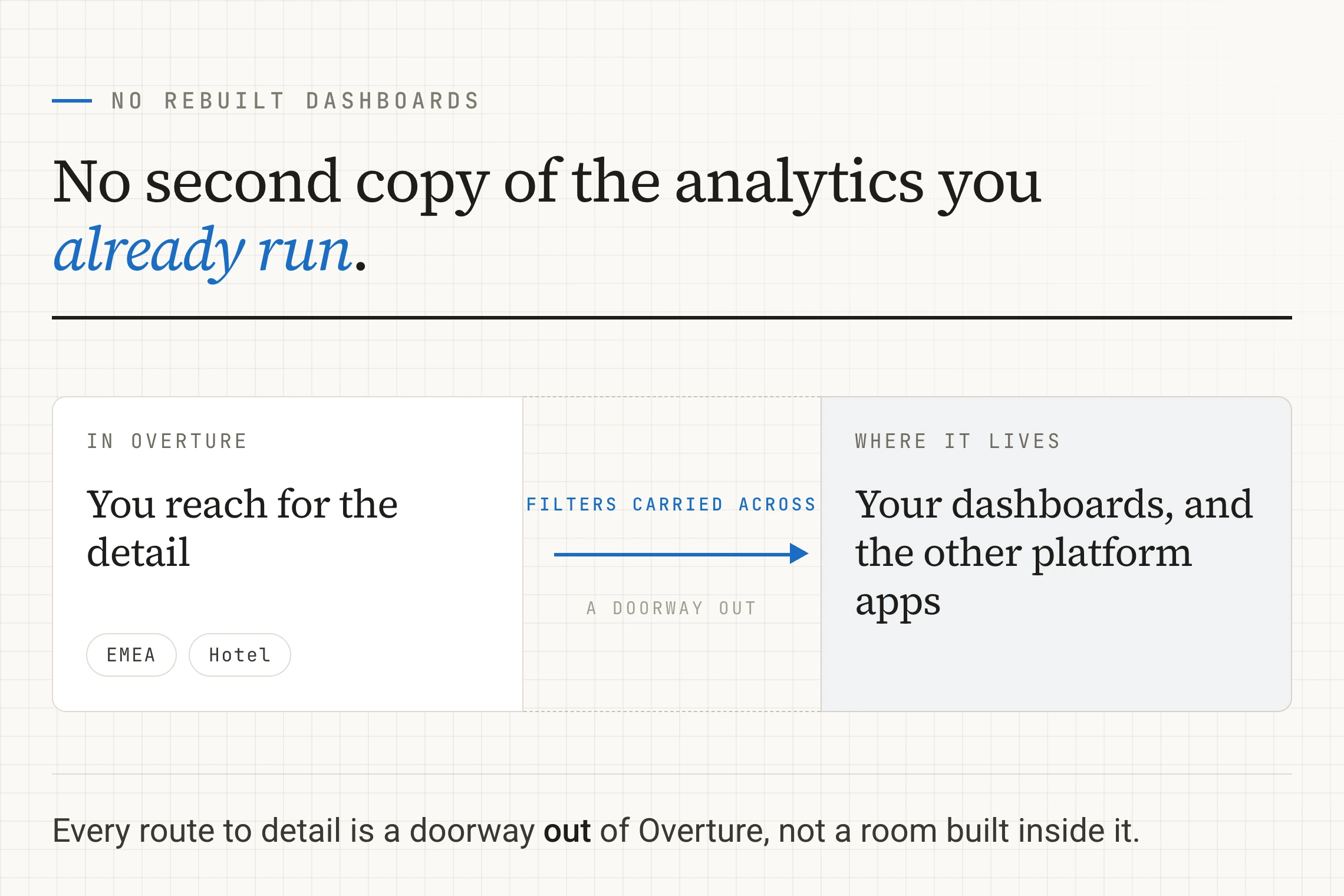
Cogent reads the same monthly snapshot the briefing was written from, so the chat panel and the briefing agree by construction. When a question needs transaction-level detail, Overture hands off to the wider travel and expense platform.

COMPARISON

Executive reporting vs management reporting: what is the difference?

Management reporting is the operating detail a function runs on: volumes, categories, exceptions, month-to-month movement. Executive reporting is the layer above it, the same programme summarised for a decision with the analysis already done. Most organisations have the first and improvise the second.

Management reporting
Executive reporting
How Overture ships both
Question it answers
Management reporting
What is happening?
Executive reporting
What changed, and what does it mean for the plan?
How Overture ships both
One detection run feeds both altitudes
Reader
Management reporting
Travel and procurement managers
Executive reporting
Executives and business unit owners
How Overture ships both
Role and scope decide the surface
Detail
Management reporting
Transaction and category level
Executive reporting
Programme level, drill-down on demand
How Overture ships both
Every executive tile opens into the detail
Cadence
Management reporting
Continuous, checked as needed
Executive reporting
Monthly, read in minutes
How Overture ships both
A monthly snapshot with a working view on top
Failure mode
Management reporting
Detail nobody has time to read
Executive reporting
A summary nobody can verify
How Overture ships both
Evidence behind every narrated claim

Against a traditional reporting platform, the real choice is what the surface does with the numbers. One shows them. The other tells you what they did, with the detection, the narration and the travel data model already built. The alternative is an 18-month in-house BI programme.

Overture works alongside your analytics dashboards. It tells you where to look, then hands off for the transaction-level work. And it is newly announced, so an early conversation shapes the configuration.

WHAT GOOD LOOKS LIKE

What is management reporting best practice for a travel programme?

Good management reporting for a travel programme follows five rules, and none of them are about adding charts.

One figure, $24.7M year to date, shown identically in the executive briefing and the working view. Illustrative.
01

Keep one set of numbers at several altitudes.

If the executive view and the working view can disagree, both lose their authority.

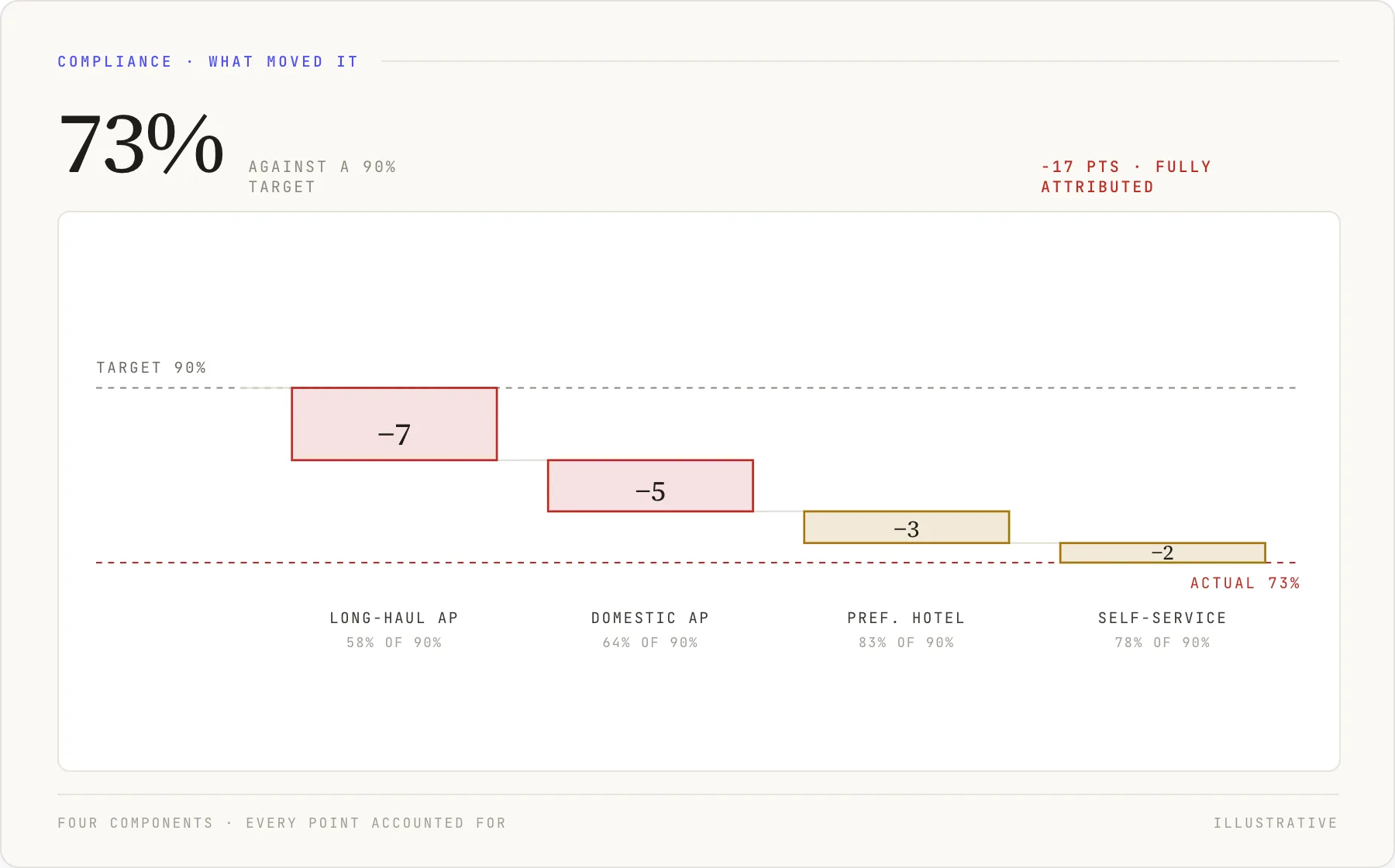
Compliance at 73% against a 90% target, with the 17-point gap broken into four components. Illustrative.
02

Explain the driver, not just the number.

A compliance figure that moved is only useful beside the components that moved it.

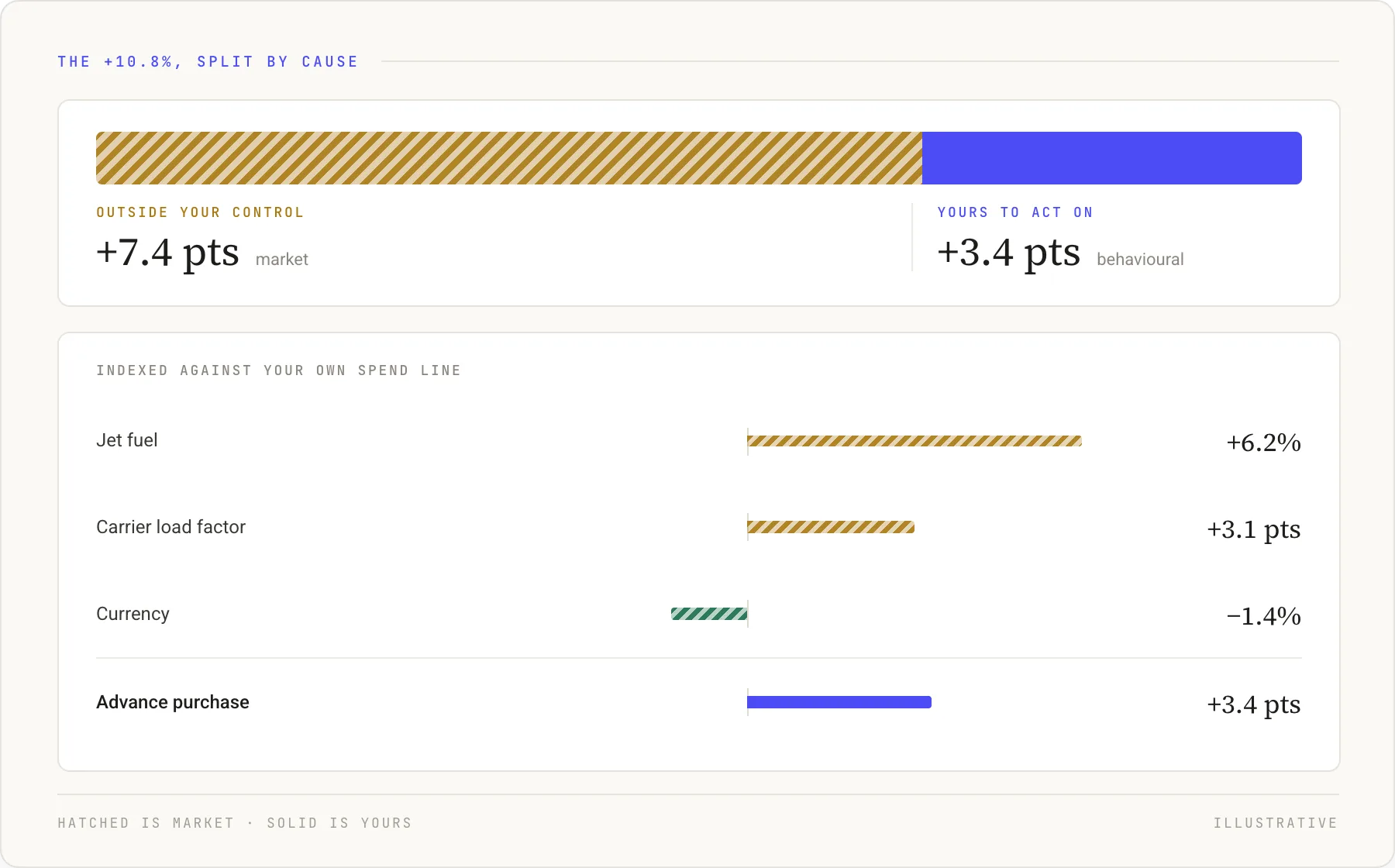
The 10.8% rise split into 7.4 points of market movement and 3.4 points of traveller behaviour. Illustrative.
03

Put the outside world in the report.

Fuel, load factors and currency move spend without any traveller behaving differently.

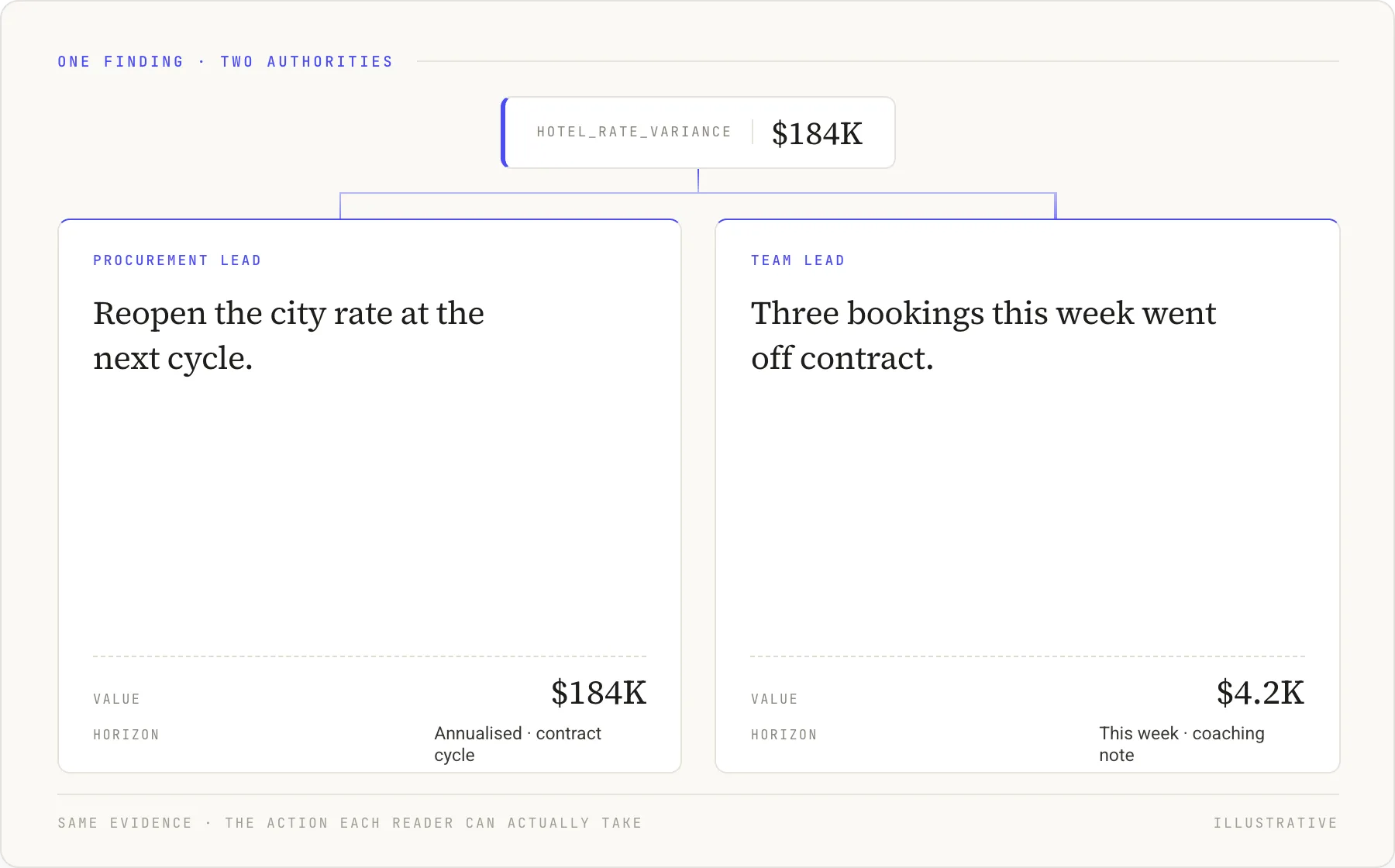
One $184K hotel rate variance shown twice: a contract action for procurement, a $4.2K note for a team lead. Illustrative.
04

Match the read to the reader's authority.

AI insights someone cannot act on read as criticism.

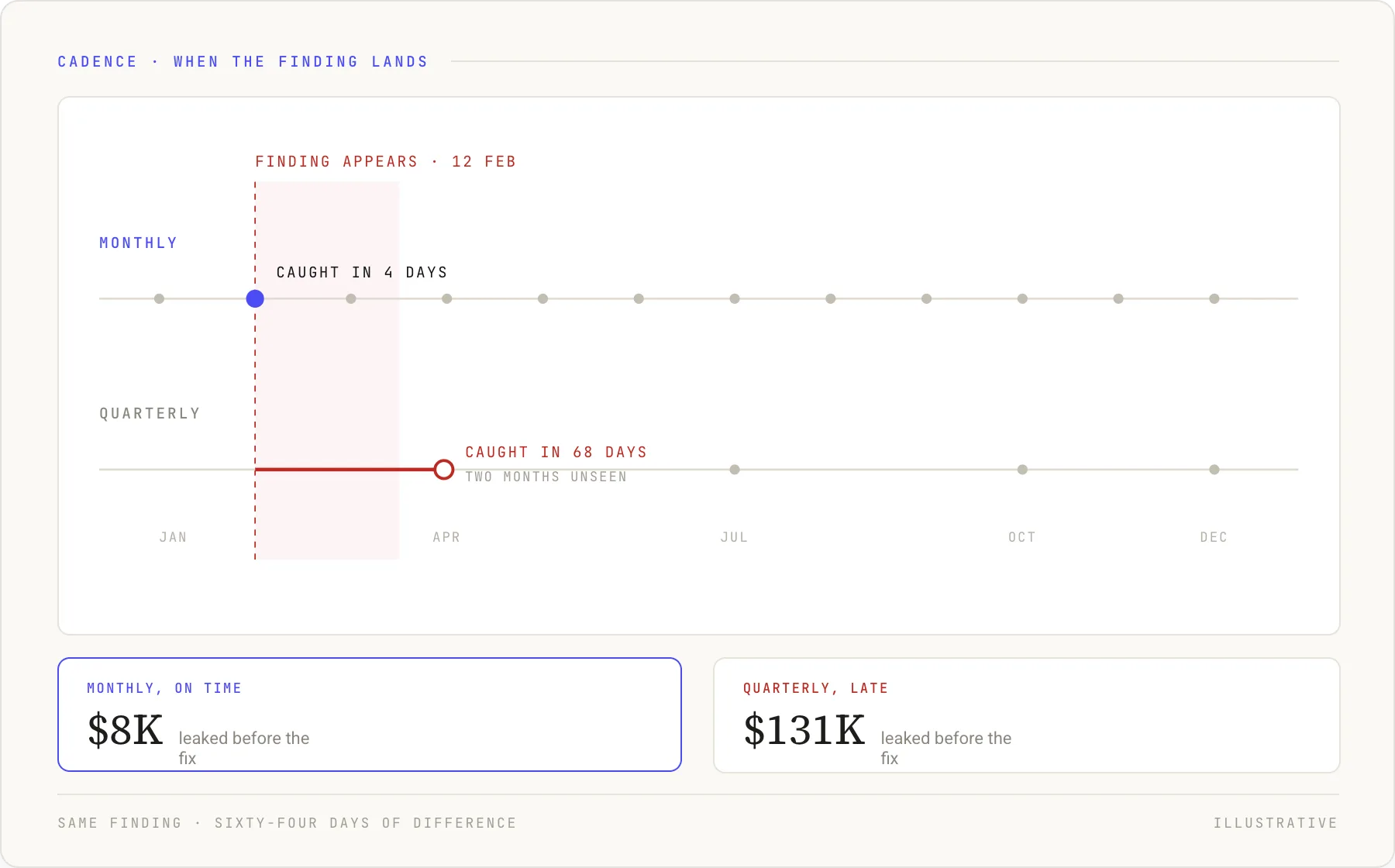
The same finding caught in 4 days monthly but 68 days quarterly, leaking $8K against $131K. Illustrative.
05

Fix the cadence.

A report that arrives when somebody has time to build it arrives late.

The last rule is the one that fails manually, which is why programmes drift to reporting quarterly and then find a pattern that has been running for two months. Automatically generated is the only version of monthly that holds.

FAQ

Executive reporting questions, answered

What is the difference between an executive briefing and a dashboard?
A dashboard shows numbers and leaves the interpretation to the reader. An executive briefing states what changed, why it changed and what needs a decision, in the order an executive reads. Overture composes the briefing monthly from the same data the dashboards hold, so the figures agree and the reading takes minutes.
How does AI turn travel data into a written narrative?
Detection and narration are separate steps. Detection runs deterministically over the data warehouse and produces facts with evidence attached. AI then writes those facts up, using templated prompts that require the evidence keys behind each claim. The model narrates what was found. It does not decide what was found.
What is the difference between executive reporting and operational reporting?
Executive reporting answers what changed across the programme and what it means for the plan. Operational reporting carries the day-to-day detail: bookings, categories, travellers, exceptions. Overture ships both altitudes from one set of numbers, so the figure an executive quotes is the figure the travel manager is working from.
What is business travel reporting?
Business travel reporting is the regular account of how a corporate travel programme is performing: spend against prior year and against plan, policy compliance, savings identified, supplier and category breakdowns, and the market conditions moving the cost base. It is the programme's record, written for the people who fund it.
Can executive reporting be automated?
Yes, provided the detection is deterministic. Overture generates each month's briefing ahead of time from a scheduled pipeline: metrics are computed at the warehouse, the narrative is written from those metrics, and the page is cached before anyone opens it. Nobody on the travel team assembles a pack.
How often should executives receive travel programme reporting?
Monthly. A quarterly cycle lets a spend pattern run for two months before anyone names it. What those two months are worth depends on the programme, and what a slower reporting cadence costs can be worked out against your own annual spend. Overture composes a briefing every month and emails the executive a short read: spend against prior year, position against plan and identified savings, with a link into the full briefing. The quarterly meeting still happens; the briefing feeds it.
What makes an executive report get read?
Three things: it says what needs their attention, it flags what threatens something they own, and it gives them what they need before their next conversation. Brevity helps; relevance decides. Overture leads with a narrative account of the month and keeps the numbers behind it one click away.
How do you write an executive briefing?
An executive briefing is not an executive summary. A summary condenses a document; a briefing reports a period. Open with what changed and why it matters, follow with the KPIs behind that claim, then trajectory against plan, then the decisions available. Overture writes that shape every month from your own data.
What KPIs belong in an executive travel report?
Spend against the same period last year, position against plan, total identified savings and the low-effort subset of them, policy compliance posture, and the year-end outlook. Overture renders these as a tile grid with red, amber and green status, each tile opening into the data underneath it.
What should an executive report include?
A short narrative lede, headline KPIs that can be drilled into, the period's wins and open opportunities, spend pacing against budget with a forecast, and the external context moving the figures. Anything that cannot be traced back to source data does not belong in an executive report.
TALK TO US

See a month of your own travel data written up

We build the briefing against your programme: your categories, your cuts, your compliance definitions. You see what your executives would receive, on your own figures. What you ask for now is what gets configured.