What is a quarterly business review in corporate travel?
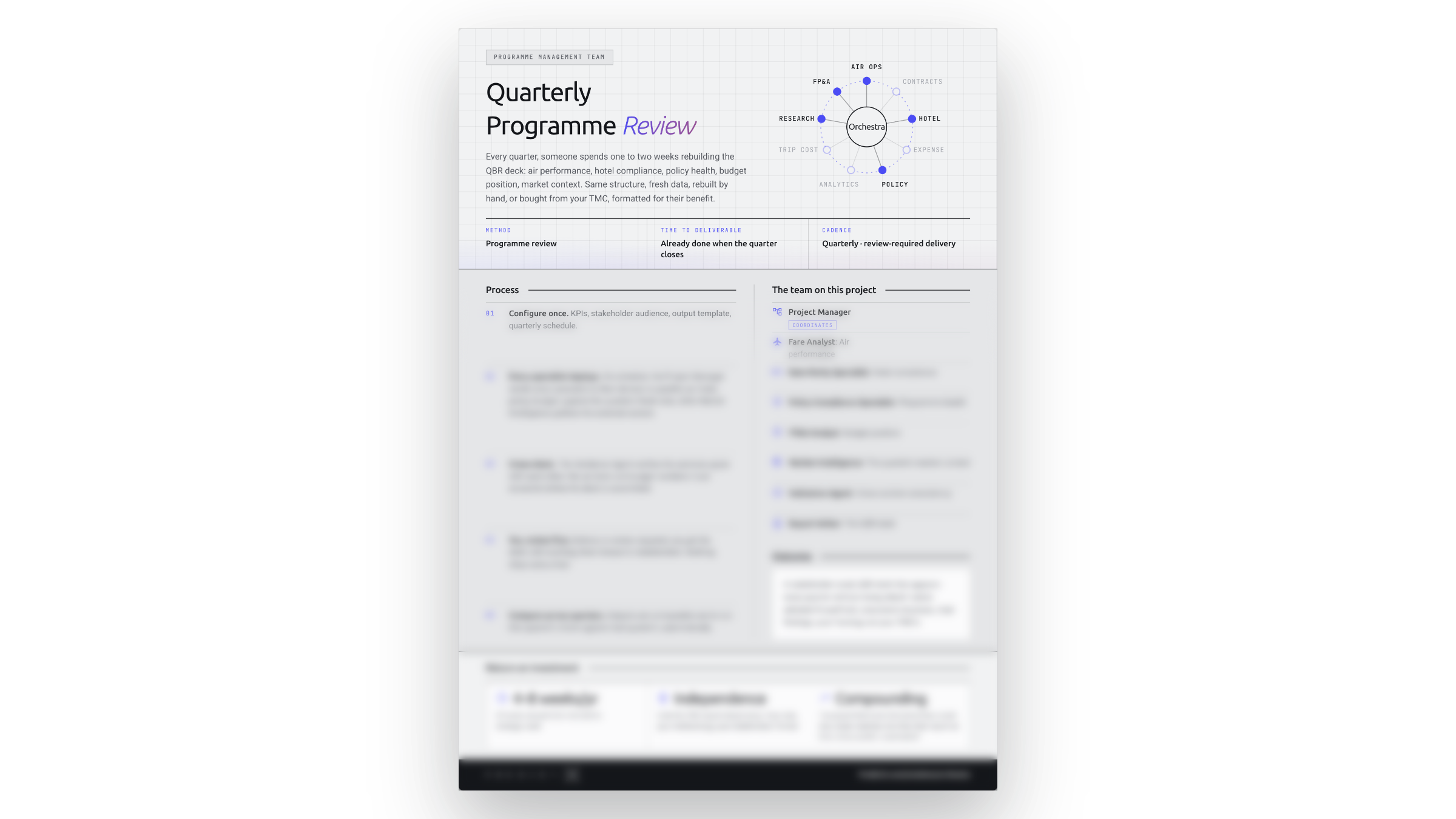
A quarterly business review, or QBR, is the quarterly report a corporate travel programme gives its stakeholders: air performance, hotel compliance, policy health, budget position and the market context behind them. Most programmes rebuild that deck by hand every quarter, or receive it from the TMC whose performance it is meant to examine. In this Orchestra project, an AI agent team rebuilds the deck on schedule from your own data, and a human reviews, edits and releases it.
The QBR deck, rebuilt by hand every quarter
Every quarter, someone spends one to two weeks rebuilding the same deck: same structure, fresh data, formatted by hand. Or it arrives from the TMC, formatted for their benefit, which leaves the supplier marking its own homework. Neither is a failure of effort. The review is structured, repeatable work, and structured, repeatable work is what an agent team is for. This project is one of five examples on the multi agent orchestration one-pager.
What is on the sheet
The process, in five steps
Configure once: KPIs, stakeholder audience, output template, quarterly schedule. From then on the project runs on that schedule: every specialist deploys in parallel, the sections are cross-checked, the draft comes to you first, and each quarter's output compares with the last.
The team on the bench
All eight roles with their scope: the Project Manager coordinating, Fare Analyst on air performance, Rate-Parity Specialist on hotel compliance, Policy Compliance Specialist on programme health, FP&A Analyst on budget position, Market Intelligence on the quarter's market context, Validation Agent on cross-section consistency, Report Writer on the deck itself. The bench comes from Orchestra, the AI agent team.
The cross-check
Before assembly, the Validation Agent verifies the sections agree with each other: the air, hotel and budget numbers must reconcile. A deck that disagrees with itself never leaves the workspace.
The deliverable and the return
A stakeholder-ready QBR deck in native, editable PowerPoint: consistent structure, cited findings, your framing rather than your TMC's. The return band: four to eight weeks of senior analyst time a year, independence from supplier-formatted reporting, and comparability that compounds quarter on quarter. Time and return figures are based on enterprise deployment patterns, individual results vary.
How the full bench runs a travel programme review
On schedule, the Project Manager sends every specialist to its domain in parallel, air, hotel, policy and budget, against the quarter's fresh data, while Market Intelligence gathers the external context. The Validation Agent reconciles the sections, the Report Writer assembles the deck, and you get the draft first: edit anything, then release it to stakeholders. Outputs are comparable run to run, so this quarter's charts sit against last quarter's automatically. The rebuild disappears. The review stays yours.
Can AI prepare a quarterly business review automatically?
Yes, when it runs as a scheduled project rather than a prompt. In this Orchestra project the deck is already done when the quarter closes: the full agent bench rebuilds it against the quarter's fresh data, the Validation Agent reconciles the sections, and delivery is review-required, so a human edits and releases every deck. Nothing ships untouched.
Who this is for
- Heads of travel who lose one to two weeks every quarter to the deck rebuild
- Programme managers who receive the TMC's deck and cannot independently verify it
- FP&A and finance partners who need the air, hotel and budget sections to reconcile
- Anyone presenting to stakeholders whose story resets every quarter because no two decks compare
Frequently asked questions
What is a QBR?
QBR stands for quarterly business review. Most guidance online covers the customer-success meaning, a vendor reviewing an account it serves. In corporate travel it is the quarterly report of programme performance to stakeholders: air, hotel, policy, budget and market context. Same abbreviation, different deck, and this sheet covers the travel one.
What should a travel programme QBR include?
Air performance, hotel compliance, policy health, budget position and the quarter's market context, in a structure that repeats so results compare across quarters. That consistency is the point of a quarterly business review template: here the output template is configured once, with KPIs and stakeholder audience, then refreshed with each quarter's data.
How long does it take to build a QBR deck?
Rebuilt by hand from supplier reports, typically one to two weeks each quarter. In this project the deck is already done when the quarter closes: the bench runs on the quarterly schedule, and what lands on your desk is a draft to edit, not a fortnight of assembly.
What is the difference between a QBR and an annual programme review?
Cadence, and what cadence makes possible. An annual review is a retrospective; by the time it lands, three quarters of decisions are already taken. A quarterly business review arrives often enough to steer the programme, and because outputs here are comparable run to run, each quarter's deck builds on the last. Shorten the cycle again and the same effect compounds, which is the argument behind monthly executive reporting for a travel programme.