

Your next travel policy change, tested before it lands.
Meridian by PredictX is travel policy intelligence software: it turns your travel and expense policy into a working model of your programme.

PredictX works with 4 of the 6 largest global T&E programmes and won gold for AI Innovation at the Business Travel Awards Europe 2026.
What is a travel policy?
A travel policy is the set of rules a company sets for how its employees book, take and pay for business travel: which cabin they fly, what a hotel night may cost, when the train replaces a flight and what can be claimed back.
Most organisations call it a corporate travel policy or a travel and expense policy.
Changing one means answering to finance for the cost and to your travellers for the rules. In GBTA's January 2026 poll, 59% of travel buyers named balancing cost controls with traveller satisfaction as a big or major challenge for 2026.
"Even if your goal is to save money, the biggest impact on that is the behaviour of your travellers. A better hotel rate is good. But travellers staying at the most expensive hotel, or booking outside the programme, move spend massively more."
What is travel policy simulation?
Travel policy simulation is testing a rule change on your own travel data before it takes effect. Keep every other rule as it is, move one, and compare cost, CO2 and traveller impact before and after.
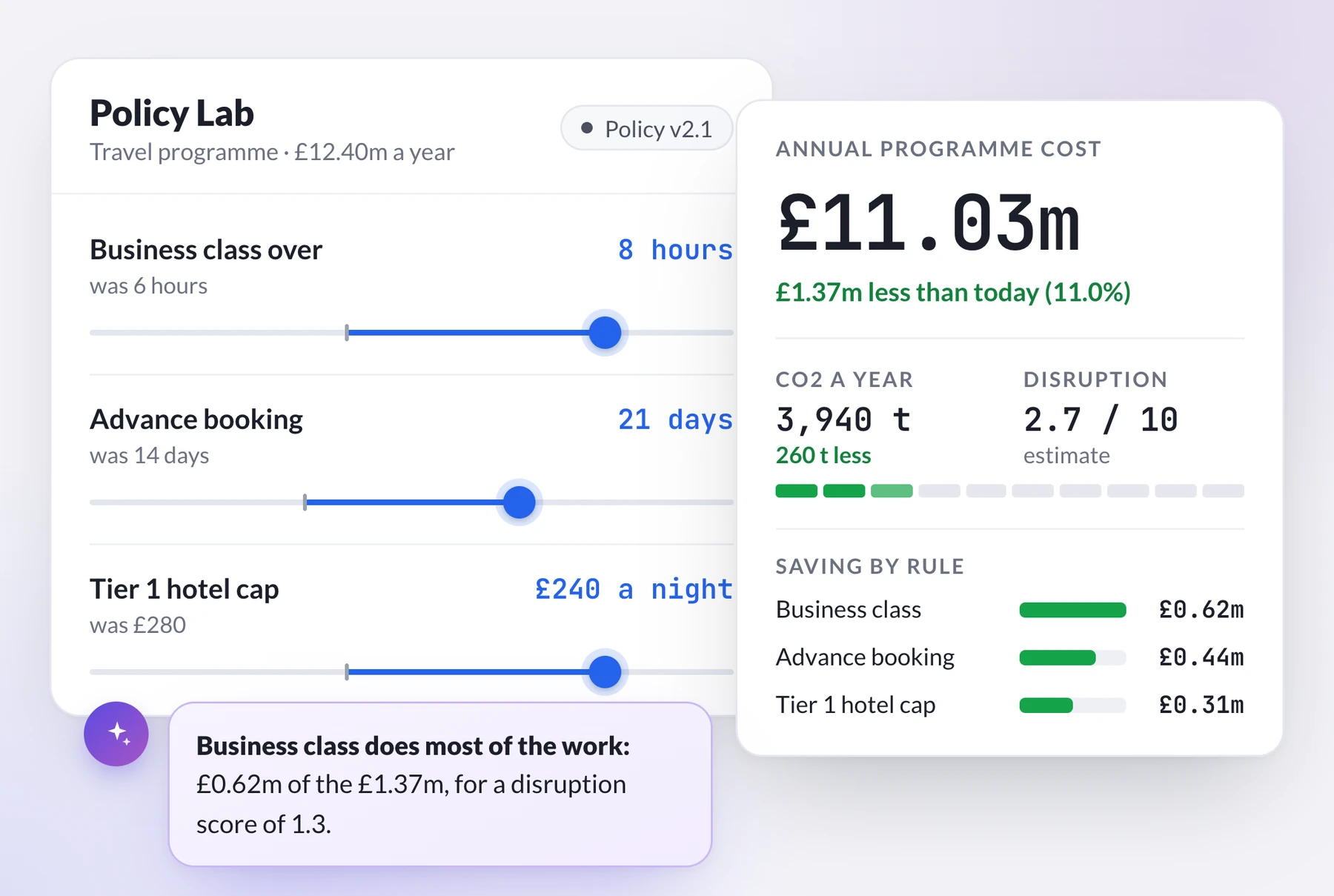
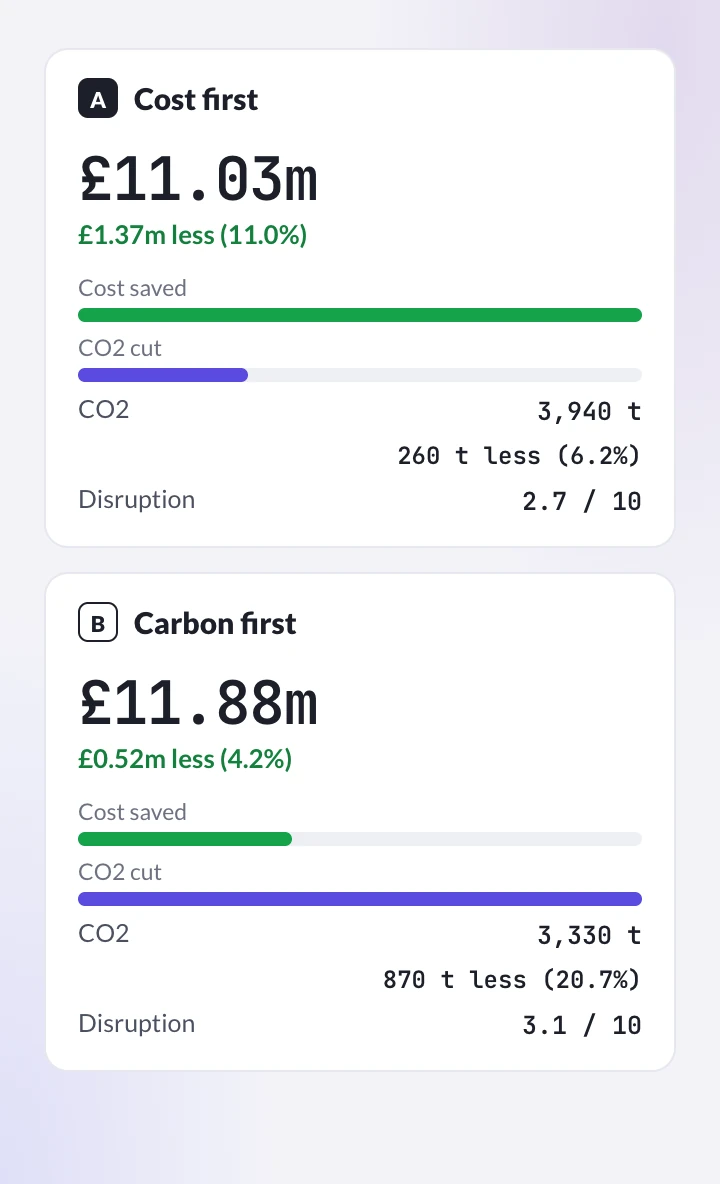
Meridian's Policy Lab runs the simulation on your route-level fares, hotel rates and trip volumes and shows each rule's share of the saving. Save versions as scenarios: cost-first, carbon-first, and the one finance will sign off.
Worked example
- Example programme
- £12.40m a year in travel, 4,200 t of CO2
- The rule
- business class on flights over 8 hours, up from 6
- Cost
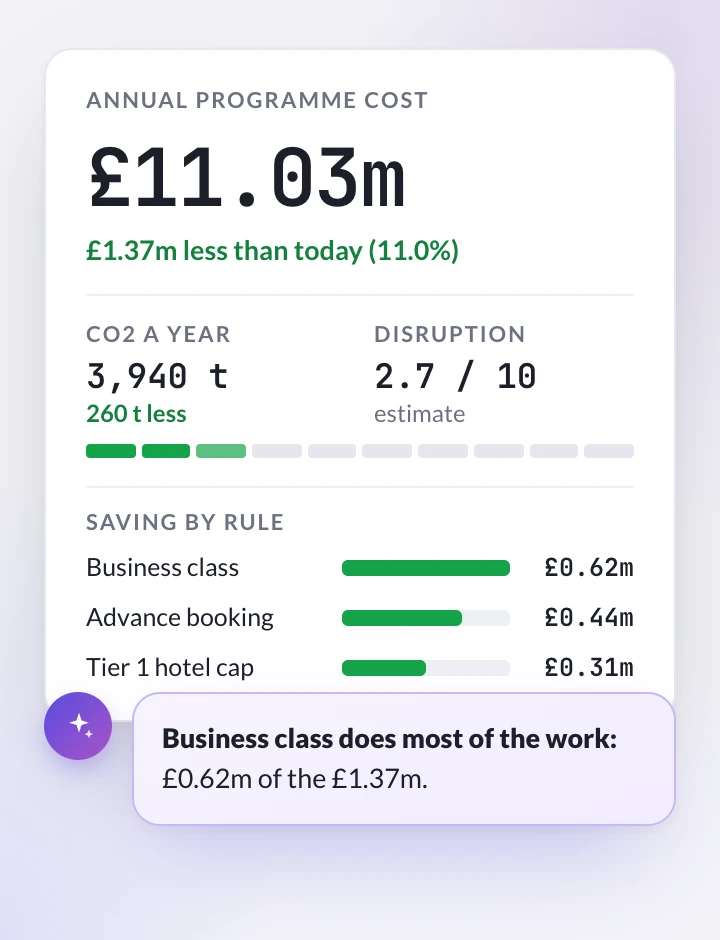
- £0.62m less a year, 5.0% of the programme
- CO2
- 260 t less a year
- Disruption score
- 1.3 out of 10, an estimate of traveller impact
- Against peers
- from generous to in line with the median of its peers
Not a forecast for your programme.
Try it on a sample programme
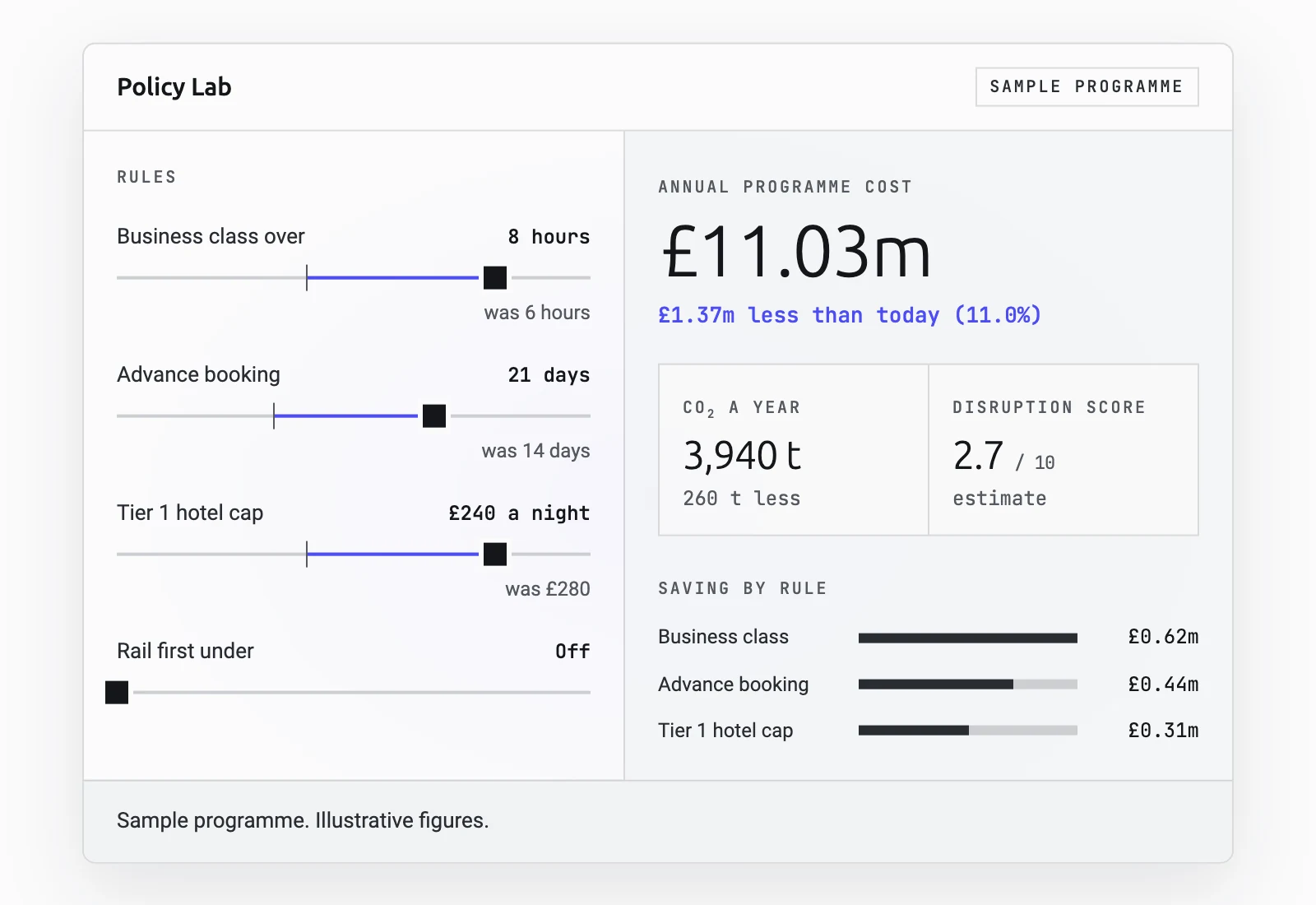
Sample dataMove any rule to see the effect.
Rules
What changes
Annual programme cost
from
CO2 a year
from
Disruption score
estimate
Saving by rule
Disruption limit in this sample:
This sample model needs JavaScript to run.
Sample programme with illustrative figures. Not a forecast for your programme.
New to PredictX? Meridian starts from benchmark-based assumptions until your travel data is connected.
For a directional figure on one rule, try the policy simulation calculator.
Run this on a programme like mine →Which travel policy rules can you test before you change them?
You can test any rule in these eight families before it changes, from cabin class and hotel caps to approval thresholds and carbon budgets.
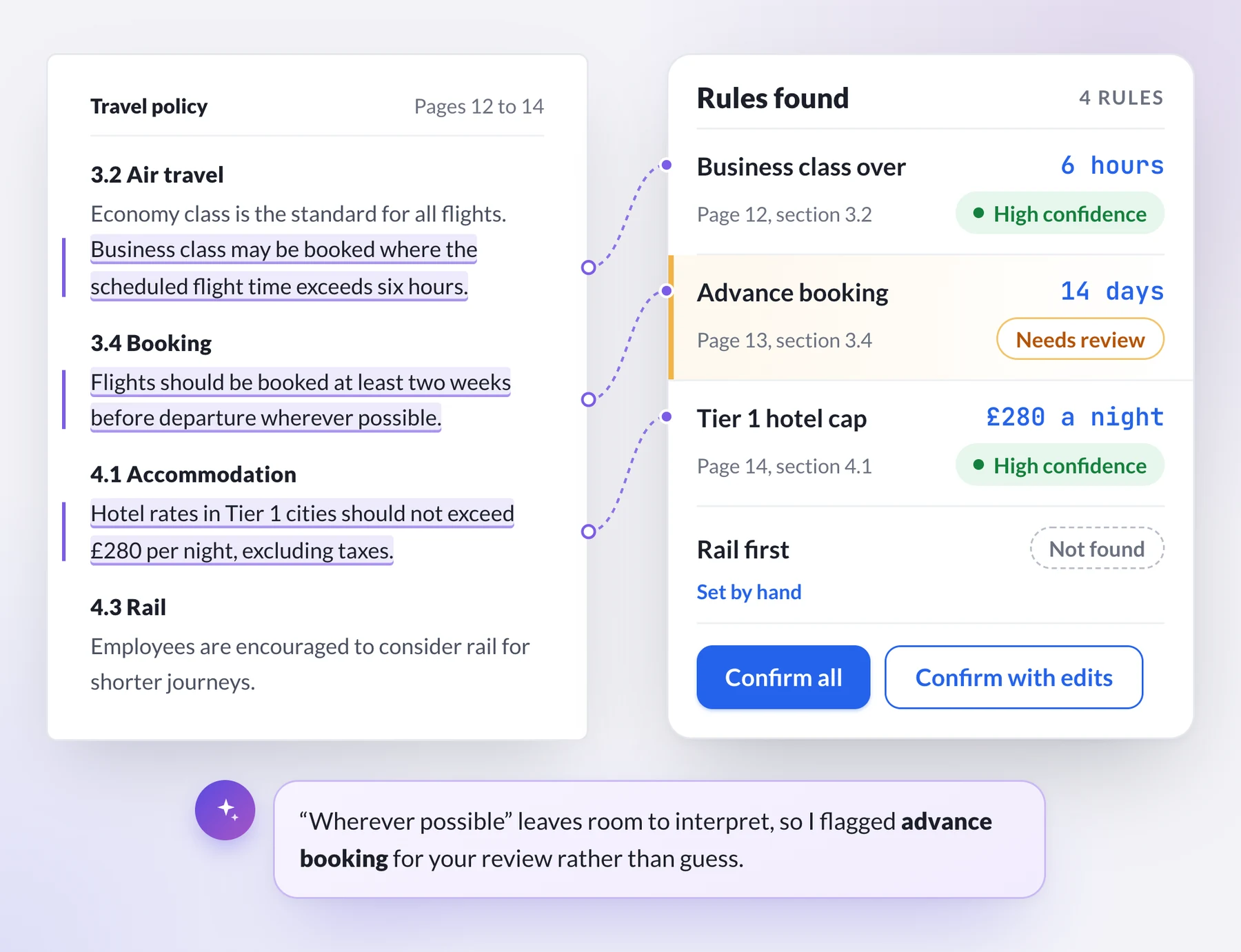
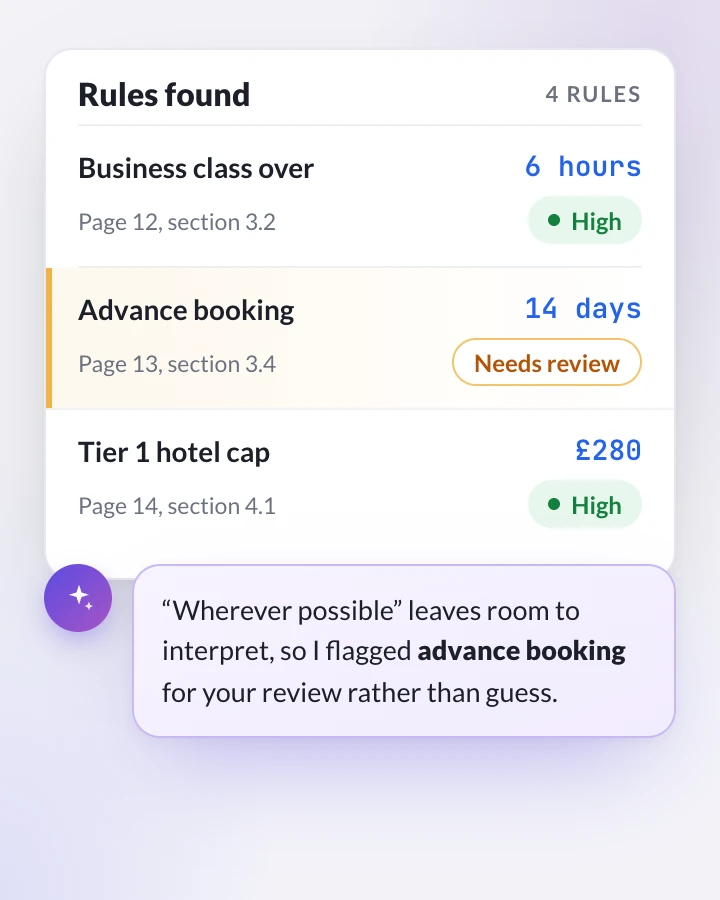
Upload the company travel policy, or the travel and expenses policy it sits in, and Meridian reads these rules out of it, for your team to confirm.
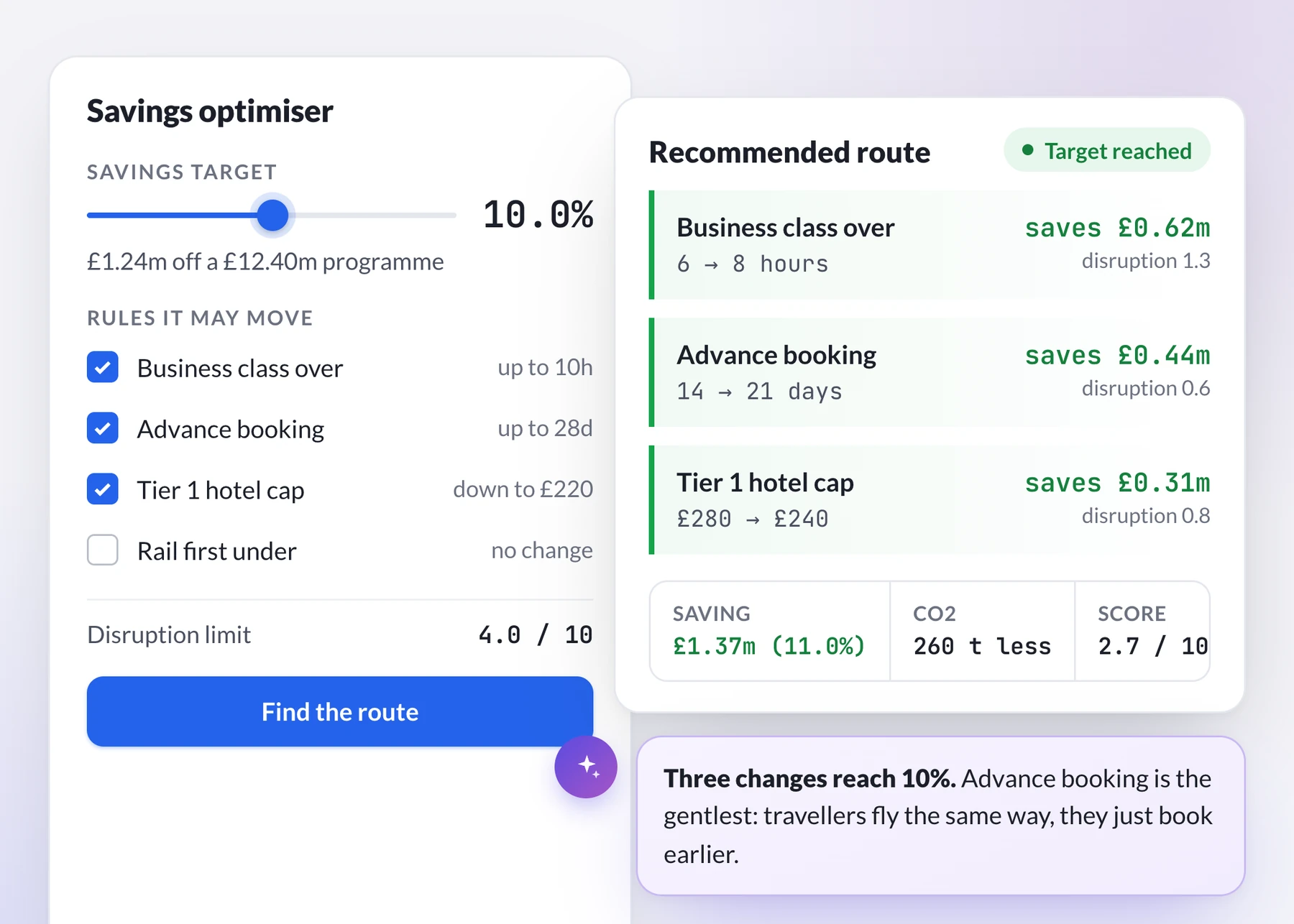
Name the saving you need. Meridian finds the gentlest route.
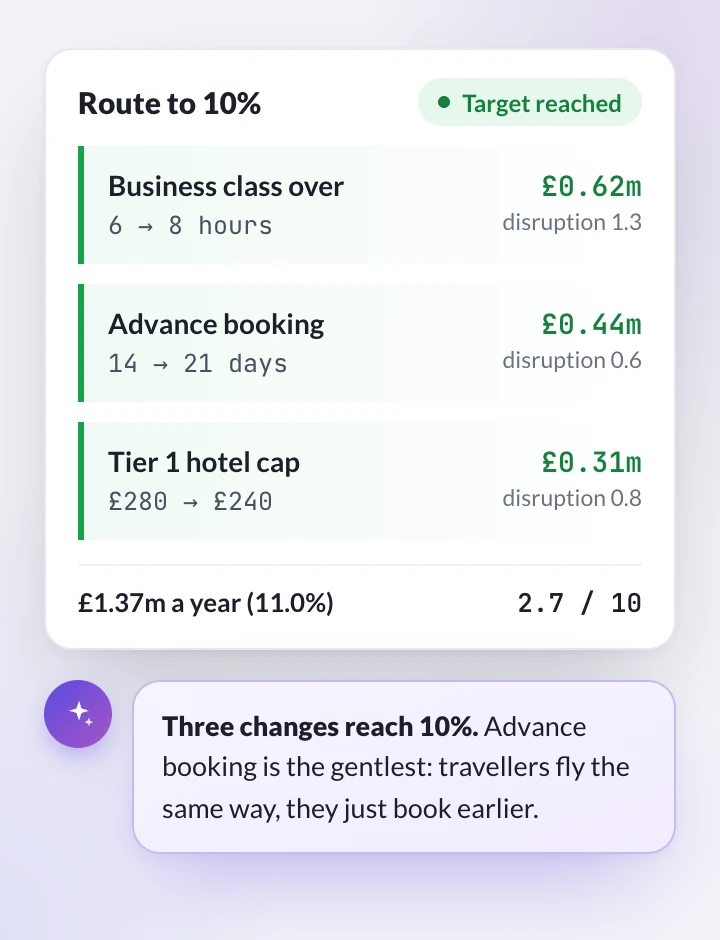
Meridian's savings optimiser works back from a target, such as 10% off annual programme cost, and finds the combination of travel policy rule changes that reaches it while asking least of the people who travel. You set how much traveller impact you'll accept.
- It moves only the rules you allow, within limits you set, such as never below premium economy on long-haul.
- Each recommended change carries a disruption score from 0 to 10, an estimate of how much travellers will feel it.
- If the target can't be reached, it says so, shows the most it can find and names the limit standing in the way.
Finance names the number. You arrive with the route to it.
How does your travel policy compare with other companies?
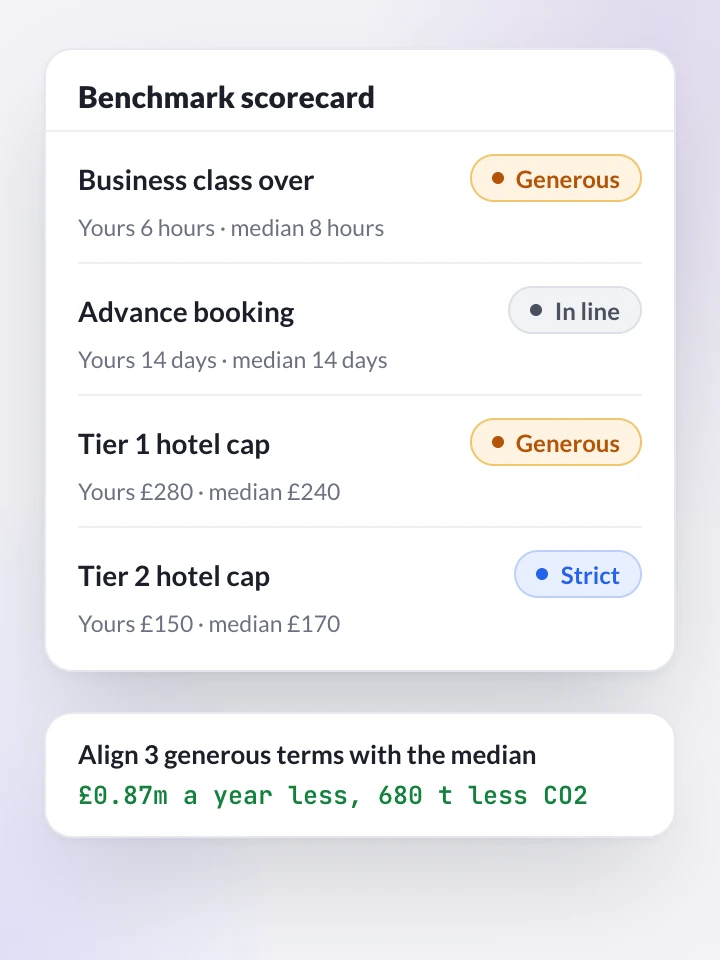
Meridian rates each term in your travel policy as generous, in line or strict against anonymised peer programmes, using the rules other organisations set and what they pay for equivalent trips on routes and in cities like yours.
Comparing notes with fellow travel managers only goes so far. Meridian sets each term against the peer median and the middle half of peers, and one click prices what aligning every generous term with the median would save, rule by rule. A generous term is paid for on every trip it covers, for as long as it stays.
The benchmark shows its method on screen: no comparison draws on fewer than five programmes, no company can be identified, and each comparison says how many programmes stand behind it. Narrow the peer group by sector, size or region; where too few travel programmes match, Meridian says so and widens it.
See where a policy like mine sits →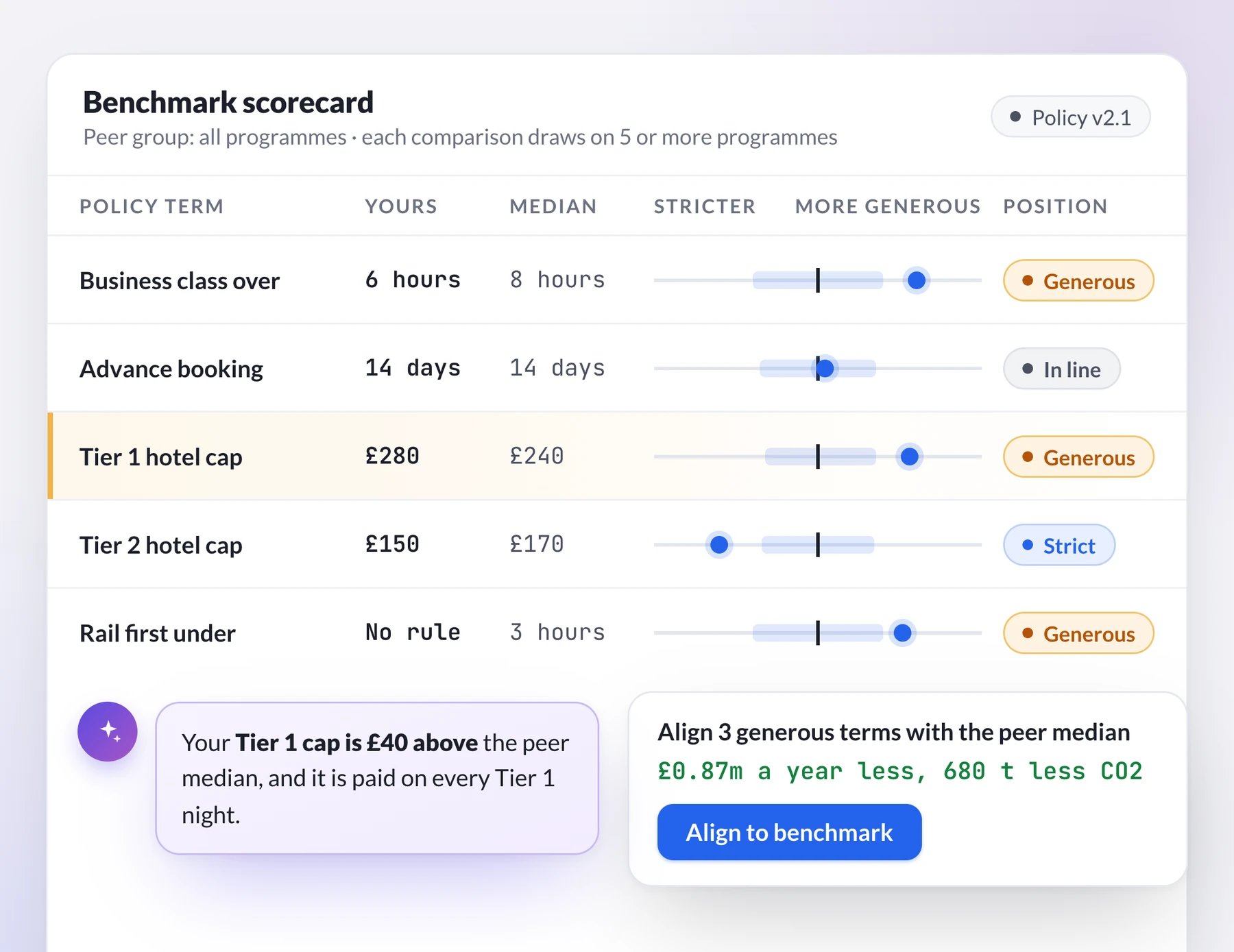
The carbon a rule cuts, beside what it costs.
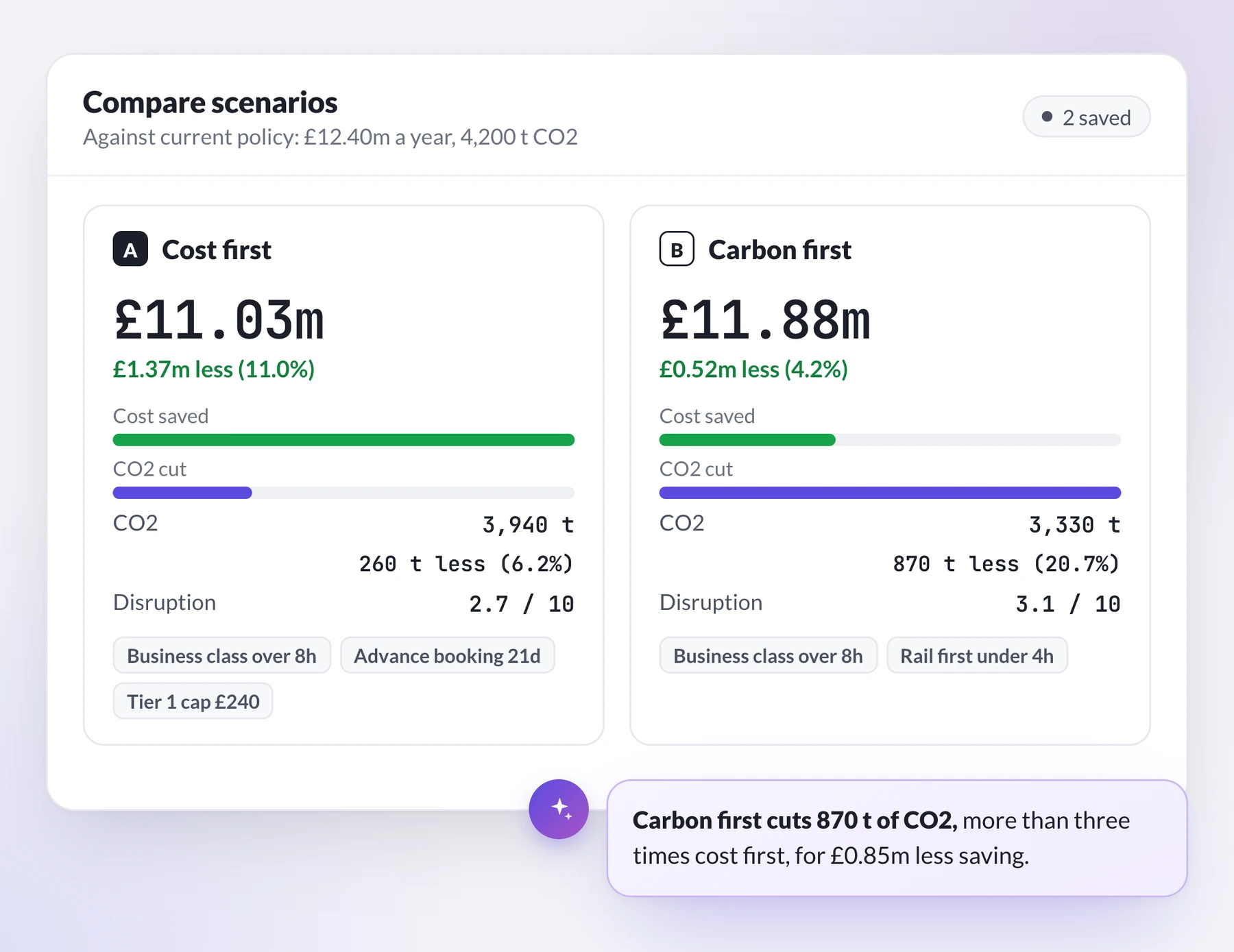
Travel policy rules such as rail for short trips and cabin limits on shorter flights cut business travel CO2, and each of them moves cost too, up or down. In Deloitte's 2025 corporate travel study, 48% of US travel managers named sustainability commitments among the top three factors restricting travel, up from 38% in 2024.
Meridian puts CO2, calculated with DEFRA methodology, beside cost in every policy scenario. Set a CO2 ceiling and Meridian finds the cheapest rules that stay under it. Measuring and reporting business travel emissions belongs to PredictX's corporate travel sustainability product; Meridian models the decision that comes before.
Companies reporting under the EU's CSRD disclose business travel emissions where they are significant, so a rule you adopt now shows up in your 2027 figures.
How do you show the CFO what a travel policy change will save?
Show the CFO a saving with its workings: every number in Meridian by PredictX traces back to the fares, hotel rates, trip volumes and policy terms behind it. Any scenario also exports as a business case in PDF or slides, with the saving, CO2, traveller impact and method set out.
Same inputs, same answer
The model returns the same result every time it sees the same inputs, so a figure checked once stays checked.
Confidence on every estimate
Each estimate carries a confidence rating based on how much data supports it.
Held to account afterwards
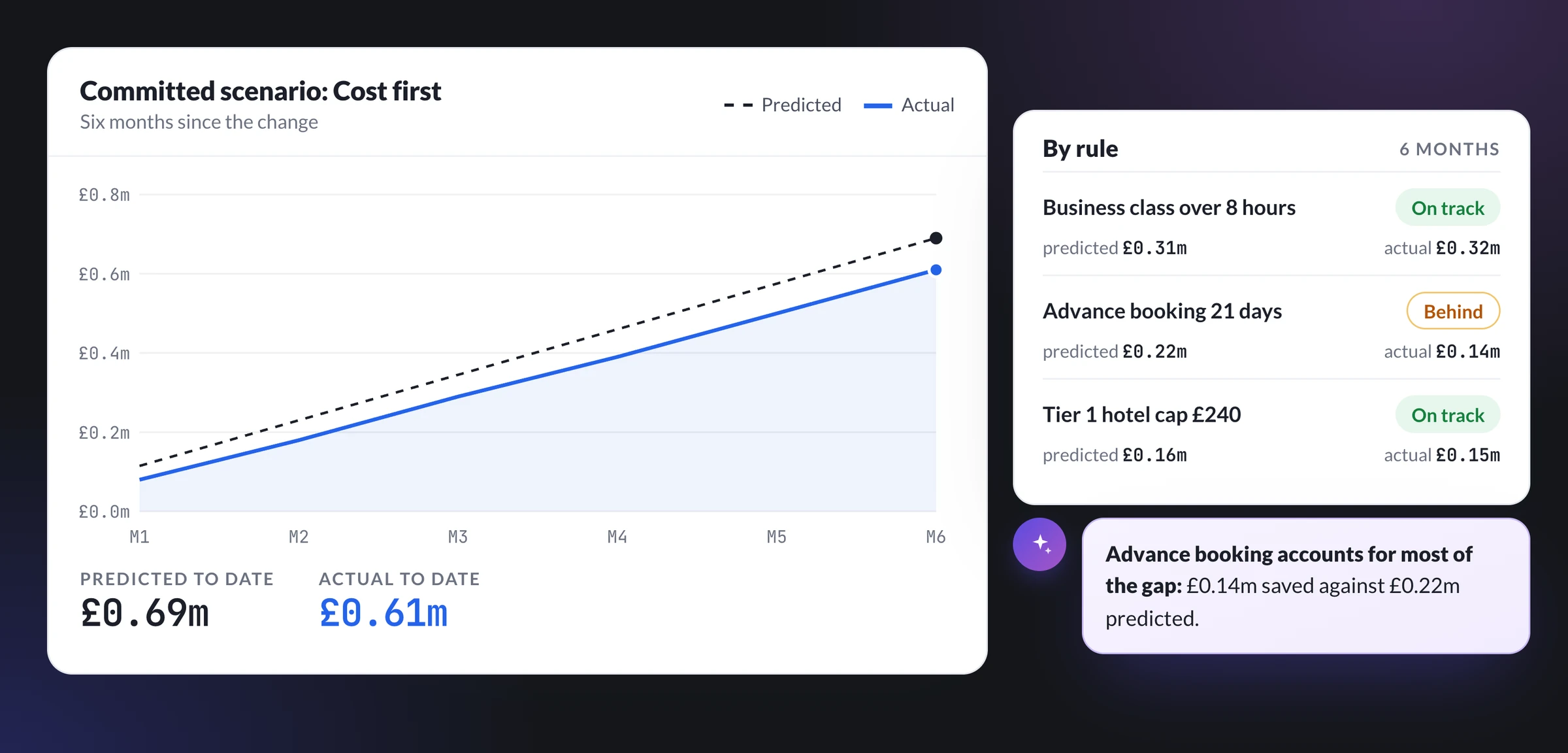
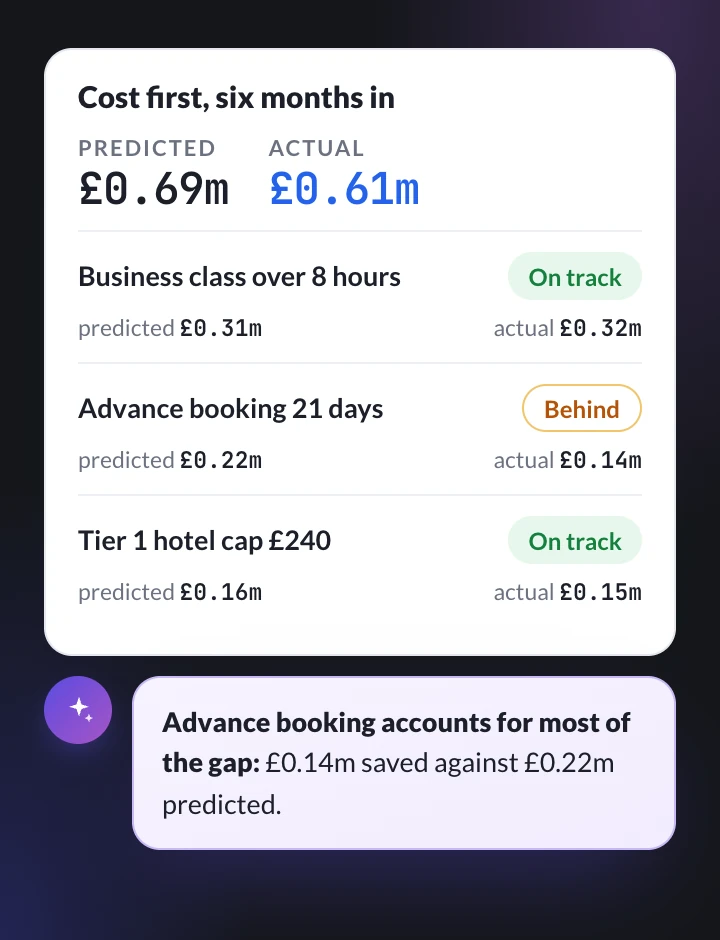
Commit to a scenario and Meridian tracks predicted savings against actual spend, rule by rule, so when finance asks whether the change saved, the answer has dates on it.
Once the new rules are live, DetectX's AI expense audit checks claims against them, showing whether spending follows the policy you designed.
Keep the tools you trust. Add the view they can't give you.
Meridian adds an independent model of your whole travel programme, compared with how other organisations travel, that you can rerun whenever the question changes.
PredictX, a travel and expense data intelligence company, doesn't sell travel or take bookings, so Meridian has no reason to favour one agency, channel or supplier. It sees bookings from every agency you connect, plus travel expensed outside them.
Questions about Meridian and your policy
How is our data protected in the benchmark?
Data reaches the benchmark only in anonymised, aggregated form, so no company can be identified in any comparison. Your own programme data stays isolated to your organisation, encrypted in transit and at rest, and every change, simulation and export is logged with who made it and when.
Should we require rail instead of flights on short routes, and what would it save?
Require rail where your route numbers support it: rail can cost more than the flight it replaces while cutting its CO2. In Meridian you set a rail-first threshold by travel time or distance and see the change in fares, CO2 and traveller impact first.
Can AI read our travel policy document and turn it into rules?
Meridian by PredictX uses AI to read a travel policy uploaded as a PDF, Word or text file and turn the rules it can quantify into settings you can test and benchmark. It handles regional versions and other languages, and you can set any rule by hand or start from a PredictX baseline or industry template.
How do we know the AI read our travel policy correctly?
Your team checks every rule Meridian reads before it counts. Each extracted rule sits beside the sentence it came from, with its page, section and a confidence rating. Meridian flags uncertain rules for review, marks anything it could not find, and saves nothing until your team confirms it.
Which teams will a travel policy change affect most?
Meridian shows which teams a travel policy change lands on before it happens, by business unit, department or cost centre, where your organisation data is connected. You see each unit's cost and share of the saving, so if a business class rule falls mostly on one sales team, you can prepare that conversation early.
What is the difference between modelling a travel policy and checking expenses against it?
Modelling a business travel policy happens before a change and estimates what new rules will do to cost, CO2 and travellers. Checking compliance happens after the spend and tests each expense against the rules in force. Meridian does the first and DetectX the second, and DetectX findings inform your next policy change.
See your travel policy as a model, not a document.
Take finance a number you can defend, and your travellers a policy they can live with.
The walkthrough runs Meridian on a sample programme like yours: a rule change priced out, and the gentlest route to your savings target. PredictX clients see it on their own data.