What is a T&E policy simulation calculator?
A T&E policy simulation calculator is a tool that estimates the financial impact of a proposed travel and expense policy change by applying new parameters to historical booking data before the change goes live.
Most enterprise travel programmes are sitting on significant unmodelled savings. The reason is simpler: no one has a fast enough way to model it.
A T&E policy simulation calculator turns that into a maths problem instead.
A travel manager suspects a Business Class threshold change would save money. Leadership asks for a number. Three weeks later, the answer arrives, after the decision is already made. That is not a slow reporting cycle. It is a gap between the data your programme holds and the speed at which you can use it. And most teams just accept it
A T&E policy simulation calculator closes that gap, giving you a defensible, finance-ready answer in seconds.
See your exact saving in 10 seconds →
In This Article
- Why do manual policy change estimates fail?
- How does a T&E policy simulation calculator work?
- Try the T&E Policy Simulation Calculator
- Which policy changes can you simulate?
- What does good simulation accuracy look like?
- Frequently Asked Questions
Why do manual policy change estimates fail?
Manual travel and expense policy change estimates fail because they rely on incomplete data, analyst availability, and spreadsheet logic that was never built to answer the specific question being asked. For a full picture of how this fits within a mature travel and expense data analytics programme, the gap between data availability and decision speed is the defining challenge. Modern travel programmes that close this gap do so by replacing the analyst queue with agentic AI.
When modelling a policy change takes three weeks, most travel managers stop modelling. They default to last year's policy, roll it forward, and present that to finance as a plan. The analysis never happens. The saving never lands.
78% of travel buyers say cost control is their top strategic priority. 74% fear travel budgets will not keep pace with rising costs.
Source: GBTA Business Travel Industry Outlook Poll, Q4 2024
Global business travel spending reached $1.47 trillion in 2024 and is projected to surpass $2 trillion by 2028, making the cost of slow policy decisions compound year on year.
The data is there. The access speed is not.
A manual Business Class threshold estimate involves pulling a booking extract, filtering by cabin class, applying new parameters, aggregating by market, and building a stakeholder summary. Five steps, two to three weeks, and most teams never finish it.
In a medium-to-large enterprise, that process takes two to three weeks minimum. Most teams skip steps and call a rough version a plan.
As PredictX CEO Keesup Choe puts it: "While corporate travel has surged, many teams haven't been able to expand to meet this demand, amplifying the need for scalable, autonomous solutions like Cogent that can address these gaps efficiently."
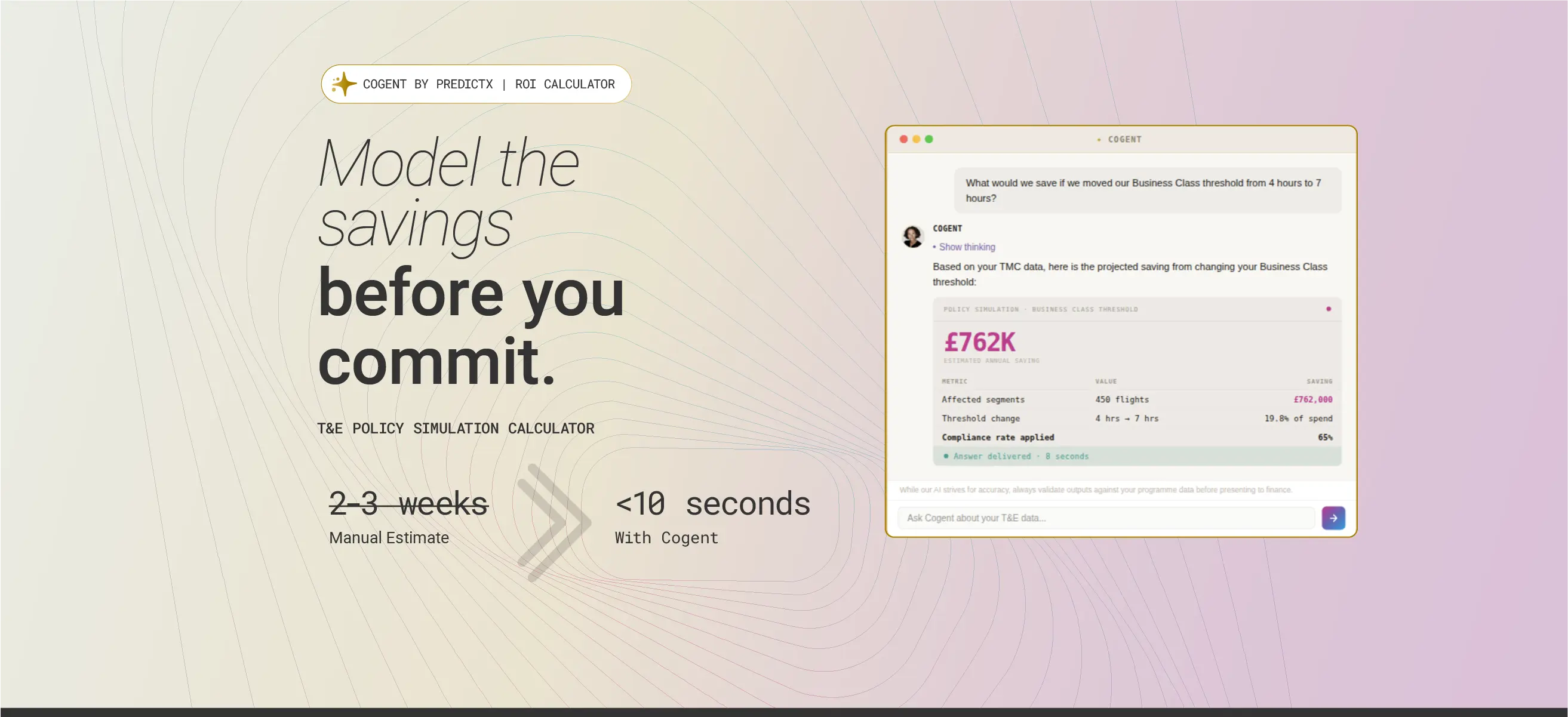
Real example: One of the largest enterprise corporate travel programmes currently using Cogent faced exactly this problem. Their travel manager needed to model the financial impact of changing the Business Class flight threshold from 4 hours to 7 hours. The platform retrieved the affected booking segments, broke down the projected savings by country across their global operation, and returned the raw underlying data for finance sign-off, all within a single conversation. The same analysis done manually would have required pulling TMC booking data, filtering by cabin class and duration across multiple markets, aggregating by country, and building a stakeholder summary. Realistically a two to three week project. With Cogent it took seconds.
How does a T&E policy simulation calculator work?
A T&E policy simulation calculator takes a policy input, retrieves the relevant booking segments from your consolidated travel and expense data, applies new parameters across those segments, and returns a projected financial outcome alongside the underlying data, in seconds.
Agentic AI is what makes this speed possible. It interprets the question, retrieves the data, applies the logic, and returns an auditable, finance-ready answer autonomously. No analyst queue. No data request. Every output includes the underlying segment data so finance can trace and validate the number.
Cogent was developed to solve the exact challenges travel managers face daily, with no heavy lifting required. Seamless results, faster decisions. -Keesup Choe, CEO, PredictX
The 4-Stage T&E Policy Simulation Process
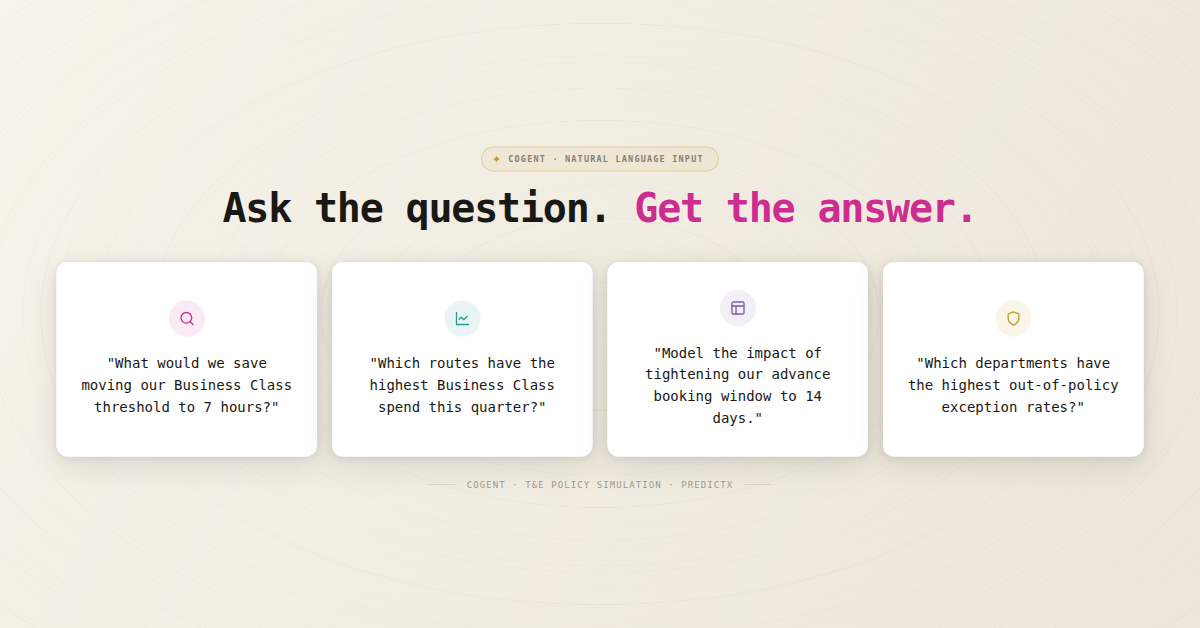
Stage 1: Policy input. Define current threshold, proposed threshold, applicable routes, and exception conditions. In Cogent this is a natural language question. In a standalone calculator, it is a form.
Stage 2: Segment retrieval. The platform queries your TMC booking data and filters for all flights falling between the current and proposed threshold, broken down by route, traveller, cost centre, and market, so finance can validate it.
Stage 3: Parameter application. New policy rules are applied to retrieved segments, covering the cabin downgrade percentage and fare differential between Business and Economy on the same routes.
Stage 4: Finance-ready output. Projected annual savings broken down by country and cost centre, plus the raw data export for sign-off. Outputs include raw segment-level data for validation, not just headline estimates. Three things every output must contain: the projected saving, the affected segment count, and a breakdown by market. An output showing only a headline number is not a simulation. It is a guess dressed in a calculator.
This is the difference between querying data and simulating outcomes. Most T&E reporting tools can show you what happened. Very few can model what will happen under new policy conditions.
For the full architecture behind the simulation capability, the modern edge of agentic AI in travel management covers it in depth.
Try the T&E Policy Simulation Calculator
Most teams never run this analysis. This is the fastest way to get the number before leadership asks for it.
Your policy change is already worth running. The only question is whether you know the saving before or after the meeting.
The calculator below gives you a directional number in seconds. When you are ready to see your actual saving on your live TMC data, calculate your real policy impact with Cogent.
You do not need perfect data to get a directional answer. But the closer your data is to production-grade, the closer your output gets to finance-ready.
Which policy changes can you simulate?
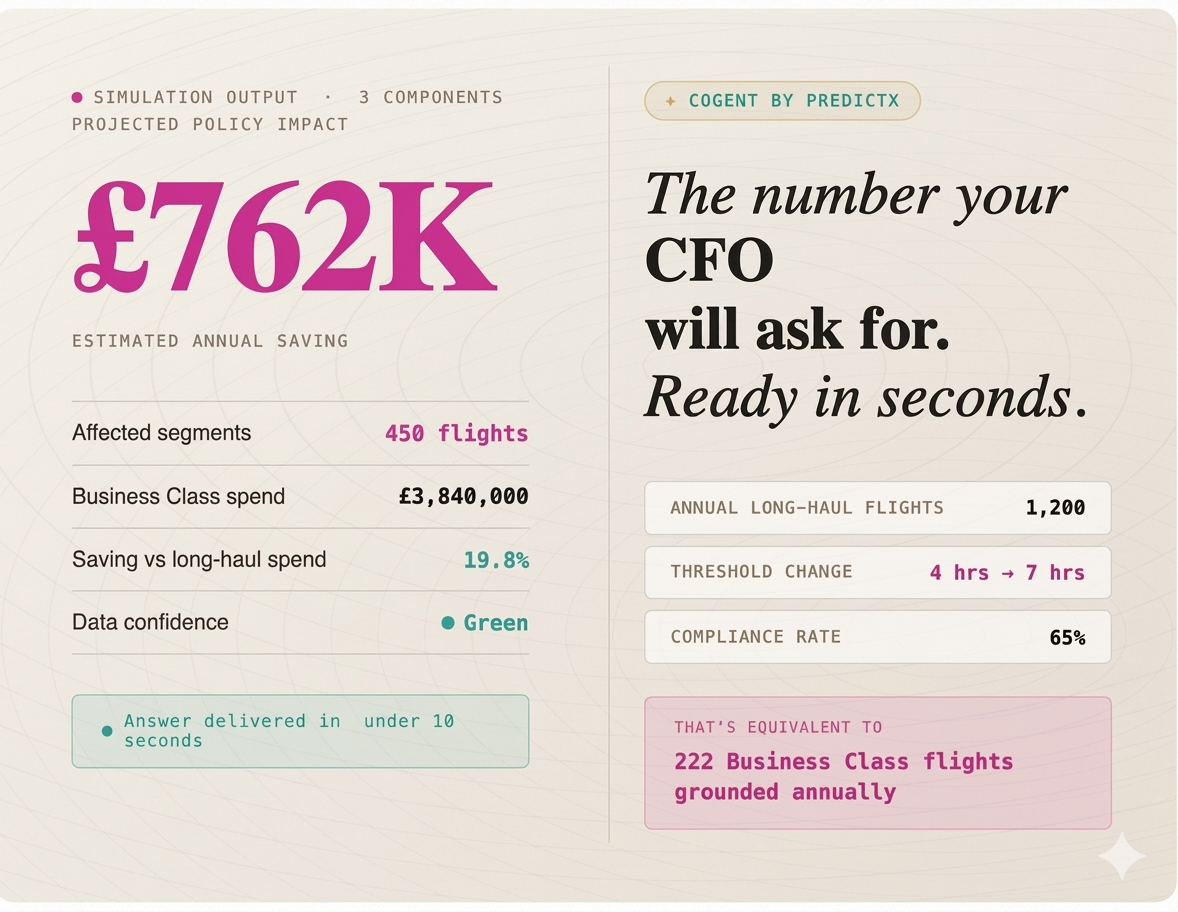
The highest-value T&E policy simulations are Business Class threshold changes, advance booking window adjustments, hotel rate cap revisions, and out-of-policy exception rate tightening, each directly reducing corporate travel spend and strengthening corporate travel compliance without restricting necessary travel.
According to Statista's corporate travel market data, air alone accounts for over 40% of managed travel spend in enterprise programmes, which is why Business Class threshold changes produce the largest single-query saving estimates. They are also the policy change most often left unchanged because the modelling burden makes the analysis feel too costly to start. Modern travel programmes use simulation as a standard step before any policy goes to finance.
In enterprise programmes, even a one-hour shift in Business Class eligibility can affect hundreds of long-haul segments annually. That is the scale of what goes unmodelled when the analysis takes three weeks.
For example, if your programme runs 500 long-haul segments annually and the average Business Class versus Economy fare difference is £1,200, even a 50% compliant shift affects £300,000 of spend in a single policy change. That number is calculable in seconds. Most teams never calculate it at all. Yet it is the most actionable output trip analytics can produce for a finance audience.
The four inputs that determine simulation accuracy are:
- Cabin class codes: consistent across direct, OBT, and agent-assisted channels
- Flight duration data: populated in the TMC feed, not only in the airline record
- Fare data: actual fare paid alongside available Economy fare on the same itinerary
- Compliance rate: judgment input; industry benchmark is 50 to 65% per GBTA 2025
For teams structuring their queries to get the most accurate simulation output, the PredictX prompt engineering guide for T&E walks through the exact technique. Programmes with strong corporate travel compliance records will find their historical exception data is the most valuable input of all.
What does good simulation accuracy look like?
A Cogent T&E policy simulation reflects your actual booking data, processed automatically through the PredictX ETL pipeline. The accuracy of the output scales with your programme size and booking volume, both of which Cogent surfaces in the result.
Most simulation errors are not data problems. They are behaviour problems.
McKinsey's State of AI 2025 found that organisations embedding AI into core decision workflows report two to three times faster cycle times on financial modelling tasks compared to those using traditional BI tools. Policy simulation is exactly that workflow.
The T&E Simulation Accuracy Framework
Cogent processes your TMC data automatically through the PredictX ETL pipeline. Data from your travel management company is ingested, normalised, and made queryable before you run a single simulation. No manual cleaning, no extract requests, no analyst queue. The confidence level of your output is determined by your programme's booking history, not by your data preparation. Larger programmes with longer booking histories return higher-confidence projections. Smaller or newer programmes return directional estimates that are still faster and more accurate than any manual model.
For the full range of use cases where Cogent applies, 6 powerful Cogent use cases for T&E reporting covers each one.
Key takeaway A T&E policy simulation calculator closes the gap between travel and expense data and travel decisions by applying proposed policy parameters to live booking data in seconds. Programmes that simulate before they change policy stop making budget commitments on gut feel and start making them on data.
Modern travel programmes can answer this question in under 10 seconds. If yours cannot, your T&E reporting is not working for you: what would you save if you changed your Business Class policy today? Run a Cogent policy simulation on your actual booking data and walk into your next stakeholder meeting with a number finance cannot challenge.
Most teams guess. You do not have to.
Frequently Asked Questions
What is a T&E policy simulation calculator?
A T&E policy simulation calculator estimates the financial impact of a proposed travel and expense policy change by applying new parameters to historical booking data before the change is implemented. It calculates projected savings, identifies affected booking segments, and flags data quality issues that could distort the estimate. Unlike standard T&E reporting dashboards, it is forward-looking rather than retrospective.
How accurate is a Business Class threshold simulation?
Business Class threshold simulations return a projected saving based on your actual booking data, processed through the PredictX ETL pipeline. The main variable is compliance: the proportion of travellers who accept Economy once the threshold changes. Using prior policy change data as the compliance baseline produces the most accurate output.
How long does a T&E policy simulation take?
With an agentic AI platform connected to live TMC data, a T&E policy simulation takes seconds. The same analysis done manually, pulling a booking extract, filtering for affected segments, applying new parameters across markets, and aggregating savings by country, takes a minimum of two to three weeks in a mid-to-large enterprise.
What is the difference between a T&E simulation and a T&E dashboard?
A T&E dashboard shows what happened in a historical period; a T&E simulation shows what would happen if a policy change were applied to that same data. Dashboards answer "What did we spend?" Simulations answer "What would we save?" For corporate travel compliance and budget planning, the simulation is the more useful tool.
What is the biggest mistake in T&E policy simulations?
Overestimating compliance. Most models assume behaviour changes instantly after a policy update. In reality, adoption lags. Travellers claim exceptions, managers approve them, and the actual saving in year one is often lower than the projected figure. Using prior policy change data as the compliance baseline matters far more than using an industry average.
Unlock Your T&E Advantage: Subscribe to PredictX in Focus Newsletter
🔔 Stay Ahead! Follow Us on LinkedIn for the Latest Innovations and Feature Updates to Enhance Your Travel Management Experience!
Related Posts
.webp)
Cogent Wins 2025 BTS Europe Innovation Faceoff: Setting a New Benchmark for AI-Driven Travel & Expense (T&E) Solutions

How Cogent’s Agentic AI Revolutionizes T&E Reporting with RAG
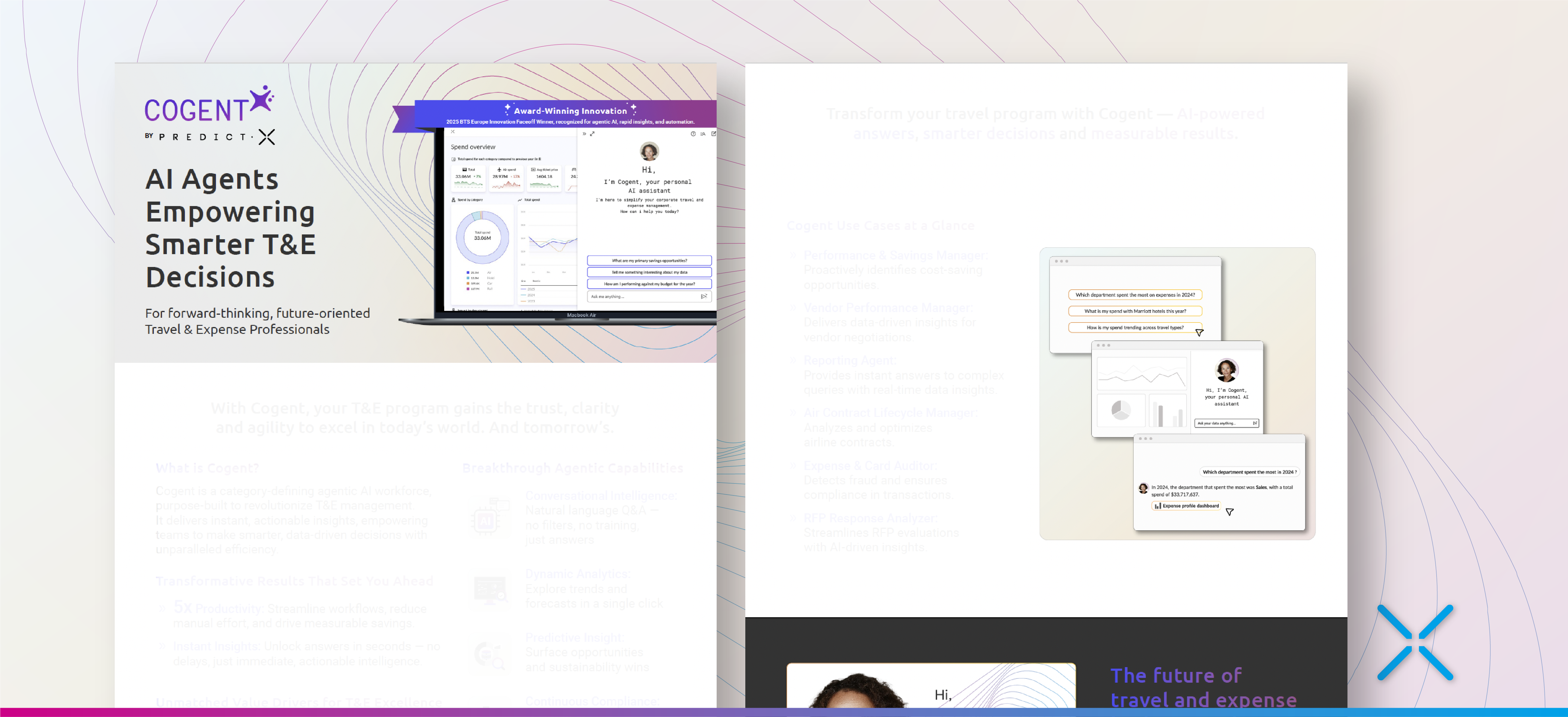
Product Sheet | Cogent - AI-Powered Travel and Expense (T&E) Reporting
Prompt Engineering for T&E: Mastering Cogent Agentic AI to Drive Savings

Transform Travel & Expense (T&E) Management with Cogent’s Agentic AI Solutions
The Ultimate Guide: What to Ask Your AI for Smarter T&E Reporting | Cogent Agentic AI
.webp)
Beyond Dashboards: Cogent - The Agentic AI Revolution in T&E Reporting & Expense Audit
The Future of T&E Reporting: A Conversation with Our CEO and BTN Group | Cogent Agentic AI
Hot List, Hot News: We've Been Named to the Tech Hotlist for Redefining Corporate Travel with Cogent Agentic AI
The T&E Manager of Tomorrow: How Cogent Agentic AI is Your Shortcut to Strategic Leadership in Corporate Travel
6 Powerful Cogent Use Cases for Travel & Expense (T&E) Reporting, Travel Data & Predictive Analytics with Agentic AI

Mastering the Future of Corporate Travel with Cogent Agentic AI: An Exclusive Interview with PredictX CEO Keesup Choe
Travel and Expense Data Analytics: How Enterprise Teams Use Agentic AI to Move From Reporting to Real Decisions