What does an air sourcing analysis actually include?
An air sourcing analysis benchmarks what a company pays to fly against what the market charges, then turns the gap into a negotiating position. A complete one covers route spend ranking, carrier portfolio, average ticket price versus market, fare parity, contract savings, advance purchase behaviour, cabin class mix and air leakage by city. It is one of the harder projects in corporate travel and expense management, because the answer depends on booking, contract and card data that rarely sit together. In this project, Orchestra, the AI agent team for travel and expense, planned it as 15 steps across five phases and ran it with five specialist agents on the Cogent agentic AI framework, with a human approving the plan before any step executed.
Most agent demos show you a chat window. This shows you the work.
You have probably watched an agent answer a question on stage. It is a good demo and it proves very little, because the hard part was never the answer. It was the fifteen steps behind it.
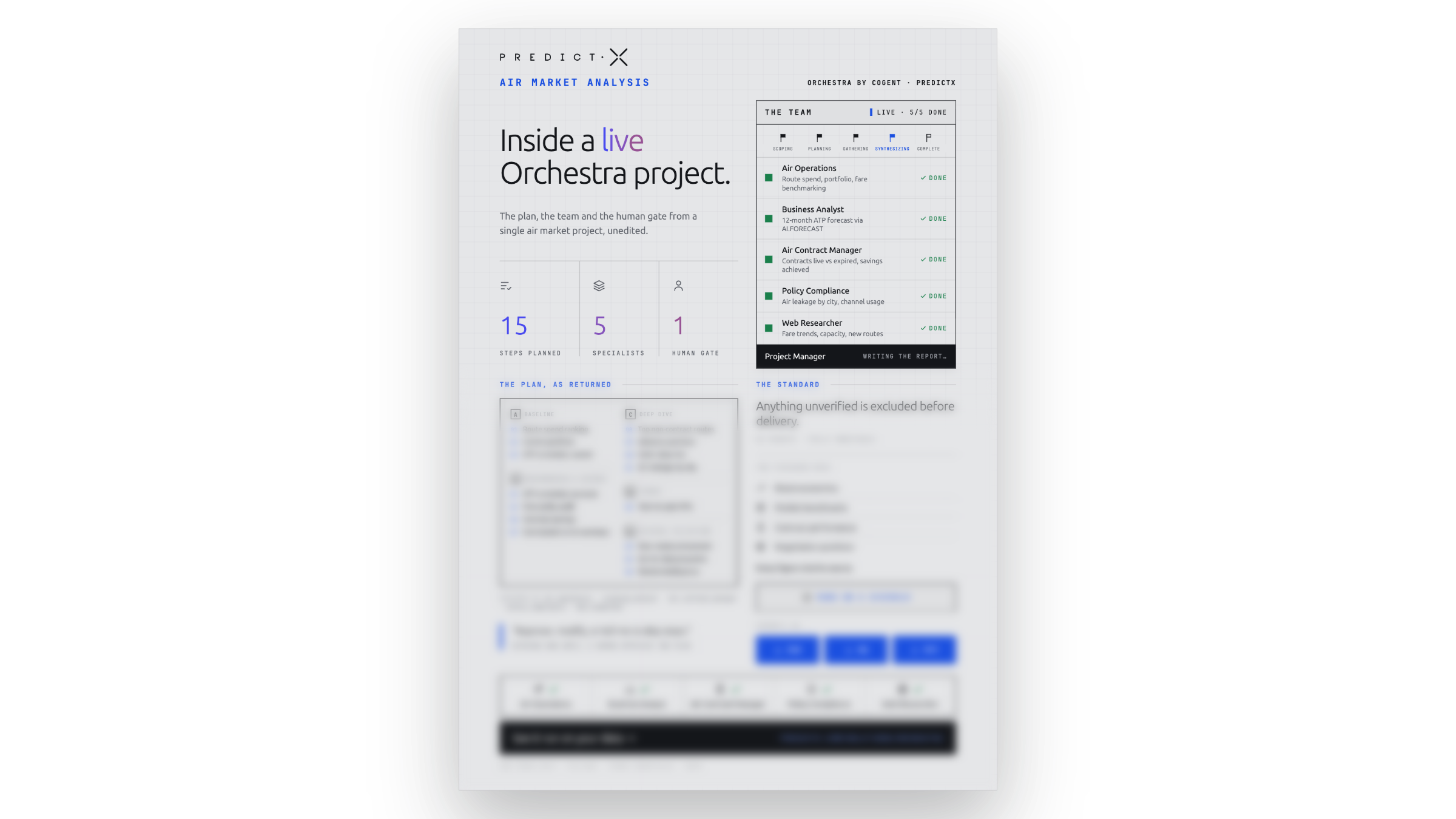
This sheet is one project, reproduced from the workspace. The plan as the team returned it. The specialists as they reported done. The gate where a person said go.
What is on the sheet
The plan, as returned
All 15 steps across five phases, from baseline route spend through benchmarking, route-level detail, trends and external validation. The plan arrived numbered and waiting for approval, not already running.
The team, live
Five specialists with their scope and status: air operations, business analyst, air contract manager, policy compliance and web researcher, with the project manager writing the report.
The human gate
The single approval point, and the exact wording the team returns: approve, modify, or skip steps.
The standard
Why anything unverified is excluded before delivery, and what the finished pack contains: route economics, market benchmarks, contract performance, a supplier scorecard and the negotiation positions a carrier renewal runs on.
How AI agent orchestration runs a sourcing project
Five specialists work in parallel rather than in sequence, each on the part of the air programme it knows. Air operations handles route spend and fare benchmarking. The business analyst produces the 12-month forecast. The air contract manager separates live carrier agreements from expired ones and calculates savings achieved. Policy compliance maps air leakage by city. The web researcher checks fare trends, capacity and new routes against the outside market.
This is a multi agent AI system applied to travel and expense work, not a single model answering a prompt. The project manager holds the plan together and writes the report. 61 events are logged and every figure is cited back to its source query. The pack exports as PDF, Markdown or PowerPoint, and the whole project can run again on a schedule.
Who this is for
- Air category managers and sourcing leads heading into a carrier renewal or an airline RFP
- Travel procurement teams who currently commission this analysis externally
- Heads of travel and travel and expense leads who want to see the working, not the summary
- Anyone evaluating agentic AI for corporate travel who is tired of demos and wants an artefact
Frequently asked questions
How long does an air market analysis take?
Manually, a project of this scope is typically two to three weeks of analyst time or an external consulting engagement. Orchestra returns the plan in seconds and executes it once a human approves. The wider argument for that shift is set out in the Orchestra whitepaper on autonomous AI agents.
Can AI prepare an airline contract negotiation?
It can prepare the position. The sheet shows contract savings, contracted versus non-contract routes, fare parity and advance purchase behaviour, which is the evidence base an airline RFP or carrier agreement renewal runs on. The negotiation itself stays human.
Does this work for hotel and ground as well as air?
Yes. Air is the example shown here because it is the most contract-heavy category, but the same sourcing automation runs across hotel, rail and ground. Hotel work starts with hotel attachment rate and the missing spend it exposes. Each category has its own methodology and its own specialist agents inside the same travel and expense workspace.
What stops the agents inventing figures?
Anything unverified is excluded before delivery. Every figure carries a citation back to the query that produced it, and all 61 events in this project are auditable.
Does this run on our own T&E data?
Yes. The same project runs against your air programme through the 200+ connectors Cogent, the PredictX agentic workspace, already maintains across TMCs, corporate cards, expense systems and GDS, and can be scheduled to re-run.