

What is T&E leakage detection?
T&E leakage detection is the practice of finding travel that was booked outside your preferred or approved channels, booked direct, on a consumer app, or expensed instead of booked, by reconciling TMC, card, and expense data so the off-channel spend is surfaced, named, and quantified. It is a channel-compliance problem, distinct from ancillary trip costs or booked-versus-billed gaps, which are expense-reconciliation matters.
Finding the Spend You Can't See: How Cogent Agentic AI Surfaces T&E Leakage in Seconds
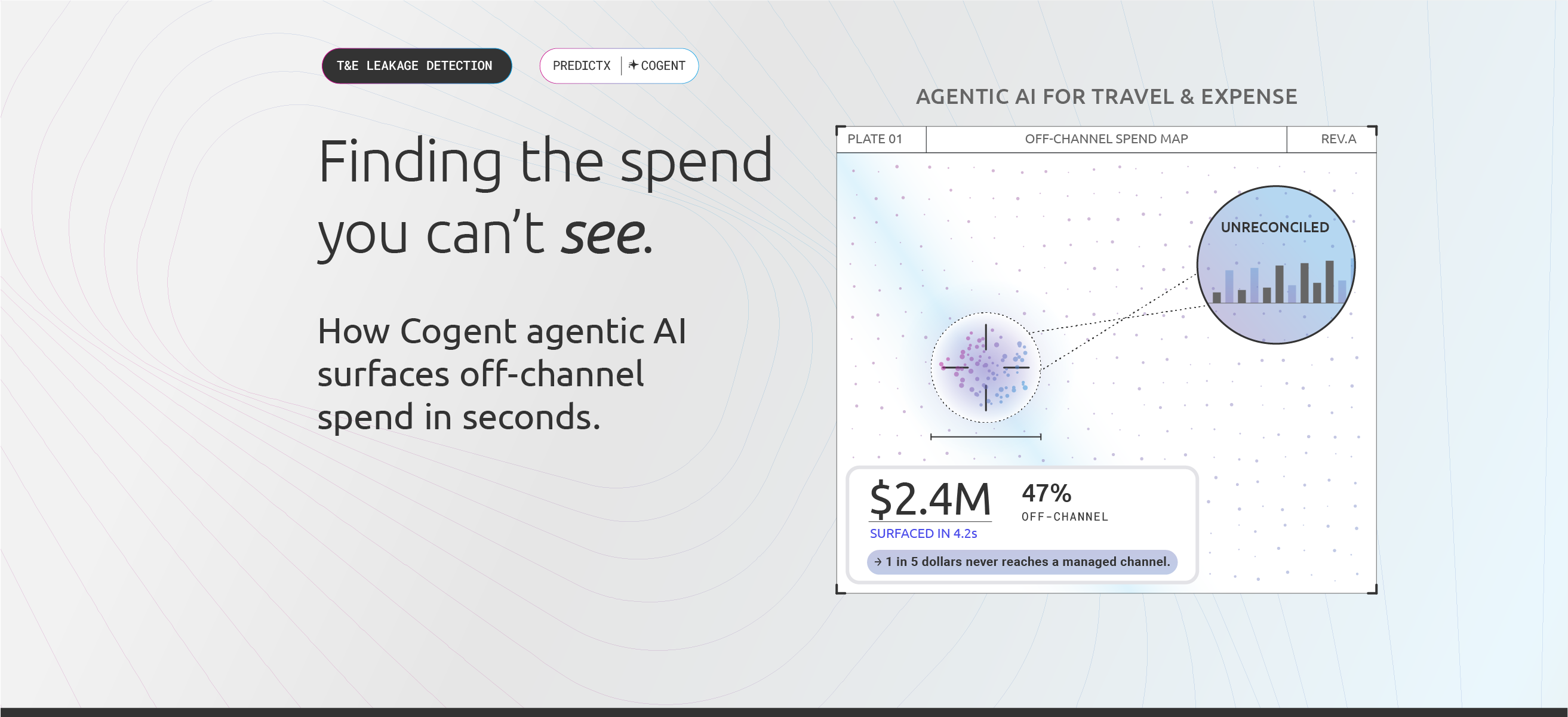
The spend you are not seeing is the spend that is hurting you. Most enterprises have somewhere between 10% and 30% of travel spend booked outside approved channels, and most programmes only discover it at quarterly review, once the money is already gone.
T&E leakage detection is how you close the gap between what your TMC sees and what your expense system sees. Nearly two-thirds of business travel spend sits outside any managed programme, according to Euromonitor International (2025). This guide explains what leakage looks like in 2026, why traditional reporting misses it, and how Cogent by PredictX, the agentic AI platform for travel and expense, surfaces non-compliant spend in seconds rather than weeks.
In This Article
- What does T&E leakage look like in 2026?
- Why does traditional reporting miss travel leakage?
- What does a cross-source leakage query look like?
- Which three leakage patterns does Cogent catch automatically?
- How does finding the number change the CFO conversation?
- How does Cogent surface leakage in seconds?
- Frequently Asked Questions
What does T&E leakage look like in 2026?
T&E leakage is travel spend that should have flowed through your managed programme but did not, showing up as off-channel hotel bookings, direct-booked flights, and expense-reimbursed travel that bypassed the booking tool. It is rarely fraud. It is mostly friction, and it is getting worse.
Three forms account for most of it:
- Hotel rooms booked outside HRS or your preferred agencies, usually direct with the property
- Air booked direct with a carrier instead of through the TMC, often after a schedule change
- Travel expensed as a claim when it should have been booked through the tool
In every case the defining feature is the same: a booking that bypassed the channel. That is what makes it leakage, not an ancillary charge on the trip or a gap between what was booked and what was billed, which are expense-reconciliation questions.
The trend is structural, not behavioural. Direct-booking platforms make it easier than ever to book around the programme, loyalty incentives reward travellers for doing so, and hybrid work has scattered trips across more bookers and more channels. For the underlying conceptual model, see PredictX's breakdown of what causes corporate travel leakage and its analysis of how leakage and invisible spending influence your programme.
Why does traditional reporting miss travel leakage?
Traditional reporting misses leakage because finding it means comparing two data sources, the TMC and the expense system, that rarely sit in the same dashboard. By the time an analyst has reconciled them across entities and currencies, the quarter is closed and the spend is unrecoverable.
The gap is mechanical. A TMC report only covers what the TMC processed, so a programme reporting 85% adoption may manage barely half its true travel spend. To see the rest, someone has to pull the booking feed, switch to the expense platform, cross-reference a card module, and align them by hand, none of which share a common identifier.
PredictX calls the compounding cost of that context-switching the Toggle Tax. The cost is not the hours spent switching; it is the decisions that never get made because the reconciliation takes longer than the decision window allows.
What stays invisible to a single-source view:
- Hotel rooms booked direct with the property instead of a preferred agency
- Flights rebooked directly with a carrier after a disruption
- Ground transport booked through a consumer app instead of an approved supplier
- Contractor and non-employee travel that never enters the expense system
What does a cross-source leakage query look like?
A cross-source leakage query asks one plain-language question across booking and expense data at once, for example: "Show hotel spend in expense data that doesn't match a TMC booking, by market, last quarter." Cogent retrieves both sources, reconciles them at trip level, and returns the unmatched spend in seconds, with the underlying detail ready to act on.
This is what enterprise users actually run, with no SQL, no analyst queue, and no report request.
Cogent connects to the TMC and expense feeds simultaneously, matches records into a single trip unit, and surfaces every payment with no corresponding booking. It also flags what you did not think to ask: proactive anomaly detection catches a spike in off-channel hotel spend in one market before anyone queries it.
The full agentic mechanism, including the Cogent five-step query process, is set out in PredictX's analysis of how agentic AI powers T&E reporting and its worked example on hotel attachment raxte and missing spend.
Which three leakage patterns does Cogent catch automatically?
Cogent automatically catches three patterns: off-channel hotel spend booked outside preferred agencies, air booked direct instead of through the TMC, and expense-reimbursed travel that bypassed the booking tool entirely. Each is found by matching payments against bookings, not by sampling, so the figure is defensible rather than indicative.
These patterns rarely show up in isolation. A single trip might carry a TMC-booked flight, a hotel booked direct with the property, and a consumer-app transfer, with only the flight visible to the TMC. Reconciling the booking record across all three sources is the work, and it is exactly what agentic AI does continuously.
How does finding the number change the CFO conversation?
Finding the number changes the conversation from "we think there is leakage" to "we recovered a defined amount by closing these three channels." A quantified, repeatable figure is one finance can act on, and the speed of detection decides how much of it is still recoverable.
Consider an anonymised deployment pattern. At a global pharmaceutical firm with more than 10,000 travellers, a single query, "show all international flights last quarter with no matching hotel booking", surfaced 145 off-channel instances and traced 80% of them to one department at one conference. The manager intervened in real time, recovering an estimated £45,000 to £55,000 in a single quarter, based on enterprise deployment patterns; individual results vary.
In a monthly report, those instances would have surfaced only as an aggregate compliance percentage, with no department, no conference, and no recovery window.
The fraud dimension sharpens the point. The median expense reimbursement scheme runs for about 12 months before discovery, with a median loss near $117,000, according to the ACFE Report to the Nations (2024). Managing leakage is already a top challenge for 39% of travel buyers, per a GBTA poll of travel professionals (January 2026). Continuous detection is the structural fix.
How does Cogent surface leakage in seconds?
Cogent surfaces leakage in seconds by connecting to TMC and expense feeds simultaneously, answering plain-language queries with no analyst step, flagging anomalies proactively, and working across entities, currencies, and geographies in a single query. It replaces a multi-day reconciliation project with a live capability.
This is the difference between a query tool and an agent. A dashboard waits for a report request, and a generative AI assistant answers the question you type and stops. Cogent is an intelligent workforce of AI agents: it acts on a plain-language question or an autonomous trigger, runs a multi-step investigation rather than a single lookup, validates its own work, and surfaces the leak before anyone asks.
Put another way, reporting tells you what was spent, analytics explains the pattern behind it, and agentic investigation root-causes the leak and produces the next action. Gartner projects that 40% of enterprise applications will feature task-specific AI agents by the end of 2026, up from less than 5% in 2025. In corporate travel and expense, that shift is already live.
What Cogent brings to leakage detection:
- Acts as an autonomous agent, investigating on a plain-language question or an unprompted trigger
- Runs a multi-step investigation across TMC, card, and expense data, not a single lookup
- Monitors continuously and surfaces leaks proactively, then root-causes them and recommends the action
- Works across entities, currencies, and geographies in one pass, on over 200 pre-built connectors
No single-source tool produces a defensible figure, which is why agentic, multi-source detection is the approach modern programmes adopt. PredictX's travel and expense analytics platform brings corporate travel analytics and expense data together from over 200 sources, and connects directly to the leakage use case finance teams act on.
As PredictX CEO Keesup Choe puts it: "The questions that drive programme decisions are almost always answerable from data you already have. The cost is not missing data. It is missing access, at the moment it matters." Cogent was named the 2025 BTS Europe Innovation Faceoff Winner, recognition of that shift from periodic reporting toward continuous, agentic programme intelligence.
Frequently Asked Questions
What is T&E leakage detection?
T&E leakage detection is the practice of finding travel spend booked outside approved channels by reconciling TMC, card, and expense data at the transaction level. It surfaces off-channel hotel spend, direct-booked air, and expense-reimbursed travel that bypassed the booking tool, then quantifies what is recoverable. Cogent by PredictX runs this continuously rather than at quarter-end.
How does Cogent detect off-channel hotel bookings?
Cogent detects off-channel hotel bookings by matching card transactions with travel merchant codes against TMC records and flagging any payment with no corresponding booking. It then root-causes the pattern at department and route level. In one anonymised deployment, this surfaced 145 instances in a quarter and traced 80% to one team, based on enterprise deployment patterns; individual results vary.
Why does my TMC adoption rate not measure leakage?
TMC adoption rate measures the share of bookings processed through the managed channel, so it cannot count bookings that bypassed the TMC entirely. A programme reporting 85% adoption may manage barely half its true travel spend once the off-channel bookings that surface only in card and expense data are counted. Leakage detection requires reconciling all three data sources, not the TMC figure alone.
How is leakage detection different from an expense audit?
An expense audit reviews submitted claims, while leakage detection reconciles bookings, payments, and claims together to find spend that never reached the expense system. The two are complementary. PredictX covers the audit side in its explainer on DetectX and AI-powered expense audit.
How much business travel spend is booked off-channel?
Most enterprises run 10% to 30% of travel spend outside approved channels, and nearly two-thirds of global business travel spend sits outside any managed programme, according to Euromonitor International (2025). Even mature programmes with an active TMC see roughly 10% of bookings go off-channel, visible only once card and expense data are reconciled with the TMC. Your own measurement always beats a benchmark.
Is agentic AI different from generative AI for leakage detection?
Yes. Generative AI answers a question when you ask it, while agentic AI monitors continuously and surfaces the anomaly before anyone asks. For leakage, that means a pattern is flagged, root-caused, and costed in the week it starts, rather than discovered in a report weeks later. This is the basis of agentic AI for travel and expense management.
Key takeaway T&E leakage detection is not a reporting upgrade, it is a recovery capability. A leak found in week one is recoverable; the same leak found at quarter-end is a sunk cost. The question is not whether your programme can see off-channel spend eventually. It is whether it can see it while the money is still on the table.
See Cogent run a leakage audit on your own data
Ask one question your current reporting cannot answer: how much of your hotel spend last quarter was booked outside your TMC, and which team drove it? If you cannot answer it today, your leakage baseline is incomplete.
About Cogent by PredictX
Cogent is the agentic AI solution from PredictX, built for travel, finance, and procurement teams as the way they work changes fast. It deploys in seconds, not months: you ask in plain language and the agent returns the answer, with no reporting build and no analyst queue.
- Named the 2025 BTS Europe Innovation Faceoff Winner
- Trusted at scale: 4 of the 6 largest travel programmes rely on PredictX
- Agentic by design: Cogent works as a virtual full-time equivalent, not a query box