What is a hotel RFP in corporate travel?
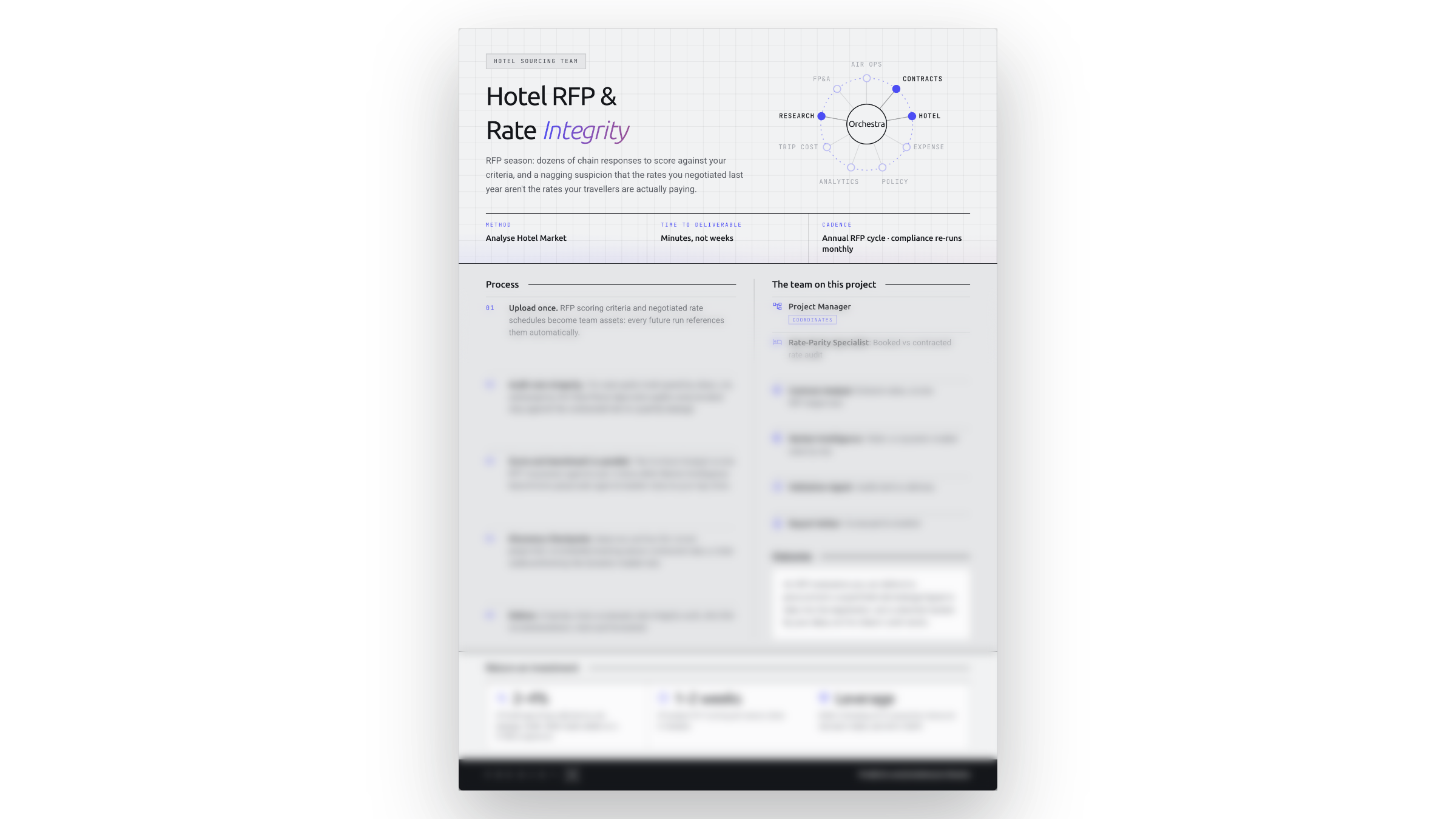
A hotel request for proposal (RFP) in corporate travel is the annual tender a company issues to hotel chains to set negotiated rates at the properties its travellers use most. It is not the meetings-and-events version: a programme RFP fixes transient room rates, and it only pays off if booked stays are then audited against the contracted rate. On this sheet, Orchestra runs both halves as one project: responses scored against your criteria, every stay checked against the rate you signed.
Corporate hotel rates are won in the RFP and lost at the booking screen
You run the RFP properly: criteria agreed, dozens of chain responses scored, rates loaded into the booking tool. That half you control. The other half happens quietly all year, as availability runs out, rate codes drop off and stays land above contract one booking at a time. Scoring and auditing are treated as two jobs in two seasons. The sheet behind this page runs them as one project, one of five examples on the multi agent orchestration one-pager.
What is rate integrity in a hotel programme?
Rate integrity is whether the rate a traveller actually pays matches the rate contracted with the property. Auditing it means pulling booked stays by chain, city and property, comparing each against the negotiated schedule, and flagging properties that consistently book above contract. In this Orchestra project, a Rate-Parity Specialist runs that audit, and the cadence is monthly, because rates drift between RFP cycles, not at them.
What is on the hotel RFP and rate integrity sheet
Five steps, upload once to shortlist
Scoring criteria and negotiated rate schedules are uploaded once and become team assets, so every future run references them automatically. Then the rate-integrity audit, scoring and benchmarking in parallel, the Discovery Checkpoint, and delivery: a chain-by-chain scorecard, the audit, and a shortlist recommendation.
The six-role team
A Project Manager coordinates. The Rate-Parity Specialist audits booked against contracted rates, the Contract Analyst extracts rates and scores RFP responses, Market Intelligence benchmarks market rates by city, the Validation Agent audits everything before delivery, and the Report Writer produces the scorecard and shortlist. The bench comes from Orchestra, the AI agent team.
The Discovery Checkpoint
Surprises surface for review before the scorecard is written. The two examples on the sheet, in plain terms: properties consistently booking above the contracted rate, and a chain whose negotiated rate is beaten by the open market price. You see both first.
The return figures
2% to 4% of hotel spend typically lost to rate leakage, which is $200,000 to $400,000 made visible on a $10M programme. 1 to 2 weeks of analyst scoring per season, done in minutes. And a stronger position for the hotel rate negotiation: walking in knowing which properties honoured last year's rates, and which did not. Figures based on enterprise deployment patterns, individual results vary.
The hotel RFP process, run in parallel
The Contract Analyst scores responses while Market Intelligence sets each proposal against market rates in your top cities, your fixed rates against the moving market. Underneath, the Rate-Parity Specialist audits the current programme, the corporate side of hotel rate parity. Method: Analyse Hotel Market. Time to deliverable: minutes, not weeks. Cadence: an annual RFP cycle, with compliance re-runs monthly.
Who this is for
- Hotel category managers with scoring season ahead and dozens of chain responses waiting
- Travel sourcing leads who need an RFP evaluation they can defend to procurement
- Travel and programme managers who suspect the negotiated rate is not the booked rate
- Anyone preparing a hotel contract negotiation who wants their own data, not the chains' pitch decks
Frequently asked questions
How do you score hotel RFP responses?
Set the criteria before the first response arrives, then score every response against the same set. On this sheet, your scoring criteria are uploaded once and become team assets; the Contract Analyst extracts rates and scores each chain's response while Market Intelligence benchmarks the proposals against market rates in your top cities. A wider view sits in strategic sourcing for corporate travel.
How do you audit booked hotel rates against contracted rates?
Pull hotel spend by chain, city and property, then compare the rate paid on each booked stay against the negotiated rate schedule. On this project the Rate-Parity Specialist runs that audit, the Validation Agent checks the findings before delivery, and the compliance re-run repeats every month.
How much leakage does a hotel rate audit typically find?
Typically 2% to 4% of hotel spend, which is $200,000 to $400,000 made visible on a $10 million programme, based on enterprise deployment patterns, individual results vary. The audit also shows which properties honoured last year's rates, which is a stronger negotiating position than any market benchmark alone.
Does the download include a hotel RFP template?
No. It is a project specification, not a hotel RFP template: the five-step method, the six team roles, the Discovery Checkpoint and the return figures for running RFP scoring and a rate-integrity audit on your own criteria. Your criteria stay yours; the team scores against them.