What is budget variance analysis?
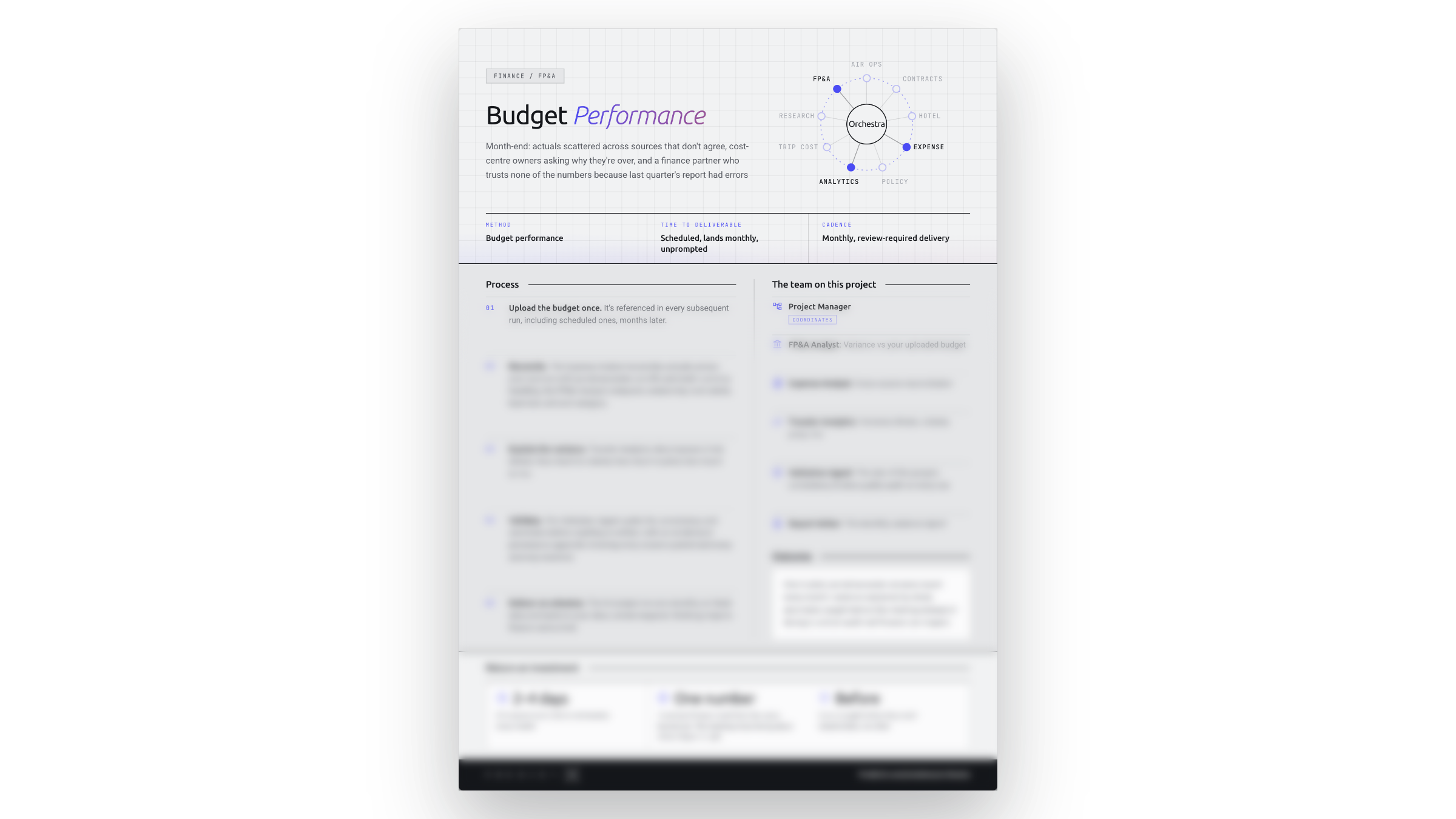
Budget variance analysis compares what a company actually spent against what it budgeted, then explains the difference. In travel and expense, a complete one reports variance by cost centre, business unit and category, and decomposes it into three drivers: volume, price and mix. In this Orchestra project the analysis is rebuilt monthly on fresh data, audited for consistency before delivery, and scheduled to land monthly, unprompted.
The budget variance is not the problem. Three versions of it are.
You already pull the exports: expense platform, card feed, agency data. Each is right by its own rules, each returns a different total, and someone senior rebuilds budget vs actual by hand to defend in the meeting. The hard part is getting three sources to agree in time, and that reconciliation is exactly what this project eliminates. Budget performance is one of five example projects on the multi agent orchestration one-pager.
What is on the sheet
The five steps
Upload the budget once, reconcile, explain the variance, validate, deliver on schedule. The budget is referenced in every subsequent run, months later, and nothing ships to finance untouched.
The team, named
Six roles: the Project Manager coordinating, the FP&A Analyst on variance against your uploaded budget, the Expense Analyst on cross-source reconciliation, Traveler Analytics on drivers, the Validation Agent, and the Report Writer on the monthly budget variance report. The bench comes from Orchestra, the AI agent team.
The validation pass
Why the Validation Agent is the star of this project: a consistency and data-quality audit on every run, with an on-demand provenance appendix showing every source queried and every anomaly resolved.
The return, quantified
2 to 4 days of manual reconciliation removed each month, one validated number instead of three competing versions, and errors caught before they reach stakeholders, not after. Based on enterprise deployment patterns, individual results vary.
Budget vs actual, decomposed into volume, price and mix
Decomposing a budget variance means splitting the gap between budget and actual into three drivers: volume, how much activity changed; price, what each unit cost; and mix, how the make-up of spend shifted. In this project, Traveler Analytics runs the decomposition after the Expense Analyst reconciles actuals with period-accurate cut-offs and multi-currency handling, so the drivers sit on one agreed baseline.
The project runs on a schedule: the full run repeats monthly on fresh data, review-required, and lands unprompted. The same baseline feeds any expense forecasting you run later, and when finance asks where a figure came from, the answer is a lookup, not a hunt.
Who this is for
- FP&A leads who own the T&E budget line and rebuild the variance story every month
- Finance business partners fielding cost-centre owners who ask why they are over
- Heads of travel who defend the programme's number to finance at month end
- Finance teams reconciling an expense platform, card feed and agency exports that disagree
Frequently asked questions
How do you explain a budget variance to finance?
Variance analysis is the discipline of comparing actuals with budget and accounting for the difference. Finance accepts an explanation when the number is period-accurate, reconciled across sources and split into drivers. This project delivers exactly that: variance by cost centre, decomposed into volume, price and mix, with a provenance appendix behind every figure. For the leakage side of the same discipline, see how to measure corporate travel leakage.
What causes variance in a corporate travel budget?
Three drivers: volume, more or fewer trips than planned; price, fares and rates moving against the assumptions; and mix, spend shifting between cabins, suppliers or cost centres. Most months are a blend of all three, which is why the sheet decomposes the variance rather than reporting one headline gap.
How long should monthly budget vs actual reporting take?
Manually, reconciling actuals across an expense platform, card feeds and agency data typically absorbs 2 to 4 days of finance time a month, based on enterprise deployment patterns, individual results vary. Run as a scheduled Orchestra project, the reconciliation is already done when the report arrives: validated, monthly, unprompted.
Can AI produce a monthly budget variance report automatically?
Yes, when it runs as a scheduled project rather than a query. Orchestra re-runs this analysis monthly on fresh data: reconciliation, decomposition and a validation audit, with a human reviewing before delivery. Because the run needs no prompting, the report lands each month unprompted, with errors caught before they reach stakeholders.