How do you prepare for an airline contract negotiation?
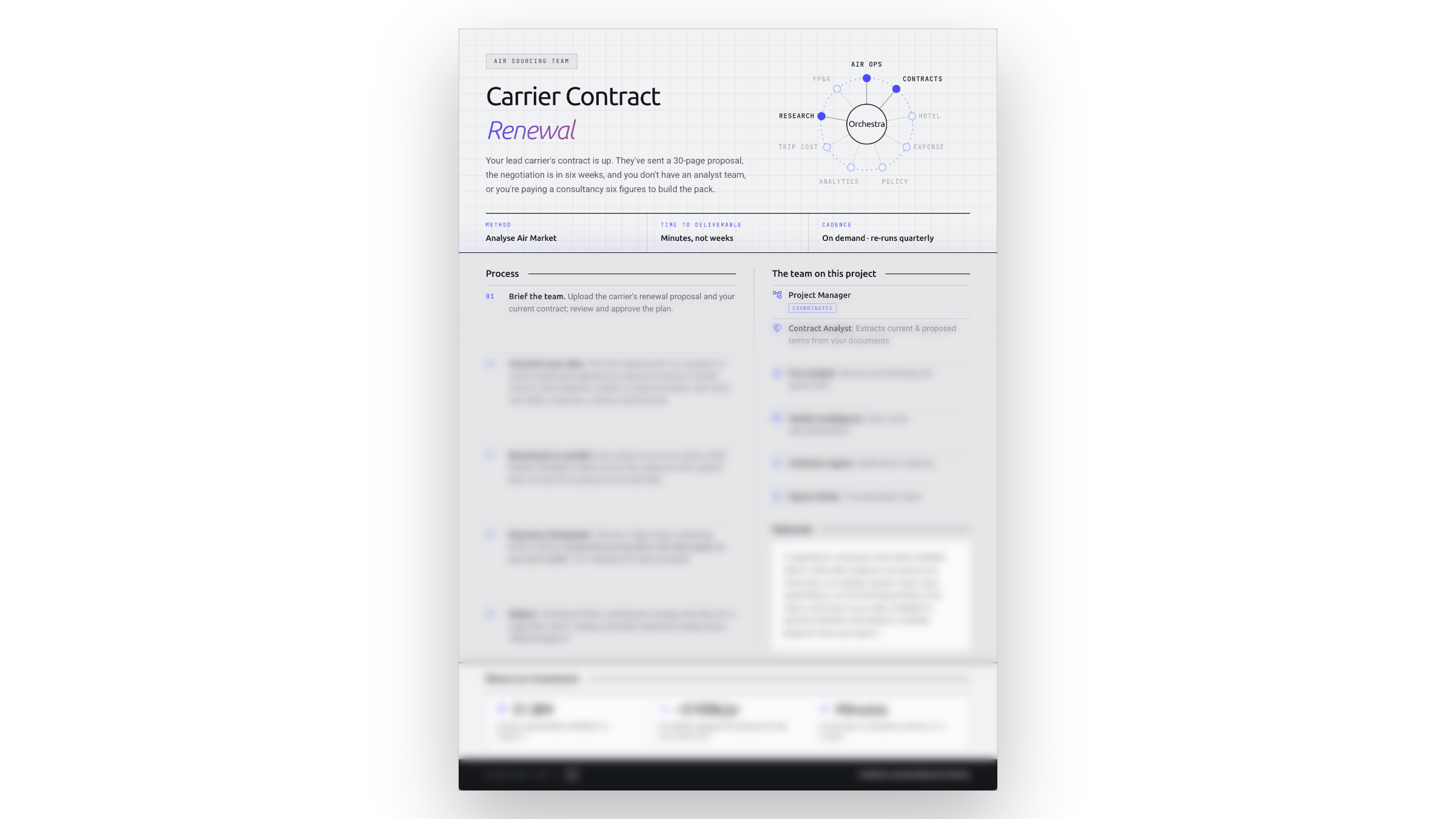
Preparing for an airline contract negotiation means benchmarking what the carrier proposes against what you actually fly and what peers pay, then turning the gaps into negotiation positions. The pack behind it covers current versus proposed terms, four quarters of route-level spend, fare benchmarks against peer carriers, and a savings waterfall. On this sheet, Orchestra runs that as a five-step project: a project manager and five specialist agents deliver the pack in minutes, not the four to six weeks a consultancy takes.
Your lead carrier sent 30 pages. The negotiation is in six weeks.
Airline contracts come up for renewal on the carrier's timetable, and a carrier contract negotiation is won route by route, with evidence. So you either build the pack in-house, which costs weeks you do not have, or commission it, which costs six figures and lands close to the deadline. Both are rational: the analysis genuinely needs an analyst team.
This sheet shows what changes when that team is briefed rather than hired. It is one of five example projects on the multi agent orchestration one-pager, from a project library that keeps growing.
What is on the carrier contract renewal sheet
The five-step process
Brief the team: upload the carrier's renewal proposal and your current contract, then review and approve the plan. The Fare Analyst grounds the project in four quarters of spend segmented by route while the Contract Analyst extracts rate cards, soft-dollar incentives and volume commitments from your current carrier agreement and the new proposal. Peer benchmarks run in parallel; the deck comes last.
The Discovery Checkpoint
Step four. Before anything is written, the team flags what is surprising and you validate it. The example on the sheet: proposed economy fares 18% above peers on your top 5 routes. Confirm the finding and the team proceeds.
The team on this project
Six roles with their scope: a Project Manager coordinating, the Contract Analyst on your documents, the Fare Analyst on your booking and spend data, Market Intelligence on peer-carrier rate benchmarks, a Validation Agent auditing before delivery, and the Report Writer producing the negotiation deck. The bench comes from Orchestra, the AI agent team.
The return
$1.8M in savings opportunities identified in a single run, and a consulting engagement of roughly $100k a year displaced for the same deliverable, based on enterprise deployment patterns, individual results vary. Scheduled quarterly, the next renewal is already prepared when you open it.
What should an airline market analysis include?
An airline market analysis for a contract renewal should include four quarters of carrier spend segmented by route, current versus proposed terms covering rate cards, soft-dollar incentives and volume commitments, fare trends on your top routes, and the proposed rates benchmarked against peer carriers and external data. The deliverable is a negotiation deck: savings waterfall, route-level comparisons, every claim cited back to your data, the evidence base any supplier negotiation opens with.
Who this is for
- Procurement and category leads with a carrier renewal in the next two quarters
- Heads of travel who own the airline negotiations but not an analyst team
- Travel procurement teams paying a consultancy for the renewal pack today
- Teams building the pack manually, losing the weeks between proposal and negotiation day
Frequently asked questions
How do you benchmark proposed airline fares against the market?
Segment your own spend by route, then set the carrier's proposed rates against peer-carrier benchmarks and external market data for the same routes and cabins. On this sheet, that comparison is where the Discovery Checkpoint example comes from: proposed economy fares 18% above peers on the top five routes.
Can AI run a carrier contract renewal analysis?
Yes, as a supervised project. You upload the carrier's proposal and your current contract, then review and approve the plan before anything runs. Specialist agents handle extraction, benchmarking and validation, a human confirms the surprising findings at the Discovery Checkpoint, and the negotiation itself stays yours.
How long does an airline contract renewal analysis take?
Manually, the pack behind an airline RFP or contract renewal is typically a four to six week consulting engagement or several weeks of analyst time. Orchestra's time to deliverable on this project is minutes once the plan is approved, and it re-runs quarterly, so the next renewal is already prepared.
Does this replace the consultancy engagement?
For the analytical pack, yes. The same deliverable displaces a consulting engagement of roughly $100k a year, based on enterprise deployment patterns, individual results vary. What it does not replace: the negotiation itself, the carrier relationship, and your judgement about which positions to take into the room. The same evidence base is explored in vendor negotiation intelligence for corporate travel.