

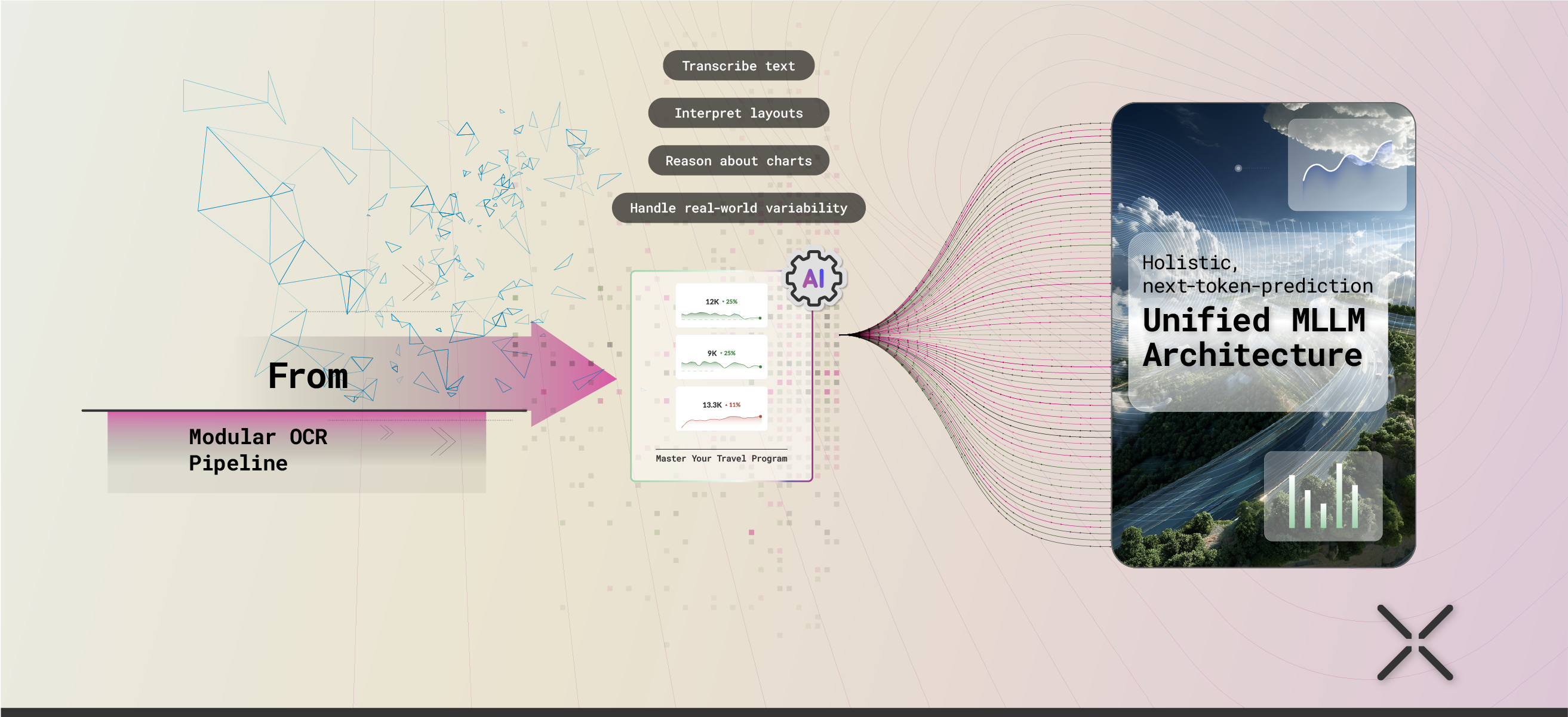
The landscape of artificial intelligence has reached a transformative milestone. As of February 2026, Multimodal Large Language Models (MLLMs), also known as Vision-Language Models (VLMs),have displaced traditional Optical Character Recognition (OCR) as the dominant paradigm for visual understanding.
While traditional OCR excels at literal character recognition under perfect conditions, it often fails when faced with degraded, handwritten, or semantically complex visuals. In contrast, modern MLLMs like Gemini 3, Llama 4, and GLM-4.6V integrate vision and language into a unified, transformer-based architecture. This shift from discrete processing to holistic, next-token-prediction allows AI to not just "read" text, but to truly understand the context of an image.
1. Traditional OCR: A Modular, Rule-Heavy Pipeline
Historically, OCR has followed a multi-stage, hand-crafted approach:
- Image Preprocessing: Binarization, noise reduction, and deskewing.
- Layout Analysis: Identifying text regions and word/character bounding boxes.
- Character Recognition: Using CNNs or classical methods to classify glyphs.
- Post-Processing: Dictionary-based correction and layout reconstruction.
The Limitation: This design is fragile. Error propagation across stages is common; for example, poor segmentation in the early stages leads to misrecognized characters later. It struggles significantly with handwriting, low resolution, and non-text elements like charts or diagrams.
2. Technical Breakdown: The MLLM Data Flow
By 2026, state-of-the-art MLLMs process images through a unified architecture that treats vision as another sequence modality.
The End-to-End Pipeline:
- Vision Encoder: A Vision Transformer (ViT) or native encoder (like the one in GLM-4.5V with 3D-ROPE) divides the image into patches (14×14 to 336×336 resolution inputs). Each patch is embedded into a vector, and 3D positional encodings are added for spatial reasoning.
- Modality Connector: A lightweight MLP or linear layer projects these visual tokens into the LLM's embedding space, aligning them dimensionally with text tokens.
- Unified Transformer Backbone: Visual tokens are concatenated with text prompt tokens into a single sequence. The same self-attention layers process everything jointly.
- Autoregressive Generation: The model predicts the next token, allowing visual information to influence language generation across all layers.
Advanced "Thinking Modes"
Innovative models now feature Explicit Chain-of-Thought toggles. This enables the model to "see" by attending to relevant image regions during generation, allowing OCR-like extraction and semantic parsing (reading tables or interpreting trends) to emerge implicitly.
Key architectural trends in 2026 include:
- Mixture-of-Experts (MoE): Used in models like GLM-4.5V (106B total, 12B active), Llama 4, and DeepSeek variants for efficient scaling.
- Native Multimodal Pretraining: Next-token prediction on interleaved image-text data (e.g., Emu3 family eliminates diffusion/compositional needs).
- Advanced Attention: Multi-head latent attention (MLA) and sparse attention for long contexts, plus bidirectional attention on visual tokens in innovations like LLaViT.
- Thinking Modes: Explicit chain-of-thought or step-by-step reasoning toggles in GLM and Gemini series.
This enables the model to "see" by attending to relevant image regions during generation e.g., OCR-like text extraction emerges implicitly, but so does semantic parsing (reading order in tables, trend interpretation in charts).
3. Comparison: Traditional OCR vs. Multimodal LLMs (2026)
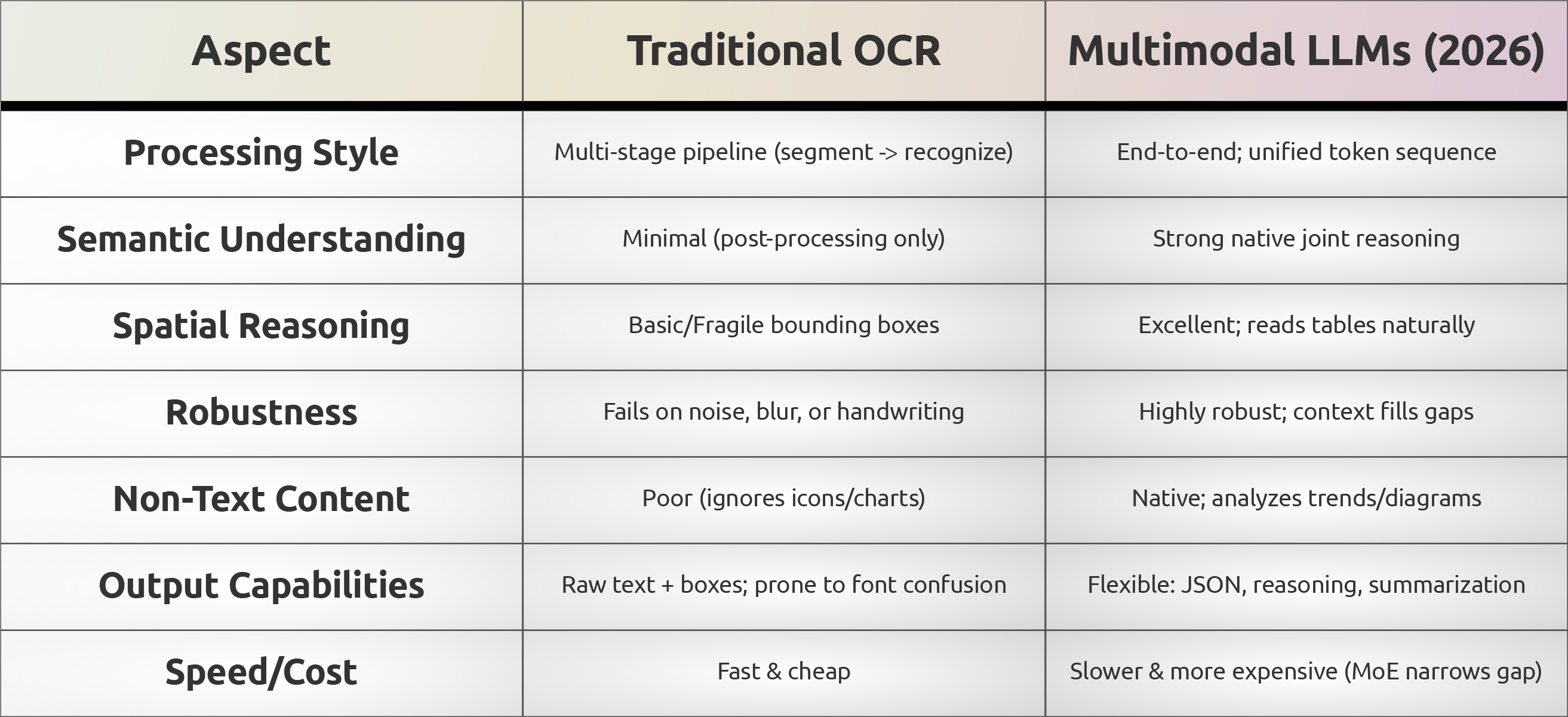
Recent benchmarks (e.g., PubTables-1M for tables, Omni AI evaluations) show MLLMs outperforming traditional OCR + vision pipelines in end-to-end tasks like structured extraction, especially on variable layouts or degraded documents. While specialized deep-learning table models (e.g., Table Transformer) retain a slight edge on pure structural layout, MLLMs dominate on textual content and holistic understanding.
4. Future Implications
The implications of this shift are profound. Studies reveal that specific "OCR heads" emerge in attention layers, specializing in text extraction distinct from general retrieval heads. This proves that vision processing is an emergent byproduct of large-scale multimodal pretraining. By 2026, the boundary between "seeing" and "understanding" has blurred, paving the way for general multimodal intelligence.
- Efficiency Gains : MoE, quantized inference, and thinking modes enable deployment on edge devices or cost-effective scaling.
- Beyond Text: Native video/audio support (e.g., in Gemini 3, Qwen3-VL) extends "seeing" to dynamic content.
- Interpretability Insights: Studies reveal "OCR heads" in attention layers that specialize in text extraction, distinct from general retrieval heads.
Conclusion
Multimodal LLMs do not merely perform OCR, they perceive images as humans do, fusing pixels into meaningful concepts through shared representations and attention. This paradigm shift has rendered traditional OCR supplementary rather than primary for most intelligent document processing and visual reasoning tasks. As models continue scaling with innovations in architecture and training (e.g., unified next-token
prediction), the boundary between "seeing" and "understanding" blurs further, paving the way for more general multimodal intelligence.
Q&A: The Shift to Multimodal Intelligence
Q: Why are MLLMs more robust to "noisy" or blurry images than traditional OCR?
A: Traditional OCR relies on pixel-level clarity for classification. MLLMs use "contextual priors"—their vast linguistic and visual knowledge—to fill in gaps where characters might be unreadable to a standard machine.
Q: Do MLLMs still make mistakes?
A: Yes. While they are more robust, they can suffer from rare hallucinations or an over-reliance on their training priors. However, in end-to-end tasks like structured extraction from variable layouts, they consistently outperform OCR pipelines.
Q: How do "Thinking Modes" improve image analysis?
A: Toggling "Thinking Modes" allows models like Gemini 3 to perform step-by-step reasoning. This means the model focuses on specific parts of the image (like an X-axis on a chart) before formulating a final answer, mimicking human ocular attention.
Q: Is it cost-effective to use MLLMs for high-volume document processing?
A: While traditionally slower and more expensive, 2026 innovations like Mixture-of-Experts (MoE) and quantized inference have significantly narrowed the gap, making MLLMs viable for large-scale enterprise scaling.