What is the connection between travel leakage and supplier negotiations?
Travel leakage undermines supplier negotiations by fragmenting volume data across channels the TMC cannot see, causing buyers to enter every RFP presenting an artificially low volume figure to suppliers who already know the real number.
Introduction
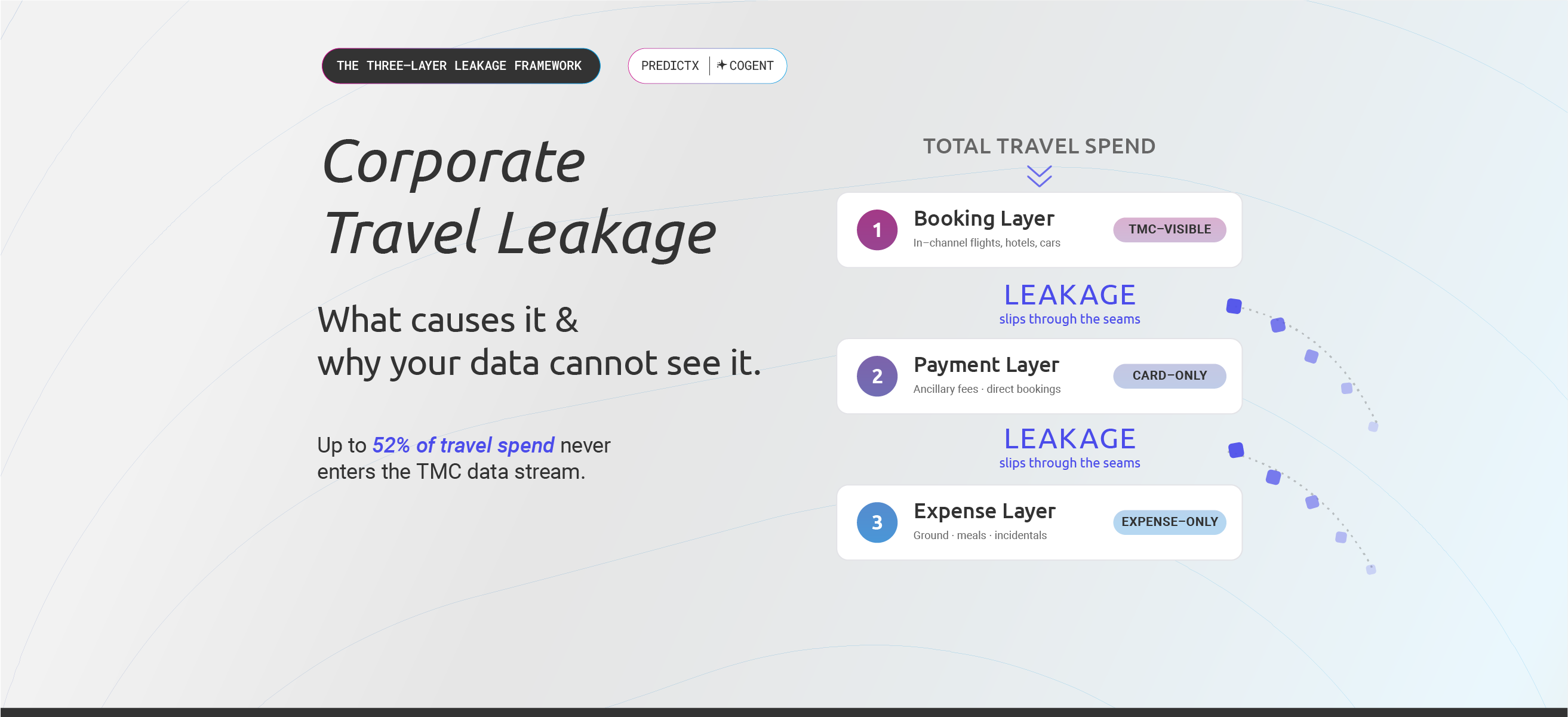
It's not that you lack volume. It is that travel leakage means the data from three sources, booking, card, and expense, never gets combined, so you enter every RFP understating your true programme value to a supplier who already knows the real number.
That sentence is uncomfortable, but it's accurate. Suppliers invest in revenue management intelligence. They track company booking behaviour across channels, monitor rate capture patterns, and enter every negotiation with a detailed picture of how your programme performs.
You, in most cases, arrive with a headline spend number and whatever the TMC produced last quarter. The information asymmetry is structural. It decides the outcome before the first agenda item is reached. Travel and expense data that spans all three layers is what closes it.
Keesup Choe, CEO of PredictX, puts it directly: "The true potential for AI is not in taking over jobs people already do. It is in doing the work that is not being done, work that is too expensive or requires too much manpower."
Supplier negotiation preparation is exactly that work. It sits in a quarterly RFP cycle, half-done, because nobody had a fast enough way to produce the data. That is the gap agentic AI closes for every T&E management team. That has changed.
Modern travel programmes are shifting their supplier preparation from intuition to intelligence. Agentic AI makes that shift available to every corporate travel manager in seconds, not weeks. This is what modern travel and expense management looks like in practice. Data consolidation across all three layers, queried at speed, is the capability most programmes describe as a future aspiration. It doesn't have to be.
In This Article
- How does travel leakage weaken your supplier negotiations?
- What volume problem does TMC data hide from negotiations?
- How do you quantify leakage before a supplier negotiation?
- What does supplier-level leakage intelligence look like in practice?
- How does agentic AI close the data gap before RFPs?
- How does negotiation readiness differ with full leakage data vs TMC-only?
- Frequently Asked Questions
How does travel leakage weaken your supplier negotiations?
Travel leakage weakens supplier negotiations in three compounding ways: it understates the volume you are committing, it removes the off-channel spend you could migrate as a future commitment, and it signals to suppliers that your programme lacks the enforcement capability to deliver what it promises.
Each of these problems compounds the others. A programme with 30% leakage is not only presenting 70% of its true volume. It is also:
- Unable to credibly promise migration of the remaining 30% because it cannot see where that spend is or why it left the channel
- Signalling to the supplier that it has delivered below its volume commitment in previous cycles
- Losing the goodwill and preferred treatment that consistently over-delivering programmes receive
According to Euromonitor International research, nearly two-thirds of global business travel spend remains unmanaged travel spend. Even in programmes with active TMC relationships, approximately 10% of bookings occur outside approved channels. These are not numbers your suppliers are unaware of.
Their revenue management systems capture bookings regardless of which channel they used.
The Industry travel benchmarks show negotiated airfares declined 4.6% year-over-year while the gap between market and negotiated hotel rates widened to 22.6%. These are conditions where data-backed buyers capture significant savings. Buyers who cannot quantify their full volume leave those savings on the table, every cycle.
What volume problem does TMC data hide from negotiations?
Your TMC data shows the volume that flowed through your managed channel. It does not show the volume that flowed to the same suppliers outside that channel, which is often the larger number and the more powerful negotiation argument.
Consider what happens on a high-volume hotel route.
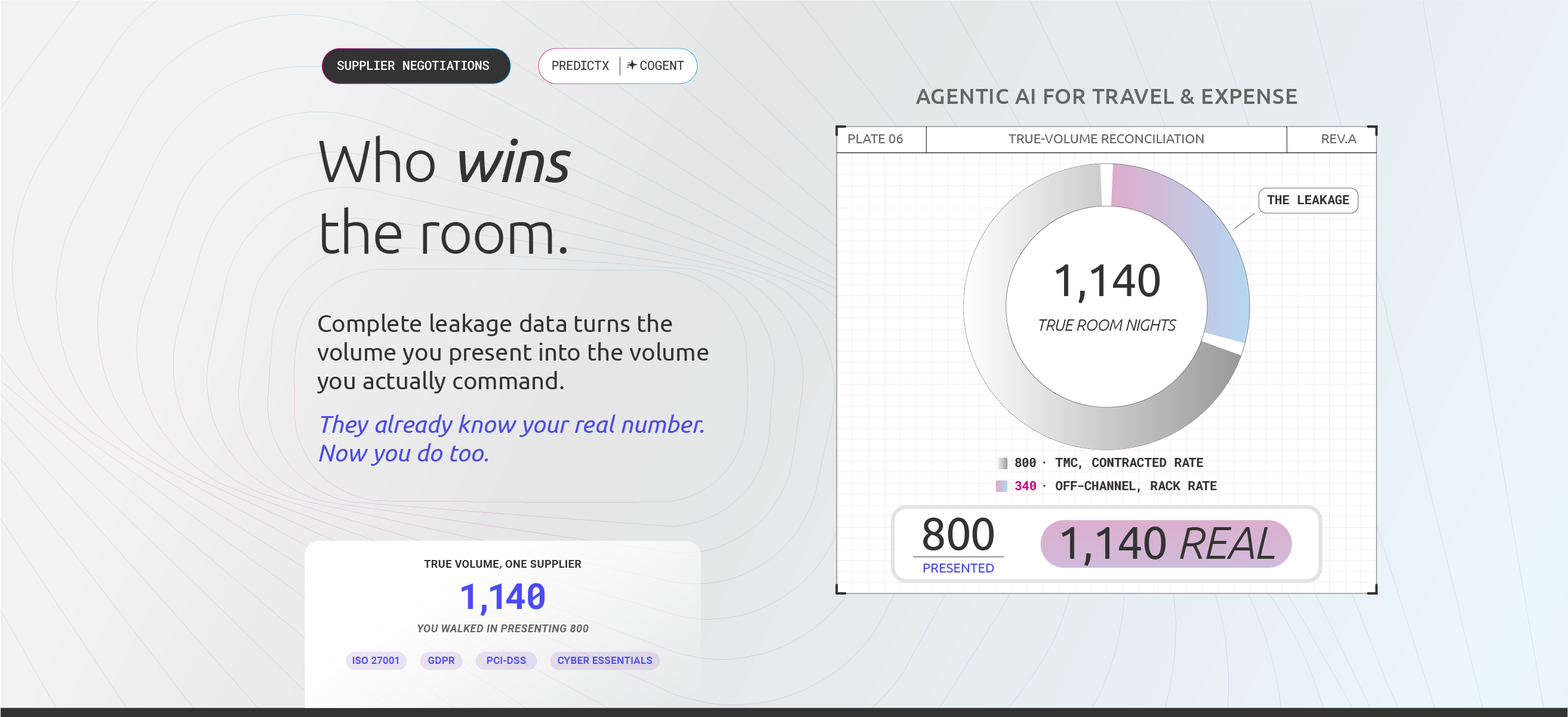
Your TMC data shows 800 room nights at a preferred property last year, at the contracted rate. You present this as your programme's volume commitment and negotiate from there.
What the hotel's revenue management system sees:
- 800 room nights at the contracted corporate rate through your TMC
- An additional 340 room nights at the rack rate, booked through consumer sites by your employees on the same dates
- A combined total of 1,140 room nights from your company, 30% of which paid a significantly higher rate
Those 340 off-channel room nights are the leakage: bookable spend that should have run through the preferred channel and did not. Ancillary charges on the stays and any booked-versus-billed differences are real trip costs, but they are not leakage and not the volume argument here. The room nights are.
You negotiated representing 800 room nights of leverage. You actually had 1,140. The missed 340 room nights, booked at rack rate, represent both negotiating power you did not use and a recovery opportunity you cannot quantify.
Off-platform booking is the mechanism. This is the volume problem it creates. And it is structural across every category in your travel programme.
According to GBTA's 2025 Corporate Travel Index, hotel and air together account for over 70% of managed travel spend in enterprise programmes. These are the categories where the volume understatement has the highest financial consequences.
PredictX's leakage analytics consolidates all three data layers (TMC, card, and expense) to produce the true volume number, including off-channel spend with each preferred supplier. That is the number that changes the negotiation.
For the conceptual model behind the three data layers and why they fragment in the first place, see our companion guide on what causes corporate travel leakage.
How do you quantify leakage before a supplier negotiation?
The goal before any RFP is to arrive knowing two numbers your supplier does not expect you to have: your true total volume with them across all booking channels, and the exact rate gap between what you paid off-contract versus what you contracted to pay.
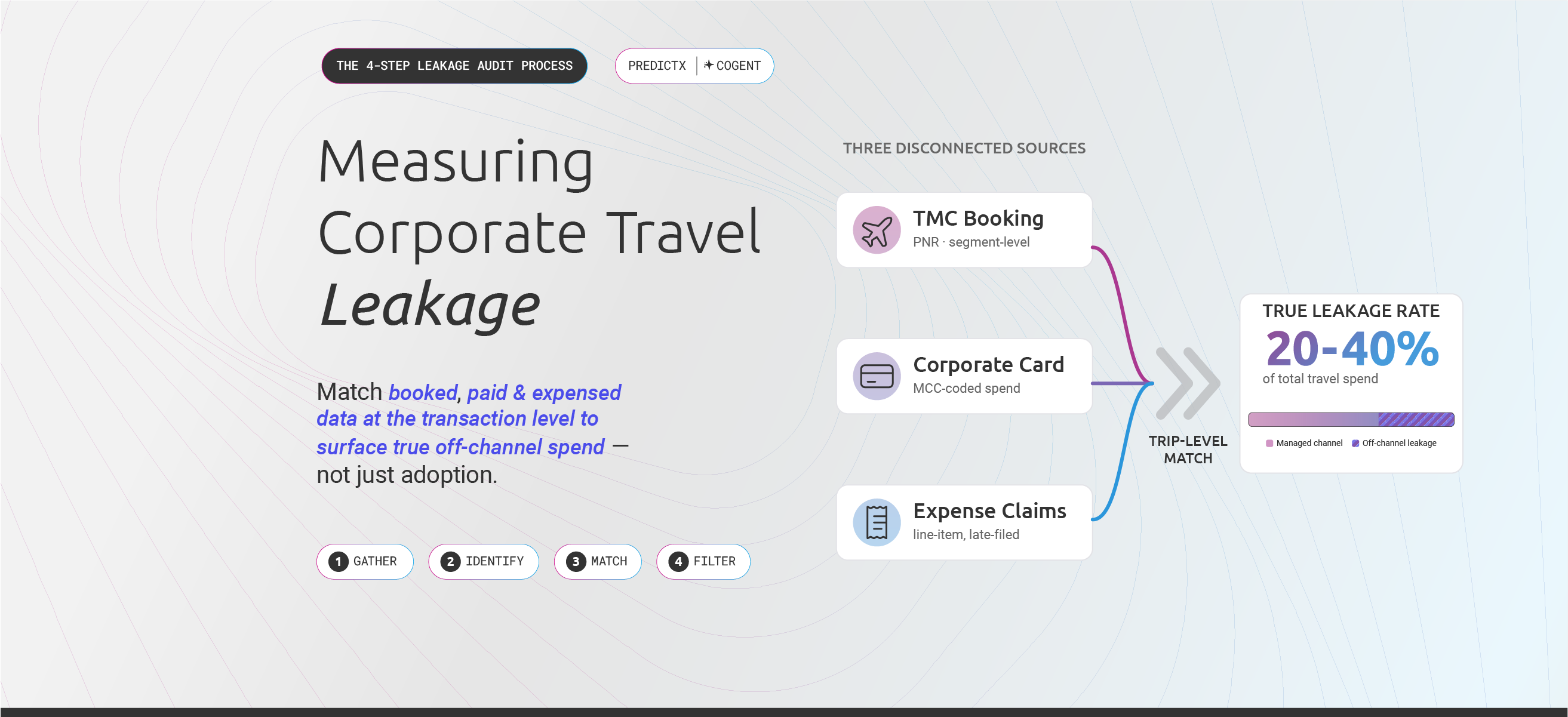
Most programmes only have the second number. Travel data and predictive analytics across all three layers is what produces the first. Getting the first requires four steps, and the data assembly is where the gap lives.
Step 1: Pull the full card picture for that supplier
Corporate card data captures every payment to a supplier regardless of which channel was used to book it. Run it for the prior 12 months, filtered by supplier name with normalisation for variants, and by the relevant merchant category code. What you get back is not just your managed spend with that supplier.
It is your company's actual commercial relationship with them, covering total travel and entertainment expense across all channels, in full, including the bookings that never touched your TMC.
Step 2: Match against what the TMC knows
Extract all TMC bookings with the same supplier for the same window. Match them against the card data using traveller ID, travel dates, and amount range. Two things will surface.
Card transactions with no corresponding TMC booking are off-channel spend. TMC bookings with no card match are either cancellations or corporate card policy exceptions. The off-channel number is what you are after.
Step 3: Price the gap
For every off-channel card transaction, compare what was paid per night or per segment against your contracted rate. That difference is your off-channel cost premium. Multiply by the off-channel volume. Compare like for like — the room or fare rate against the contracted rate — not the ancillary extras on the same transaction, which are trip costs rather than part of the leakage gap you are pricing.
The resulting figure, expressed as an annual total, is the number you take into the room. It is also the number that changes the tone of the conversation before the supplier has presented their opening position.
Step 4: Build the recovery commitment
Off-channel spend that is recoverable through programme improvements, such as better booking tool adoption, loyalty alignment, or policy clarification, becomes your future volume commitment. Quantify it. Express it as a trajectory: "We will migrate X% of this off-channel volume to your preferred rate tier by Q3 through the following specific actions." A supplier who sees a credible recovery plan has a financial reason to move on rate today.
A supplier who sees a static volume figure has none.
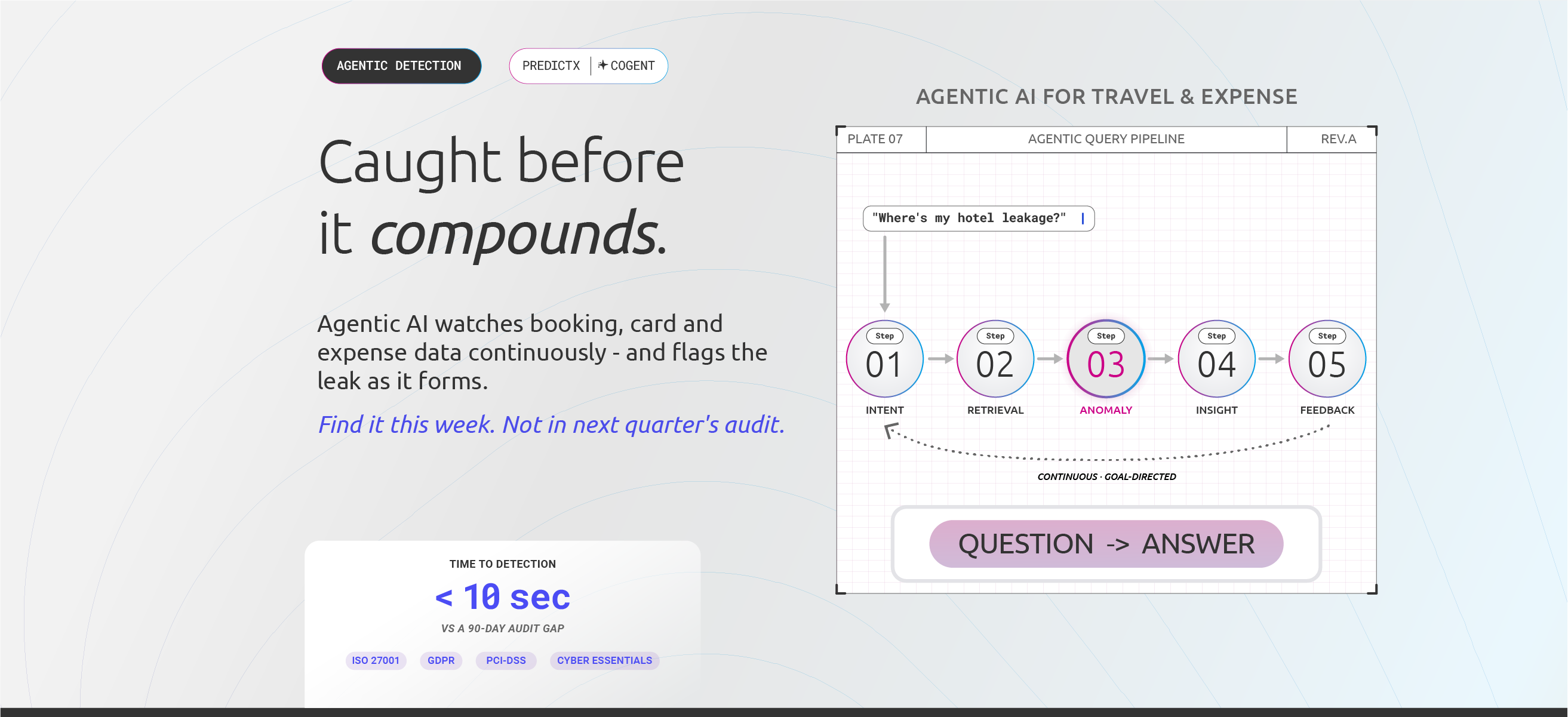
With Cogent by PredictX, these four steps collapse into a single plain-language query. "Show me our total spend at [preferred chain] last year including off-channel bookings, the rate gap between contracted and off-channel stays, and which departments are driving the most off-contract usage." The output arrives in under 10 seconds, structured and finance-ready, before the preparation window has closed. Consolidated travel and expense data, delivered at query speed, is what that intelligence runs on. That is travel spend analytics operating at the speed decisions actually require.
The travel and expense data analytics, expense audit methodology and travel policy compliance data underneath this query, including the timing buffers and the exception-removal step, is covered in detail in our guide on how to measure corporate travel leakage.
What does supplier-level leakage intelligence look like in practice?
Supplier-level leakage intelligence is the combination of total spend per supplier across all channels, the rate gap between contracted and off-channel bookings, and the volume recovery trajectory that converts off-channel spend into negotiating position. Travel compliance and booking channel data from all three layers feed every component of this intelligence.
Three patterns show up consistently across enterprise programme deployments. Each one illustrates how travel data analytics, trip analytics, and expense management data combined in a single query produce intelligence unavailable from either source alone. For the full library of patterns and queries, PredictX publishes six powerful Cogent use cases for T&E reporting and travel data, which extends beyond the three covered here.
Air: identifying the full ATP story
On a high-volume long-haul corridor, one enterprise team queried average ticket prices by airline and fare class for the prior 12 months. The output showed one carrier's business class averaging approximately 25% more than a competing airline on the same route. The carrier had positioned both products as equivalent in value.
On a route with over 900 annual segments, that gap was worth more than £400,000 in annual overspend.
The query also surfaced off-channel bookings: employees booking the same route directly with the airline, bypassing the TMC contract entirely. The off-channel fare was 18% above the contracted rate.
Without that intelligence, the negotiation proceeds on incomplete data. The overspend continues unchanged into the next contract cycle.
Hotel: ADR trends and volume recovery
One team queried the average daily rate for a preferred hotel chain comparing two consecutive years. The data showed a rate increase of approximately 8% alongside a volume increase of over 40% in room nights. Two things became immediately clear:
- The rate had risen significantly despite the programme delivering substantially more volume
- That volume growth gave the team a strong argument to challenge the rate in the next contract
The query also surfaced non-preferred bookings at competing properties in the same markets, with a rate comparison showing the cost premium per night and the annual total. The team entered the RFP with those numbers. The supplier didn't expect that level of granularity.
Ground transport: the invisible category
Ground transport is consistently the highest-leakage category in corporate travel. It is also the most overlooked in supplier negotiations, because most programmes have no preferred ground transport contracts to protect, which means they have never built the data infrastructure to measure leakage in this category at all.
A query pulling all card transactions in the ground transport merchant category codes (MCC 4121 for rideshare and taxi, 4111 for local transit, 7513 for car hire), matched against any managed ground transport bookings, typically reveals that 60 to 80% of ground transport spend is entirely off-channel. This is not an expense compliance failure in most cases. It is a programme design gap.
The financial profile of unmanaged ground transport is more significant than most programmes realise:
- A global programme with 10,000 travellers generating even two ground transport transactions per trip at an average of £35 per transaction is running approximately £700,000 in annual ground transport spend.
- At 70% off-channel, that is £490,000 flowing through personal apps and taxi cash payments with zero programme visibility.
- That £490,000 is also the volume basis for negotiating a corporate rate with a preferred ground transport provider in your highest-frequency cities.
The data has a second use even before any supplier contract exists. Ground transport leakage data shows where your travellers are actually travelling within cities, which markets generate the most volume, and which corridor patterns make a preferred supplier contract financially viable. Most programmes start ground transport RFPs without this picture, which is why most ground transport contracts are under-utilised and outperformed by consumer apps within 12 months of signing.
Cogent surfaces this analysis in seconds: "Show me all ground transport card transactions in our top 10 travel cities last year, with volume and average transaction value, and flag which cities have no corresponding managed supplier contract." That output is the foundation for a ground transport negotiation that most competitors in your RFP cycle are not prepared to have.
How does agentic AI close the data gap before RFPs?
Agentic AI closes the data gap before supplier negotiations by making supplier-level leakage intelligence available in seconds through plain-language queries, replacing the multi-day analyst preparation cycle with a conversation anyone on the team can have.
The traditional RFP preparation process for a programme covering 20 priority hotel markets required a procurement analyst approximately five full working days before a single meeting. Pull bookings by city, filter for relevant properties, calculate ADR by quarter, cross-reference against contracted rates, aggregate into a stakeholder summary. Most teams skip steps and call a rough version a plan.
Gartner projects that 40% of enterprise applications will feature task-specific AI agents by the end of 2026, up from less than 5% in 2025. In corporate travel, that shift means RFP preparation moves from a resource-constrained periodic exercise to a continuous real-time capability.
The Cogent agentic AI platform won the 2025 BTN Europe Innovation Faceoff and was recognised as the Business Travel Technology Innovation Data and Reporting award winner by Business Travel Europe, as well as being featured on the BTN Europe Hotlist 2026. It processes over 100,000 data points per query, delivers responses in under 10 seconds, and maintains a 99% reliability rate for relevant programme queries.
The Cogent agentic AI architecture processes every negotiation query through the same five stages: intent interpretation, data retrieval across all connected sources, logic and calculation, anomaly detection, and a structured output with proactive insights the user did not explicitly ask for. The output is finance-ready and can be taken directly into the RFP meeting.
As Keesup Choe observed: "The problem was never the data. It was the speed at which decisions could be made from it." In supplier negotiations, speed is not just a convenience. An insight that arrives after the preparation window closes has zero value.
For the architectural detail behind the 5-stage Cogent query process and the 4-layer platform that supports it, see our companion piece on agentic AI for corporate travel leakage detection.
How does negotiation readiness differ with full leakage data vs TMC-only?
Before every major supplier negotiation, it is worth assessing what your data actually supports.
Outcome
Rate holds or increases marginally
Data-backed challenge to rate increases, volume-based improvements
Industry travel benchmark data confirms the same trend: negotiated airfares declined 4.6% year-over-year for programmes that entered negotiations with strong data. The data advantage is not theoretical. It translates directly into rate outcomes.
The negotiation methodology in this post sits on top of a broader reduction strategy. Our 5-Lever Framework for reducing corporate travel leakage covers the programme-wide approach that makes the recovery trajectory in your RFP credible.
Frequently Asked Questions
How does travel leakage affect supplier negotiations?
Travel leakage understates your true volume when presenting data to preferred suppliers, reducing your negotiating position and signalling unreliable volume delivery. Suppliers track your company's bookings across all channels through their own revenue management systems. A programme presenting TMC-only data in a hotel RFP typically understates its total value by 25 to 40%.
What data do you need for a supplier negotiation?
For a data-backed supplier negotiation you need four inputs: total spend with the supplier across all channels, the off-channel versus contracted rate gap, the annual cost of that gap, and a recovery trajectory. Each input requires T&E data from all three layers. TMC data alone provides only the first, and only partially.
How do you calculate your rate gap before an RFP?
The rate gap is calculated by comparing the average rate paid on off-channel bookings against your contracted rate, multiplied by off-channel volume: ADR gap times room nights for hotels, ATP difference times segments for air. Cogent calculates this in seconds. In one deployment on a long-haul corridor with 900 annual segments, the rate gap was worth over £400,000 per year.
Why do suppliers know more about my programme than I do?
Suppliers' revenue management systems capture every booking regardless of channel, tracking your off-contract usage and rate patterns across their entire inventory. Your TMC only captures the managed portion. That's a corporate travel risk management and corporate travel compliance problem. Entering a major RFP without completing the leakage analysis means accepting that information asymmetry permanently.
How does agentic AI improve supplier negotiation preparation?
Agentic AI replaces the multi-day analyst preparation cycle with a plain-language query returning supplier-level rate gap analysis, off-channel volume by department, and recovery trajectory in under 10 seconds. Preparation collapses from days per market to under a minute. With Cogent, a team covers 20 hotel markets in the time previously spent on one.
What is the recovery trajectory and why does it matter in negotiations?
The recovery trajectory is a quantified estimate of how much off-channel spend can be migrated to the preferred channel, expressed as a future volume commitment with a delivery plan behind it. It converts off-channel spend from a liability into a commercial asset: a reason for the supplier to move on rate today in exchange for committed future volume.
Key takeaway The information asymmetry in supplier negotiations is not neutral. It systematically favours the supplier, and the gap between what you know and what they know widens every year you run a programme without aligning all three data layers. What changes when you close that gap is not just the quality of the negotiation. It is the nature of it. A travel manager who arrives at a hotel RFP with the supplier's own rate variance data, the total addressable volume including off-channel, and a quantified recovery trajectory is not responding to the supplier's opening position. They are setting the agenda. The number that does the work is the off-channel bookable volume and its rate gap, not ancillary charges or booked-versus-billed differences, which belong to total trip cost. Leakage data is not a reporting improvement. It is a commercial capability.
Ready to Enter Your Next RFP Better Prepared Than Your Supplier?
Related Posts
How to Reduce Corporate Travel Leakage: The 5-Lever Framework
%20(7).png)
How Leakage and Invisible Spending influences Your Travel Program
Corporate Travel Leakage: What Causes It and Why Your Data Cannot See It