What is agentic AI for corporate travel leakage detection?
Agentic AI for corporate travel leakage detection is an autonomous intelligence layer that continuously monitors TMC, card, and expense data for off-channel spend patterns and surfaces quantified anomalies in seconds without human-triggered report requests.
Introduction
It's not the leakage that costs you. It is that the 90-day gap between when corporate travel leakage happens and when your dashboards surface it makes recovery impossible. By the time the monthly compliance report reaches the right desk, the quarter has already moved on and the cost is locked in.
In January, a team at a global pharmaceutical firm starts booking hotels off-platform through Booking.com on two specific routes. In February, the monthly compliance report shows the hotel attachment rate has dropped by 3.2 percentage points. In March, the data team investigates.
In April, the root cause is confirmed.
One team, two routes, consumer platform, three months of avoidable off-channel spend. At a $55 per night rate gap on thousands of room nights, that's not a reporting delay. It is a recoverable cost that becomes unrecoverable because nobody knew what to look for in time.
In the agentic model, the pattern surfaces in the same week it starts. The query "show me all international flights where no corresponding hotel booking exists in our system" takes under 10 seconds. The answer includes the team, the routes, the platform, the rate gap, and the estimated quarterly cost.
This post covers what agentic AI actually does in corporate travel leakage detection and what it means for T&E management and travel and expense management teams who are still running monthly report cycles. Not the promise, but the practice. It starts with three deployment examples, then explains the process and architecture that made them possible.
In This Article
- What is agentic AI for corporate travel leakage detection?
- Agentic AI vs generative AI vs traditional analytics: what is the difference?
- What is the Toggle Tax and why do dashboards fail at leakage detection?
- What does agentic leakage detection look like in practice?
- How does Cogent detect corporate travel leakage? The 5-step process
- What is the Cogent 4-layer architecture for leakage intelligence?
- Why is continuous monitoring better than periodic audits for leakage?
- Frequently Asked Questions
What is agentic AI for corporate travel leakage detection?
Agentic AI for corporate travel leakage detection is the application of autonomous, goal-directed artificial intelligence to the continuous identification, quantification, and root-cause analysis of off-channel travel spend, operating across TMC, card, and expense data simultaneously without waiting to be prompted.
Traditional analytics is retrospective. It answers questions after someone has thought to ask them. Generative AI is responsive. It answers questions when asked, in natural language, faster than a dashboard. Agentic AI is proactive. It identifies problems before they are named, surfaces anomalies before they are reported, and quantifies leakage exposure in real time, whether or not anyone asked.
For leakage detection, the distinction is practical and significant:
- Traditional analytics: You run a compliance report at month-end. It shows TMC adoption rate. Off-channel spend is invisible.
- Generative AI assistant: You ask "what is our hotel leakage rate in EMEA?" and receive a structured answer if the data is connected. You have to ask.
- Agentic AI (Cogent): Cogent monitors continuously. When a pattern of off-channel hotel bookings emerges, it flags the anomaly proactively, identifies the root cause, quantifies the cost, and surfaces the insight without being prompted. You receive the intelligence. You did not have to think of the question first.
Gartner projects that 40% of enterprise applications will feature task-specific AI agents by the end of 2026, up from less than 5% in 2025. That shift is already live in corporate travel. The programmes pulling ahead are not using better dashboards.
They have replaced the dashboard model entirely.
Throughout this post, leakage means one specific thing: bookable spend that should have gone through a preferred channel and did not. Ancillary charges and booked-versus-billed differences also sit in card and expense data, but they are trip costs, not leakage. Cogent surfaces those separately rather than folding them into the leakage number.
Agentic AI vs generative AI vs traditional analytics: what is the difference?
The fundamental distinction is what triggers the output. Traditional analytics requires a report request. Generative AI requires a question. Agentic AI requires neither: it operates continuously toward a goal, identifies deviations, and surfaces them without waiting to be asked.
The corporate travel industry has spent years adding layers to the traditional analytics model: better dashboards, self-service BI tools, natural language query interfaces. Each added capability without changing the underlying problem. You still had to know what question to ask, and you still had to ask it before the data arrived.
The Cogent by PredictX whitepaper, produced in May 2026, makes the distinction plain: generative AI produces outputs. Agentic AI produces outcomes. That difference is the entire gap between knowing leakage exists and stopping it while it is still recoverable.
For a fuller view of what this shift means for travel and expense data analytics specifically, PredictX has documented the agentic AI shift in T&E data analytics, covering why traditional analytics architecture can't evolve into agentic operation without a structural redesign.
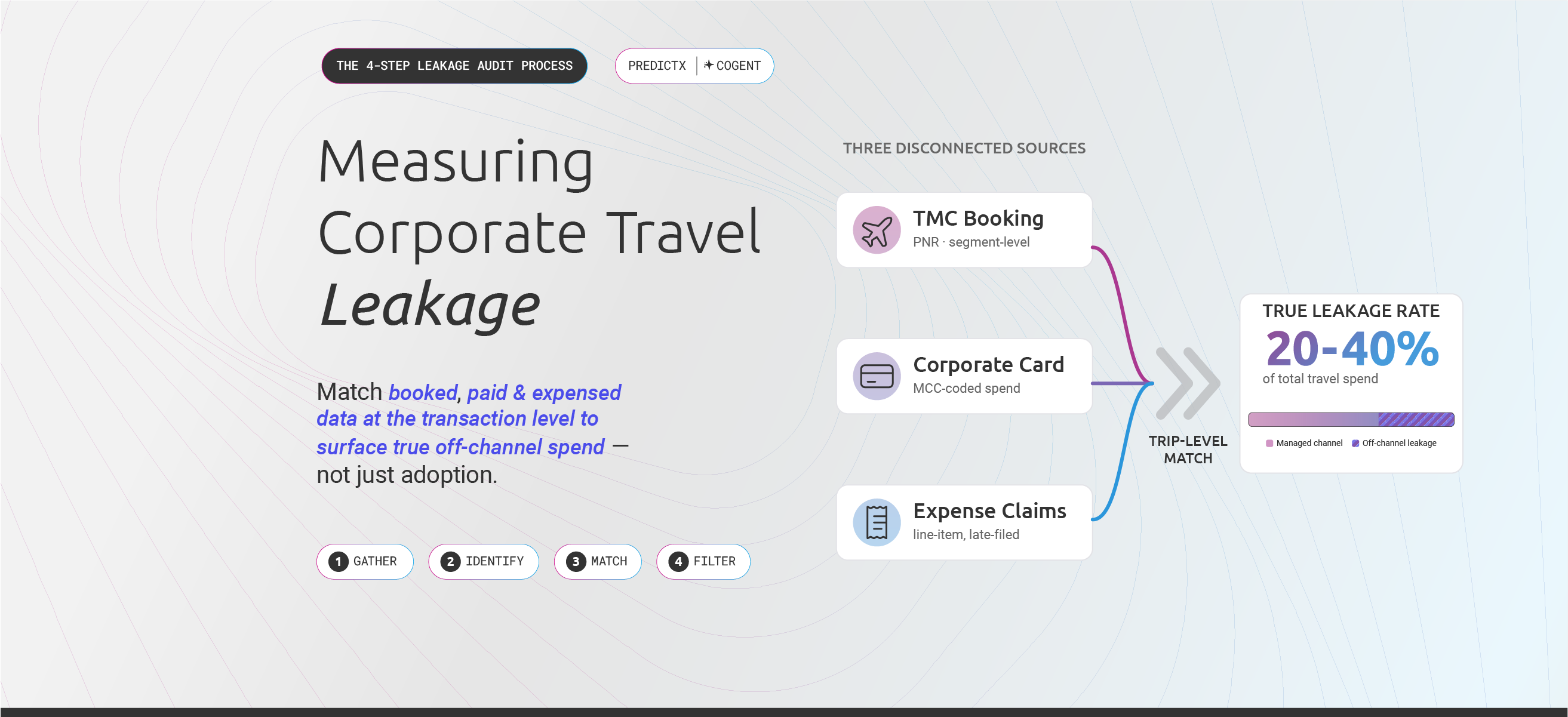
The methodology that agentic AI accelerates is itself a rigorous discipline. For the underlying audit process that produces a defensible leakage rate, see our guide on how to measure corporate travel leakage.
What is the Toggle Tax and why do dashboards fail at leakage detection?
The Toggle Tax is the compounding cost of context-switching between disconnected systems to answer a single leakage question, and it is structural in programmes that rely on traditional dashboards for travel data analytics.
To detect a single off-channel hotel booking pattern, a travel manager using traditional tools needs to:
- Open the TMC booking tool to check hotel bookings by date range
- Switch to the expense platform to check hotel expense claims for the same period
- Log into a card analytics module to cross-reference travel and entertainment expense MCC transactions
- Pull a compliance dashboard to check policy flag rates
- Return to the TMC to match the booking against the card transaction
None of these systems share a common identifier. None of them talk to each other. The travel manager, or more precisely the entire expense management function, becomes the manual connector between them, manually assembling the picture that an agentic AI platform surfaces in under 10 seconds as a single structured output.
The cost of the Toggle Tax is not the hours spent context-switching. It is the decisions that do not get made because the assembly process takes longer than the decision window allows. A leakage anomaly identified three weeks after it starts is a different recovery problem from one identified three hours after it starts.
This is the same conclusion PredictX has reached across multiple enterprise deployments. Their full analysis on moving beyond dashboards into the agentic AI revolution in T&E reporting and expense audit covers why dashboards plateau as a category, regardless of how much polish is layered on top.
Keesup Choe has put it precisely: "The questions that drive programme decisions are almost always answerable from data you already have. The cost is not missing data. It is missing access, at the moment it matters." The Toggle Tax is what makes that access expensive.
Agentic AI is what removes it from the managed travel workflow entirely.
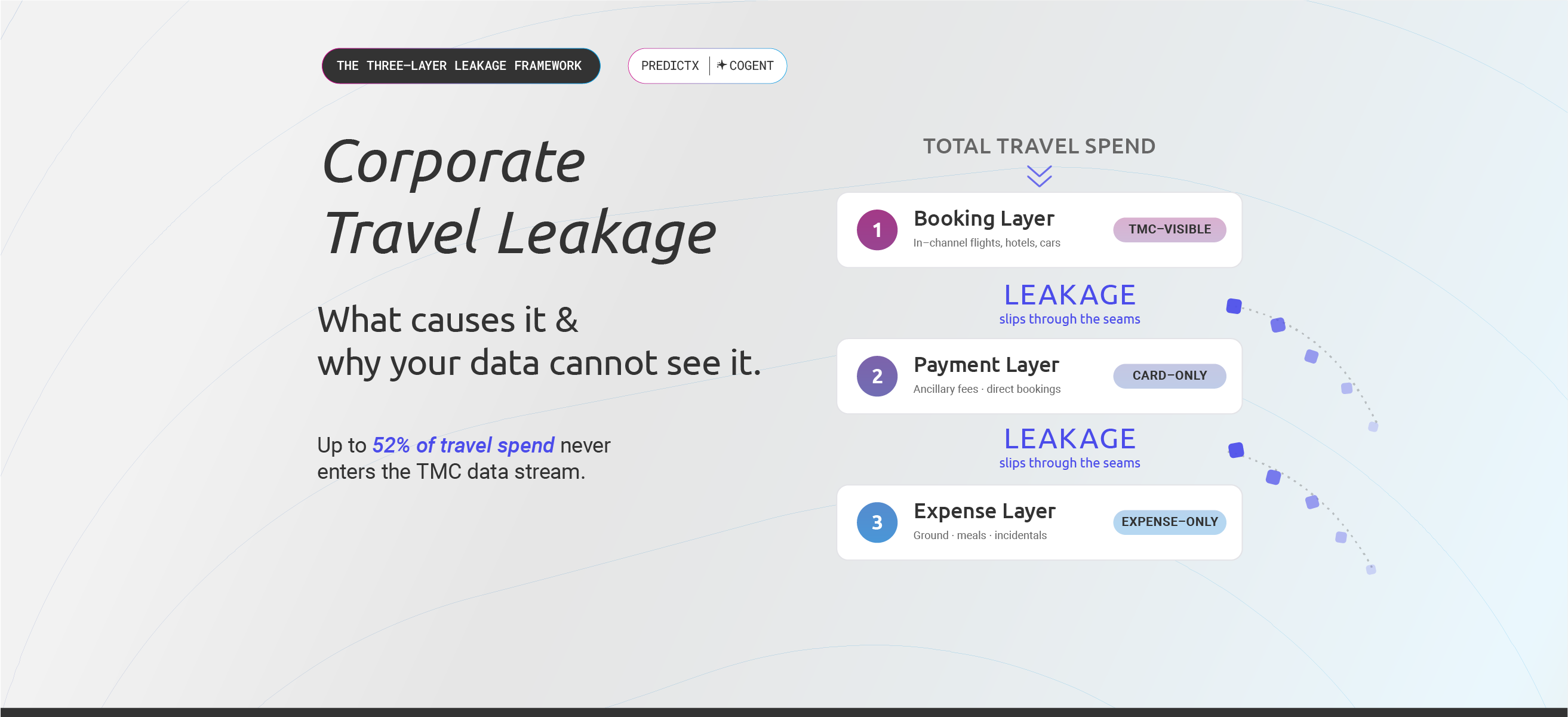
The Toggle Tax is symptomatic of a deeper structural problem: data fragmentation across TMC, card, and expense systems. For the conceptual framework behind that fragmentation, see our companion guide on what causes corporate travel leakage, which introduces the Three Layers of Travel Leakage model.
What does agentic leakage detection look like in practice?
The most powerful demonstration of agentic leakage detection is not what it finds when you ask it to look. It is what it finds before you think to ask.
Three deployment patterns illustrate how this works in practice. They are worth reading before the architecture explanation, because understanding what the outputs look like makes the process that generates them easier to evaluate.
Hotel attachment rate and off-channel detection
At a global pharmaceutical firm with over 10,000 travellers, hotel leakage was rising. Air and hotel data sat in separate silos. Monthly compliance reports were showing declining attachment rates but could not identify why or where.
Cogent was asked a single question: "Show me all international flights in Q1 where no hotel booking was recorded in our system."
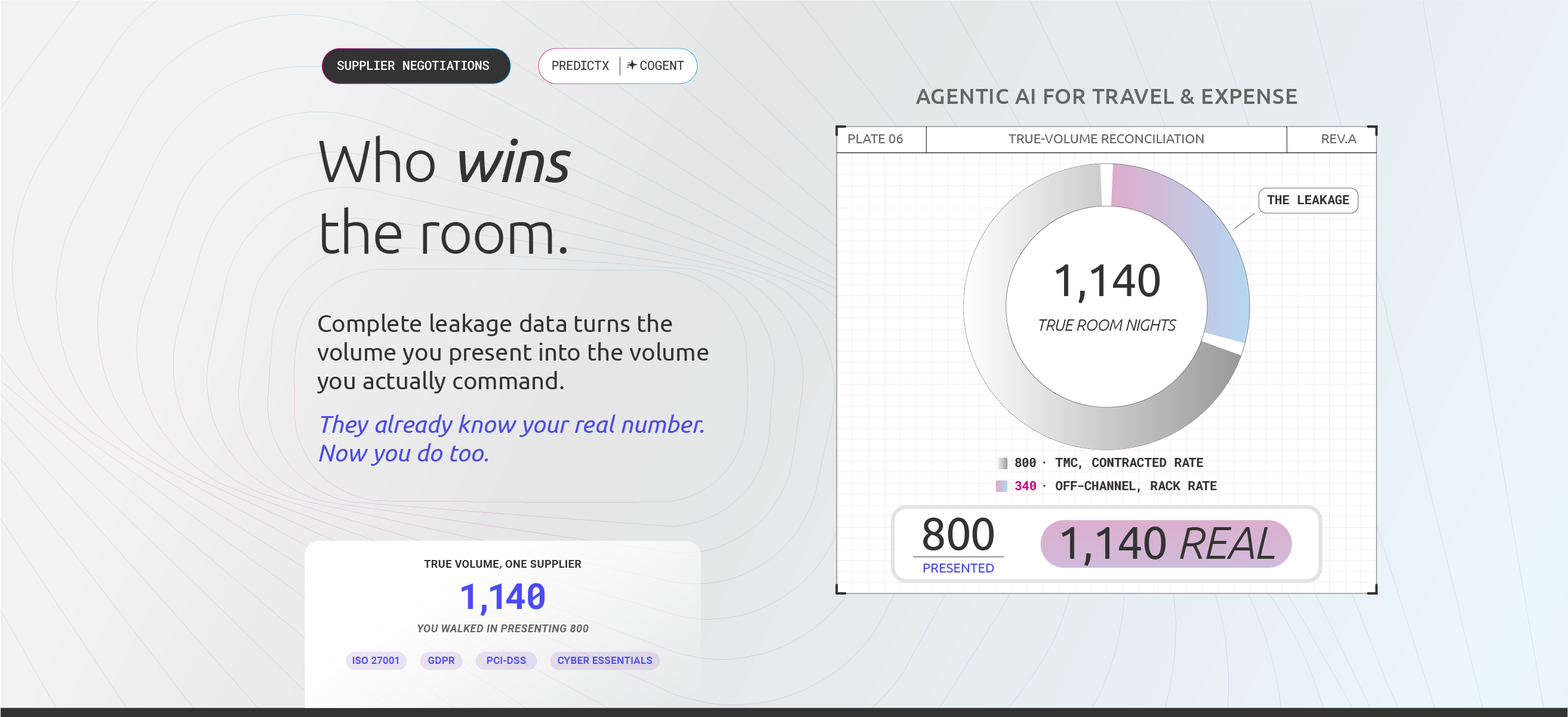
The output showed that 72% of all unattached trips came from one team on two specific routes, booked through a consumer hotel site. The data had been there the entire time. Nobody had looked in that specific way.
The root cause was identified in seconds. Previously, that investigation would have taken three to five days, and by the time the analysis arrived, the quarter would already have moved on.
The cost: a $55 gap per night between open market and corporate negotiated rates on every off-channel booking, based on published industry benchmarks for corporate hotel rate gaps. On thousands of room nights, that gap compounds to a significant annual cost that now has a precise number, a named root cause, and an actionable owner.
Off-channel hotel leakage and department-level attribution
At a global enterprise programme, Cogent flagged 145 instances of off-channel hotel spend in a single quarter and traced 80% to one department at one conference. The travel manager acted in real time.
Estimated savings based on the intervention: £45,000 to £55,000 in a single quarter. Without agentic monitoring, those 145 instances would have surfaced in the monthly report as an aggregate compliance percentage with no department-level attribution, no conference linkage, and no real-time recovery opportunity.
Travel compliance reporting would have flagged this as an attachment rate drop. Expense compliance reporting would have flagged it as an off-policy claim. Neither would have traced it to one conference, one department, in real time. This is the structural difference between monitoring and detection. Monitoring tells you the rate changed. Detection tells you why, where, and what it costs.
Proactive anomaly surfacing during a different query
A travel manager at a global industrial enterprise ran a carrier spend query to prepare for an airline RFP. The explicit question was about average ticket prices by route. Cogent returned the ATP data requested and, proactively, flagged that two internal business divisions were travelling the same long-haul route regularly on the same carrier and paying materially different average fares.
Same route. Same airline. Different business units. Measurably different prices.
That pricing inconsistency had been invisible in the standard dashboard view because the dashboard showed the route total, not the entity-level breakdown. The anomaly surfacing was not requested. Cogent identified it as relevant during the logic step and included it unprompted.
The team entered the RFP with that data. The carrier didn't expect the level of specificity.
This is precisely the scenario covered in our deep dive on travel leakage and supplier negotiations. The full methodology covers how to convert agentic anomaly detection into supplier-facing negotiation inputs: rate gap calculations, volume recovery trajectories, and entity-level fare variance.
According to the GBTA 2025 Corporate Travel Index, managing leakage is a top challenge for 39% of travel buyers. The programmes moving ahead of that majority have shifted their unmanaged travel spend from a visibility problem to a solved one, and their travel expense management model from periodic, retrospective detection to continuous intelligence.
How does Cogent detect corporate travel leakage? The 5-step process
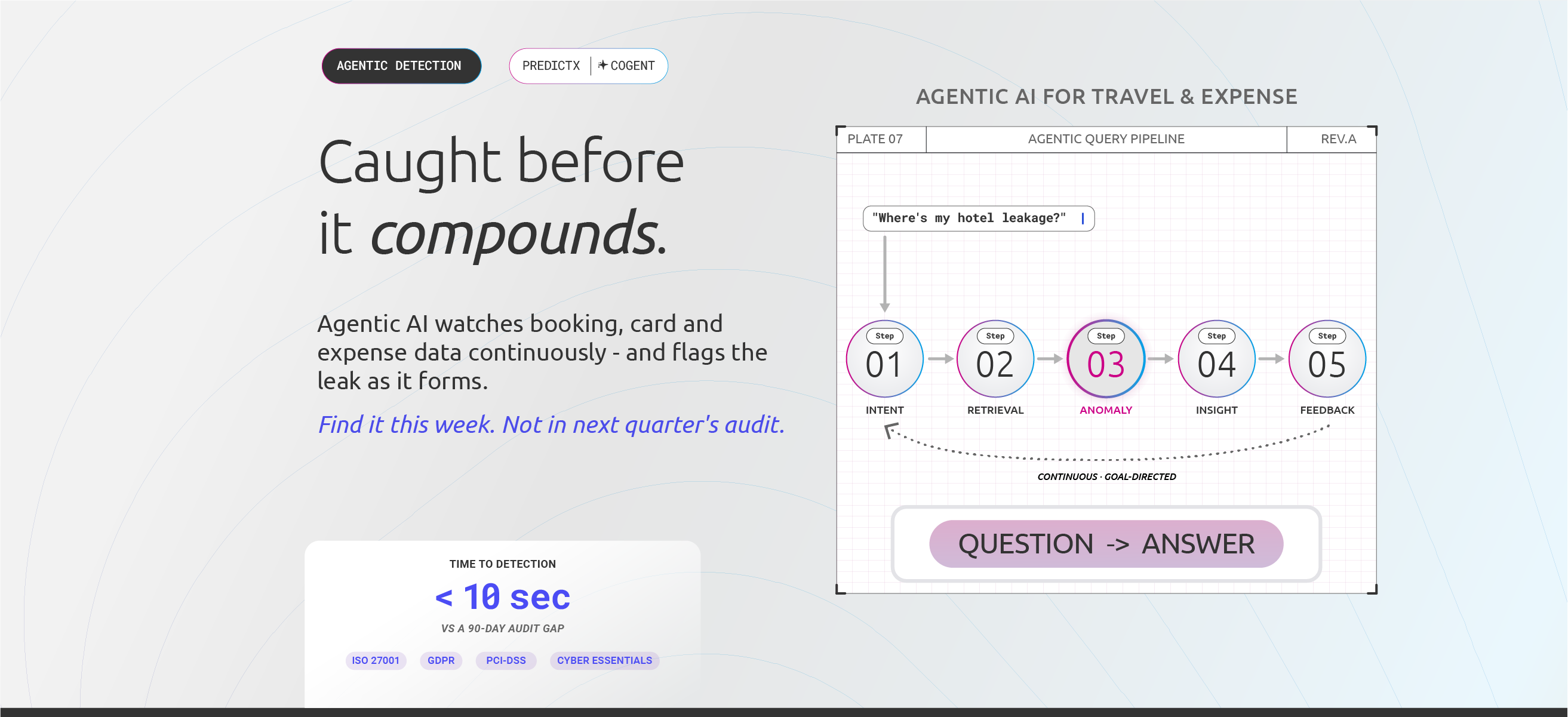
Cogent processes every leakage detection query through a five-step agentic architecture that moves from a plain-language input or autonomous trigger to a structured, finance-ready output with proactive insights, in under 10 seconds, across 100,000+ data points per query.
Step 1: Intent Interpretation
Cogent receives the question in plain language, or triggers autonomously from a monitoring rule. It interprets what is being asked at the level of business intent, not syntax. "Show me all international flights in Q1 where no hotel was booked in our system" is not a database query.
Cogent maps it to the correct data fields, hierarchy levels, and time dimensions across all connected sources simultaneously, without the user needing to know any of that structure exists.
Step 2: Data Retrieval
All 200+ connected data sources are queried simultaneously across the travel programme — TMC feeds, expense systems, corporate card feeds, OBT data, GDS data, supplier portals, HR systems, and General Ledger. This is enterprise-grade data consolidation at query speed. Parallel querying across every connected source is what compresses the answer time to seconds rather than the hours a manual cross-system query requires. Trip analytics, spend patterns, and predictive signals are all processed in a single pass.
Step 3: Logic and Anomaly Calculation
Rate gap calculations, volume comparisons, period-over-period trends, and policy compliance checks are applied at the output of data retrieval. Simultaneously, anomaly detection runs across the full result set, flagging deviations the user did not specifically ask about. This is the step that distinguishes agentic AI from a faster query tool: the anomaly layer is autonomous and doesn't wait to be pointed at a problem.
Step 4: Answer with Proactive Insight
The structured answer to the original question is returned, along with any anomalies and patterns identified during Step 3 that are relevant but were not part of the explicit query. A query about hotel attachment rates might return the attachment rate plus a proactive flag that 72% of unattached trips in the previous quarter came from one team on two specific routes.
Step 5: Feedback and Continuous Improvement
Every interaction is logged and reviewed for accuracy. Response quality improves over time as Cogent learns the specific vocabulary, hierarchy structure, and data patterns of each programme. Every answer is grounded in your actual programme data: your negotiated rates, your policy rules, your booking history.
Not generic AI inference.
What is the Cogent 4-layer architecture for leakage intelligence?
Cogent's agentic leakage intelligence is built on a four-layer architecture: a Data Layer consolidating 200+ sources, an Intelligence Layer applying reasoning and anomaly detection, an Action Layer executing autonomous workflows, and a Feedback Layer improving response quality over time.
Understanding the architecture matters because it explains why agentic AI produces structurally different leakage outcomes from traditional analytics, even when both are working from the same underlying data.
Layer 1: Data Layer
200+ connectors across TMCs, expense systems, corporate cards, OBTs, GDS systems, suppliers, HR systems, and General Ledger, all unified into consolidated travel and expense data in a single queryable foundation. ISO 27001:2017, PCI-DSS, GDPR, and Cyber Essentials certified. Without this layer, even the most sophisticated reasoning produces answers that are only as complete as the data it can reach.
Layer 2: Intelligence Layer
Cogent's reasoning engine interprets plain-language questions, determines what data is needed, applies logic, and surfaces anomalies proactively. Every answer is grounded in your actual programme data: your negotiated rates, your policy rules, your booking history. Not generic AI inference. Predictive analytics built on that foundation is the difference between a system that recognises patterns and one that guesses at them.
Your data, reasoned against in real time.
Layer 3: Action Layer
TMC feeds, card data, expense records, policy parameters, and supplier contracts unified across every entity and geography. The Action Layer moves Cogent beyond answering questions to executing workflows: flagging anomalies, routing exceptions for approval, triggering follow-up actions. Human-in-the-Loop controls are embedded throughout. Every anomaly flagged can be reviewed against travel policy rules, corporate travel compliance thresholds, and total trip cost parameters before any action is taken.
Cogent never commits spend without a human Go or No-Go approval.
Layer 4: Feedback Layer
Every interaction is logged and reviewed for accuracy, improving response quality over time. The Feedback Layer is what makes Cogent's leakage detection progressively more precise as it learns the specific patterns, exceptions, and anomaly baselines of each individual programme.
Why is continuous monitoring better than periodic audits for leakage?
Periodic audits identify leakage that has already run for weeks or months. Continuous agentic monitoring identifies leakage as it begins, when the cost is still recoverable and the root cause is still current.
The difference is not speed. It is recoverability.
A leakage pattern that runs for three months before being identified in an audit may have generated six figures in off-channel spend, involved dozens of travellers across multiple departments, and influenced the procurement team's volume commitment in an RFP negotiation that has already concluded.
The same pattern identified in week one is recoverable. The corporate travel manager can act before the behaviour becomes habitual, before the cost compounds, and before the supplier RFP window opens.
Corporate travel risk management and corporate travel compliance both require continuous detection, not periodic sampling. Continuous detection, powered by travel data and predictive analytics across all three layers, is also what makes structured leakage reduction targetable. Our companion guide on how to reduce corporate travel leakage covers the 5-Lever Framework that operates on top of continuous monitoring data.
The Speed-to-Value comparison from Cogent's enterprise deployment patterns illustrates this clearly:
- Off-channel booking detection: With Cogent: seconds plus root cause. Without Cogent: hours of manual work. And the hours only happen if someone thought to look.
- Policy simulation: With Cogent: seconds. Without Cogent: two to three weeks of analyst work.
- Fraud detection: With Cogent: continuous pre-reimbursement monitoring. Without Cogent: monthly sampling that catches fraud after payment.
Keesup Choe frames the broader shift clearly: "The true potential for AI is not in taking over jobs people already do. It is in doing the work that is not being done, work that is too expensive or requires too much manpower." Continuous leakage monitoring is exactly that work. It's too expensive to do manually across a global programme.
Agentic AI makes it structurally affordable by removing the headcount dependency. Choe expands on this position in his BTN interview on Cogent and agentic AI at PredictX, describing Cogent specifically as a framework rather than an application: "It's not a chatbot; it's not an app. It is an entire platform, a framework from which all of our apps are built." The distinction matters for leakage detection, because frameworks scale where applications don't.
Cogent was recognised as the 2025 BTN Europe Innovation Faceoff Winner, named the Business Travel Technology Innovation Data and Reporting award winner, and was featured on the BTN Europe Hotlist 2026 and the Business Travel Magazine Tech Hotlist, recognitions that reflect the shift in the industry toward agentic, continuous programme intelligence over periodic, dashboard-dependent reporting.
Modern travel programmes do not win on dashboards. The programmes that will control travel spend and travel spend analytics in 2026 and beyond are not the ones with the most of them. They are the ones where leakage is found before it has a chance to compound.
Frequently Asked Questions
What is agentic AI in corporate travel?
Agentic AI in corporate travel is AI that plans, decides, and executes tasks autonomously toward a goal, without waiting to be asked. For leakage detection, it means continuous monitoring across TMC, card, and expense data that surfaces root causes before a compliance report would flag the symptom. Unlike a generative AI assistant, it does not wait for the question.
How is agentic AI different from a standard travel analytics platform?
Standard analytics platforms answer questions when asked, using pre-built reports requiring specialist knowledge. Agentic AI interprets plain-language questions, surfaces anomalies proactively, and executes multi-step analysis autonomously. A standard platform says your attachment rate dropped. An agentic platform says one team on two routes is booking through Booking.com at $55 per night above contracted rates, costing £48,000 per quarter. Same T&E data. Structurally different output.
What is the Toggle Tax in corporate travel?
The Toggle Tax is the compounding cost of context-switching between six or more disconnected systems to answer a single leakage question, making the travel manager the manual connector between tools that never communicated. The cost is not the hours spent switching. It is the decisions that do not get made because the assembly takes longer than the decision window allows.
How does Cogent detect off-channel hotel bookings?
Cogent detects off-channel hotel bookings by continuously matching card transactions against TMC booking records, flagging unmatched transactions, and identifying the root cause at department and route level. In one deployment, Cogent flagged 145 instances in a single quarter and traced 80% to one department at one conference, producing an estimated £45,000 to £55,000 quarterly saving.
What data sources does Cogent connect to for leakage detection?
Cogent connects to 200+ data sources through its Data Layer, including TMC feeds, corporate card systems, expense platforms, OBTs, GDS data, supplier portals, HR systems, and General Ledger. All sources are queried simultaneously on each request. The practical implication: a leakage query that would require context-switching across six separate systems in the traditional workflow arrives as a single structured output from one plain-language question.
How long does it take for Cogent to identify a leakage anomaly?
Cogent's average response time is under 10 seconds, processing over 100,000 data points per query with a 99% reliability rate. For continuous monitoring, anomalies are flagged as data arrives rather than at a scheduled report run. The detection gap collapses from the industry-typical 60 to 90 days to hours or less.
Key takeaway The pharmaceutical firm example in this post is not about technology. It is about the cost of a 90-day detection gap. Three months of undetected off-channel bookings at $55 per night above contracted rates, across a team that travels frequently on two specific routes, is a quantifiable, recoverable cost that becomes unrecoverable the moment the quarter closes. Multiply that pattern across a global programme's full portfolio of leakage anomalies, and the financial case for continuous agentic monitoring is not a technology investment question. It is an arithmetic one. The question is not whether your programme can afford Cogent. It is whether it can afford the 90-day gap.
Ready to Move from Periodic Audits to Continuous Leakage Detection?
Related Posts
How to Reduce Corporate Travel Leakage: The 5-Lever Framework
%20(7).png)
How Leakage and Invisible Spending influences Your Travel Program
How to Measure Corporate Travel Leakage: The 4-Step Audit Process
Corporate Travel Leakage: What Causes It and Why Your Data Cannot See It