

Executive Summary
Senior buyers and procurement leaders managing complex global programmes face a consistent gap: travel dashboards built for the top of the organisation cannot answer the specific, entity-level questions that regional leadership asks in the room. This article explains why that gap is structural, what immediate entity-level travel spend analytics actually looks like in practice, and how agentic AI closes the distance between the question and the answer.
What you will take away:
- Why standard T&E reporting dashboards fail at delivering legal entity, local currency, and cross-period queries simultaneously.
- How Cogent by PredictX treats every question as a unique request, returning the specific answer in plain English, in seconds, without a data team queue
- A real-world procurement scenario showing how entity-level data changes an airline RFP negotiation before it begins
- The PredictX T&E Analytics Maturity Model, a four-level framework for benchmarking where your programme currently sits
- How the same entity-level capability applies across hotel, rail, corporate card, and sustainability reporting
Who this is for: Travel managers, procurement leaders, and finance directors running multinational programmes across multiple legal entities, currencies, and regional business units.
What is entity-level travel spend analytics?
Entity-level travel spend analytics is the ability to reach any answer from your T&E data, on demand, in plain language, without needing to know which dashboard to open, which filter to apply, or which view to build, and without waiting for analyst output.
In This Article
- Why a "good" travel dashboard still leaves you saying "I'll pull a custom report"
- Why getting to the right answer in your dashboard takes so long
- What Cogent actually does: removing the navigation layer
- What this looks like in practice
- The same capability across every spend category
- The maturity model: from global dashboards to entity intelligence
- Why the gap between dashboards and leadership questions will only widen
- Frequently Asked Questions
Your Travel Dashboard Has the Data. But Do You Know How to Find It?
Entity-level travel spend analytics is not about whether your dashboard holds the data. It almost certainly does. The real problem is what happens between having the data and getting the answer: the wrong chart, the wrong filter, the wrong level of your company hierarchy, a table that does not exist yet, a dataset you cannot identify. For most travel managers, getting from the question to the answer is more time-consuming than it should be, often requires someone who knows the system deeply, or simply does not happen before the moment has passed.
That gap, between how the data is structured and how the questions are asked, is where time is spent and decisions get made without the full picture.
That is the gap Cogent closes. Not by replacing your dashboard, but by making every answer inside it immediately reachable, in plain language, without knowing in advance which filters to apply or which view to build.
Why Does a "Good" Travel Dashboard Still Leave You Saying "I'll Pull a Custom Report"?
The problem with most travel dashboards is not the data they hold. It is the time and expertise required to get from a question to an answer. Finding the right chart, applying the right filters, navigating the right level of company hierarchy, or building a view that does not yet exist: each of those steps adds friction, requires specialist knowledge, and creates delay that most travel managers cannot afford.
Your dashboard probably contains the answer to most questions a CFO, regional VP, or procurement lead would ask. The problem is that getting to that answer is not straightforward for someone who did not build the system and does not live inside it every day.
The moments that expose this gap follow a recognisable pattern:
- "I need spend by the sales team, but there are four levels of company hierarchy and I am not sure which one to filter on."
- "I know the chart exists somewhere, but I cannot find the right dashboard for this."
- "The graph I need does not exist as a pre-built widget. I would need to create one from scratch, which means identifying the right dataset first."
- "I want to apply a specific filter, but I do not know which field name maps to what I am looking for."
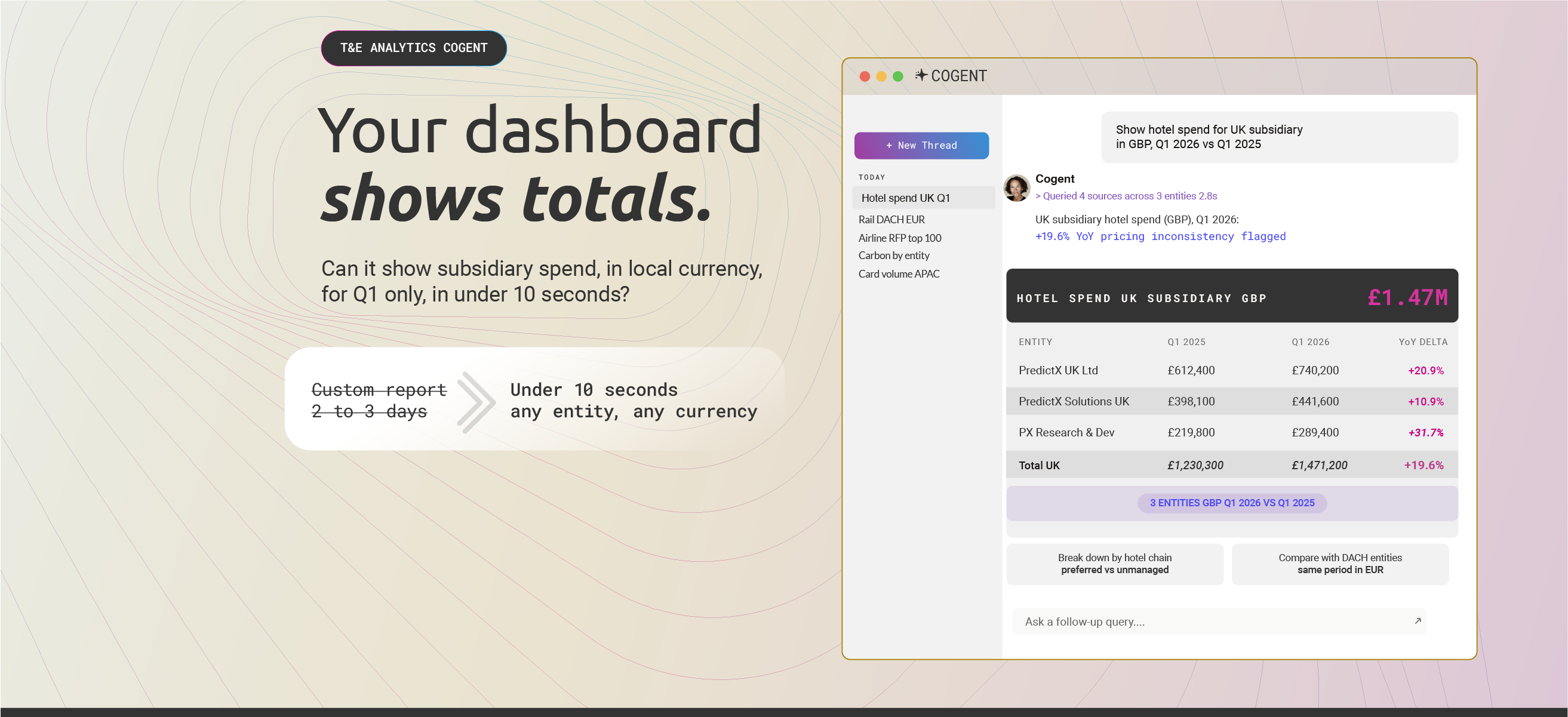
- "Can you show me rail spend for our Central European entities in EUR, compared to the same quarter last year?"
These are not failures of the data. They are failures of access. The answer is in the system. The travel manager just cannot reach it in the time the meeting requires.
And the result is always the same: "I'll need to pull a custom report for that."
That answer has a cost beyond the time it takes. By the time the output arrives, the meeting has happened. The negotiation has started without it. The decision has been made on the information that was easy to get, not the information that was actually needed.
"The questions that drive programme decisions are almost always answerable from data you already have. The cost is not missing data. It is missing access, at the moment it matters." Keesup Choe, CEO, PredictX
Why Getting to the Right Answer in Your Dashboard Takes So Long
Travel dashboards are built by data teams who understand the system deeply. They are used by travel managers who often do not. That gap, between how the data is structured and how the questions are asked, is where time and decisions are lost.
The friction is not one problem. It is several, layered on top of each other, and each one adds delay:
Finding the right chart or dashboard. Most enterprise T&E platforms contain dozens of pre-built views across multiple modules. When a question does not map neatly to a named report, the travel manager has to search for the right starting point, or ask someone who built the system to point them to it.
Applying the right filters without the guesswork. "Show me spend for the sales team" returns the correct result even when the right filter combination is not obvious. T&E data can be sliced by dozens of dimensions, and selecting the wrong one returns the wrong number. Cogent resolves the ambiguity from the plain-language description, without the user needing to know which fields to combine.
Finding the right field name. The field in the system may not be labelled the way the business talks about it. "Sales team spend" might live under a cost centre code, a department name, or a subsidiary identifier. Without knowing the data model, the filter search returns nothing or the wrong thing.
Building a view that does not exist. When the required analysis has not been pre-built as a widget or dashboard, the travel manager faces a choice: request it from a data team, or attempt to build it from scratch by identifying the right dataset, the right dimensions, and the right visualisation type. For most travel managers, the first option means days of waiting. The second is not realistic without technical support.
Creating a specific table layout. Structuring data into a particular output format, such as a comparison table of spend by entity across two periods, would typically require working in a BI tool, an export to a spreadsheet, or a custom request. The underlying data is there. Getting it into the right shape is the barrier.
The three friction points that consistently cause delay in live programmes:
"Dashboards hold the answers. The problem is that reaching them requires knowledge most travel managers do not have and time most meetings cannot spare." PredictX Cogent Team
This is the intelligence gap that defines the difference between a managed programme and a reactive one. Enterprise travel and expense data analytics has advanced significantly in recent years. But the ability to answer any question from existing data, in plain language, without knowing the system's structure in advance, remains the capability that separates the best programmes from the rest. Learn more in our deep-dive on T&E reporting beyond dashboards.
What Cogent Actually Does: Removing the Navigation Layer
Cogent by PredictX removes the navigation layer entirely. Instead of searching for the right chart, applying the right filter, or building a view from scratch, users describe what they need in plain language and receive a structured, analysis-ready output in seconds, without knowing the data model, without touching a BI tool, and without raising a support ticket.
The difference is not about having better data. Cogent's agentic AI layer sits on top of the same consolidated travel and expense data your dashboard already uses: TMC feeds, hotel data, rail, corporate card, and expense systems. The data is identical. What changes is how you reach it.
Six things Cogent makes immediately accessible that would otherwise require navigation, expertise, or a data team:
Finding the right chart or dashboard. Instead of searching across modules, the travel manager describes what they need. Cogent identifies and surfaces the relevant data directly, without the user needing to know which pre-built view contains it.
Applying the right filters without knowing the hierarchy. "Show me spend for the sales team" returns the correct result even when the sales team sits four levels deep in the company hierarchy and the user is unsure whether to filter by cost centre, business unit, or legal entity. Cogent resolves the ambiguity from context.
Finding the right field name. Users describe what they want in business language, not system language. Cogent maps "sales team travel" to the correct underlying field identifiers without requiring the user to know what those fields are called in the data model.
Building a specific chart or table from scratch. When the required analysis does not exist as a pre-built view, Cogent generates the relevant graph or table on demand. No dataset identification required. No BI tool access required. Just the question, in plain language.
Creating a specific table layout. Structuring data into a particular output, a comparison of spend by entity across two periods, spend per traveller by department, top fifty routes by average fare, happens in response to a description. The same output that would require an analyst to export data, structure it manually in a spreadsheet, and format it for presentation is returned in seconds.
Cross-period and cross-entity analysis. Comparing a full prior year against a defined current quarter, for a specific internal entity, in local currency, is a single natural-language request. Not a multi-step export and reconciliation exercise.
How It Works
- Plain-language input. The travel manager describes what they need, the way they would explain it to a colleague. No filter navigation. No field name knowledge. No dashboard search.
- Intelligent data retrieval. Cogent maps the request to the correct data fields, hierarchy levels, and time dimensions across all connected T&E sources simultaneously.
- Structured output. Results are returned in an analysis-ready format, filterable, exportable, and ready to use in a negotiation, a leadership brief, or a budget review, before the meeting ends.
What previously required knowing the system, finding the right starting point, and building the view manually is now a single sentence.
The "Aha" Moment: When Entity-Level Data Changes the Negotiation
The procurement value of Cogent is not just faster reporting. It is the ability to walk into a supplier negotiation with a level of specificity the supplier does not expect, because you could reach data that previously required hours of preparation in the time between meetings.
Consider a travel manager preparing for an airline RFP. The data needed for a precise negotiation exists in the dashboard. The problem is knowing which view to pull, which hierarchy level to filter on, and how to structure the output to show divisional spend alongside route-level totals. Without Cogent, that preparation requires an analyst, a data request, and time the programme manager usually does not have.
Cogent surfaces the same data sliced by internal business division. What it reveals: two internal divisions are travelling the same long-haul route regularly, same carrier, same origin and destination, but paying materially different average fares.
Same route. Same airline. Different business units. Measurably different prices.
This is a pricing inconsistency that should have been visible before the last RFP cycle. It was not, because no one had pulled the entity-level view. The dashboard showed the route. It did not show the divisional breakdown that made the pricing gap visible.
The travel manager now enters the airline negotiation with their own granular data, broken down by entity and route, rather than relying on the carrier's aggregated estimates. The conversation changes, because the programme manager knows more than the supplier expected them to know.
This is what the best procurement teams have always done instinctively. They find the internal pricing inconsistency before the supplier meeting. They know which entities are travelling at above-average rates. They arrive with specificity, not just totals.
The difference Cogent makes is making that capability available to every travel manager, not just the ones with a data analyst available before every negotiation. See how vendor negotiation intelligence works in practice.
What This Looks Like in Practise
In one Cogent deployment at a large multinational, a travel manager ran a carrier spend query broken down by internal business division ahead of an airline RFP. The query surfaced that two divisions travelling the same route regularly were paying measurably different average fares on the same carrier. Neither division had flagged it. The dashboard had never shown it.
The travel manager brought that divisional breakdown into the RFP negotiation. The carrier's opening position was based on programme-wide averages. The travel manager's position was built on the entity-level split. The rate alignment conversation that followed would not have been possible with a standard dashboard view.
A second deployment pattern: a global programme with travel activity across more than twenty legal entities needed to compare rail spend by entity across two consecutive reporting periods, in local currencies, for a regional budget review. With previous tools, that query was a multi-day analyst exercise. With Cogent, it was a single plain-language question. The answer arrived in the same conversation, before the review meeting started.
"Cogent was developed to solve the exact challenges travel managers face daily, with no heavy lifting required. Seamless results, faster decisions." Keesup Choe, CEO, PredictX
"The best procurement teams walk into supplier negotiations knowing more than the supplier expects them to know. Entity-level analytics is what makes that possible for every travel manager, not just the ones with a data analyst on speed dial." , PredictX Cogent Team
The Same Capability Across Every Spend Category
The same capability that removes navigation friction from airline analysis applies identically across every spend category in a modern travel programme. Hotel, rail, corporate card, sustainability: in each case, the data exists. The barrier is reaching it quickly enough to matter.
The common thread is not the spend category. It is the same underlying problem: a question asked in a meeting, a dashboard that holds the answer, and a gap between them that costs time, confidence, and decisions made on incomplete information.
Hotel programme: Room nights, average daily rate, and total accommodation spend at specific preferred properties, filtered by a defined set of internal company codes. For a worked example of how this surfaces leakage, see hotel attachment rate analysis with Cogent. This is the data that makes a hotel chain volume argument credible, real room nights from specific entities, not a programme-level estimate.
Rail and ground transport: Comparing rail spend across entities and periods to identify where managed versus unmanaged booking patterns differ by region. For European programmes where rail is a primary travel category, this is material, and it is rarely visible at entity level in standard dashboards.
Corporate card programme visibility: Tracking card spend across business units reveals which teams are booking within managed channels and which are booking outside them. That visibility is the starting point for understanding where policy compliance is breaking down and where negotiated rates are being bypassed.
Sustainability reporting by entity: For programmes with auditable corporate sustainability goals, the entity-level breakdown is not a nice-to-have, it is a compliance requirement. Carbon emissions by legal entity, for a defined reporting period, in a format that maps to the organisation's sustainability framework. This is a query that defeats most standard dashboards entirely.
For complex global programmes where spend is fragmented across dozens of legal entities, that on-demand granularity is not a reporting convenience. It is the difference between managing the programme and reacting to it.
"The true potential for AI is not in taking over the jobs and tasks that people already are doing, but in doing the work that is not being done by humans, that is too expensive or requires too much manpower." Keesup Choe, CEO, PredictX
Entity-level analytics across hotel, rail, and sustainability is exactly that kind of work: theoretically possible for years across every programme, but never practical at the frequency or depth that decisions actually require. Cogent makes it routine.
The Maturity Model: From Global Dashboards to Entity Intelligence
The shift from top-level programme dashboards to entity-level intelligence reflects a broader maturation in how enterprise travel and expense management is practised, and the organisations advancing furthest are not necessarily the ones with the biggest budgets.
Most global programmes believe they are operating at a higher analytical maturity than they actually are. The indicator is not whether the data exists. Almost every enterprise T&E system holds the data. The indicator is how long it takes to reach it, and whether the answer arrives before or after the decision it was meant to inform.
The PredictX T&E Analytics Maturity Model:
Most programmes at Level 2 believe they are at Level 3 because the data is technically accessible. The test is whether anyone on the team can reach the answer they need, independently, in the time the meeting requires, without knowing the data model.
Why the Gap Between Dashboards and Leadership Questions Will Only Widen
As multinational travel programmes grow more complex, more legal entities, more currencies, more regional supplier relationships, the distance between what a standard corporate travel management dashboard can show and what regional leadership actually needs to know will increase, not decrease.
The structural driver is organisational complexity, not analytical capability. As companies expand through acquisition, geographic growth, and operational restructuring, the number of legal entities, cost centres, and regional business units that need to be visible in travel analytics multiplies. The standard dashboard, built for simplicity at programme level, does not scale with that complexity.
The organisations getting the most value from their travel and expense data analytics are not necessarily the ones with the most sophisticated BI platforms. They are the ones that can answer the question their CFO, regional VP, or procurement lead asks in the room, without saying "I'll get back to you."
That capability is not a data engineering project. It is a navigation layer, the ability to reach any answer from data that was always there, in plain language, without knowing the system, without waiting for a data team, and without the question being lost between meetings.
According to the GBTA Business Travel Index 2025, global business travel spending is projected to reach $1.57 trillion in 2025, with growth continuing into 2026. As that spend scales across more entities and markets, the analytical demand on travel programmes grows with it. At the same time, a commissioned study by Forrester and Airtable found that knowledge workers in large organisations spend nearly 29% of their working week searching for information across disconnected systems. In a corporate travel context, that is the analyst time spent building the cross-silo extract that Cogent replaces with a single query.
The gap between confidence and capability is where the entity-level problem lives. And as Business Travel Executive noted in its 2026 AI industry roundup, travel data fragmentation across GDS, expense, and payment systems remains the primary obstacle to AI-driven analytics in the sector: "The biggest challenge in travel AI isn't model sophistication. It's data fragmentation."
The travel managers and procurement leaders who close that gap first will not just be better reporters. For a broader view of how agentic AI is reshaping the function, see agentic AI for modern travel management. They will be better negotiators, better programme managers, and better partners to the regional leadership teams that increasingly need answers, not apologies.
Key Takeaway
Your travel dashboard is not failing you because it lacks data. It almost certainly holds the answer to every question your CFO, regional VP, or procurement lead will ask. It is failing you because reaching that answer requires knowing the system, navigating the hierarchy, finding the right chart, and building the view, steps that most travel managers cannot complete in the time a live meeting allows. Cogent removes those steps. The data was always there. Now anyone on the team can reach it.
Frequently Asked Questions
What is entity-level travel spend analytics and why does it matter?
Entity-level travel spend analytics is the ability to query travel and expense data filtered by specific legal entity, subsidiary, currency, and time period simultaneously, without requesting a custom report. It matters because multinational organisations manage travel spend across dozens of legal entities, each with different reporting needs, supplier relationships, and compliance obligations. Standard dashboards show programme-level totals; entity-level analytics reveals the specific data that drives procurement negotiations and regional budget decisions.
Why does getting a specific answer from a travel dashboard take so long even when the data exists?
Most travel dashboards hold comprehensive T&E data but are built for users who know the system. Getting from a business question to a specific answer requires finding the right report, selecting the correct level of company hierarchy, knowing which field names map to the business concept being measured, and in many cases building a view that does not yet exist as a pre-built widget. Each step requires either system knowledge or data team involvement. For travel managers without that expertise, or in situations where time does not allow for it, the answer simply does not arrive in time to be useful.
How does agentic AI improve T&E reporting for multinational travel programmes?
Agentic AI improves T&E reporting for multinational programmes by replacing fixed-filter dashboards with a plain-language query layer, allowing travel managers to ask any multi-dimensional question and receive a structured, analysis-ready answer in seconds. Rather than navigating pre-built reports, users type the question they actually need answered, specifying entity, currency, period, and spend category in natural language. The agentic system queries consolidated T&E data across all connected sources and returns the result without requiring analyst preparation.
What types of questions can Cogent by PredictX answer that a standard dashboard cannot?
Cogent handles any question where the barrier to getting an answer is navigation, system knowledge, or build time rather than the availability of data. This includes questions where the user does not know which hierarchy level to filter on, where the required view does not exist as a pre-built widget, where a specific table layout needs to be created on demand, and where a cross-period or cross-entity comparison would require manual export and reconciliation. Any question a travel manager can describe in plain language, Cogent can answer from the underlying T&E data, without requiring the user to know how that data is structured.
What is the difference between T&E reporting and travel spend analytics?
T&E reporting delivers structured, after-the-fact summaries of travel and expense data, typically at programme level, for defined periods, in pre-built formats. Travel spend analytics is the active, on-demand querying of that same data to answer specific business questions in real time. The distinction matters because reporting tells you what happened; analytics tells you what is happening and what the data means for the decision you are about to make. Entity-level travel spend analytics represents the most advanced layer of this capability, available on demand, without analyst intermediation.
Related Posts
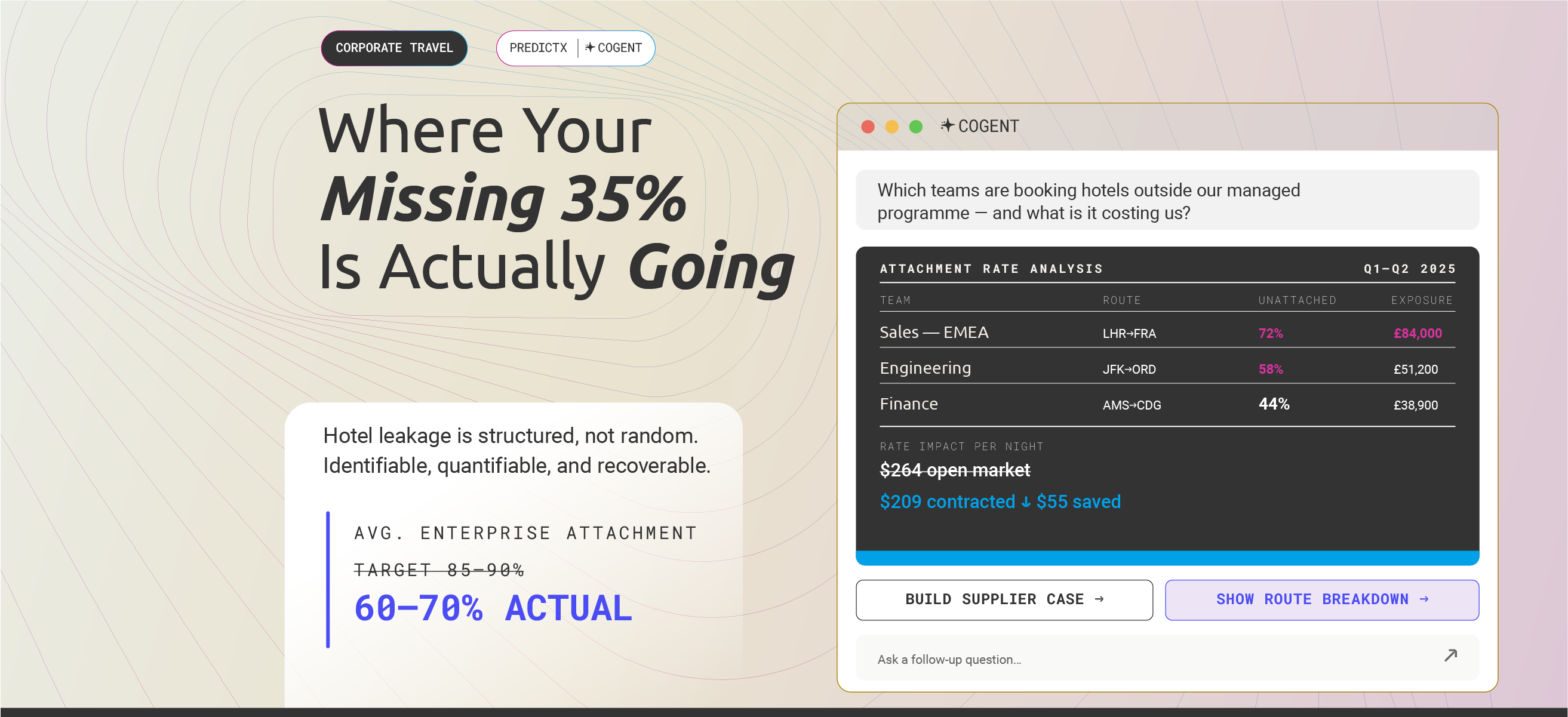
Hotel Attachment Rate: Where Your Missing 35% Is Going

Vendor Negotiation Intelligence: How Enterprise Travel Teams Stop Negotiating Blind
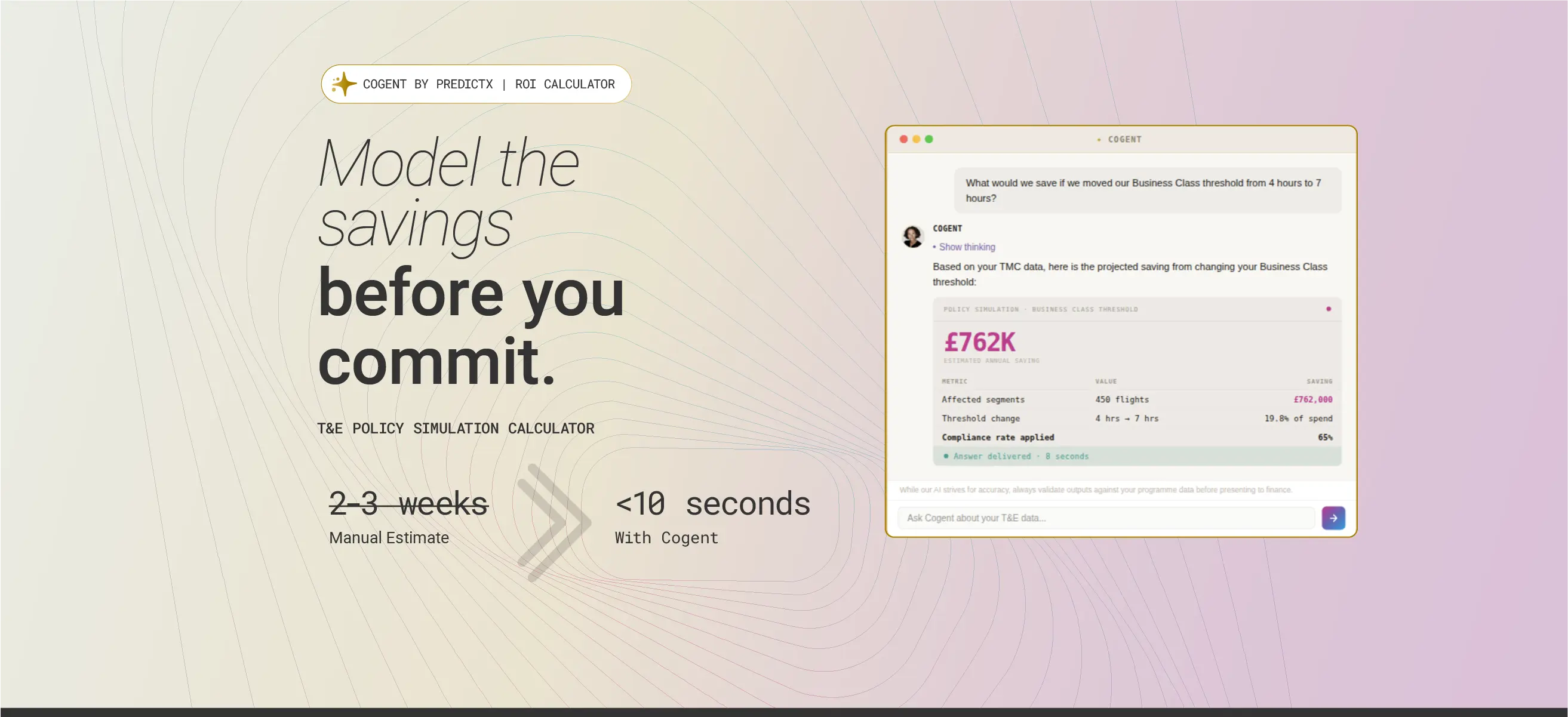
T&E Policy Simulation Calculator: Model Policy Changes Before You Commit
Travel and Expense Data Analytics: How Enterprise Teams Use Agentic AI to Move From Reporting to Real Decisions
Agentic AI for T&E: Guide to Modern Travel Management
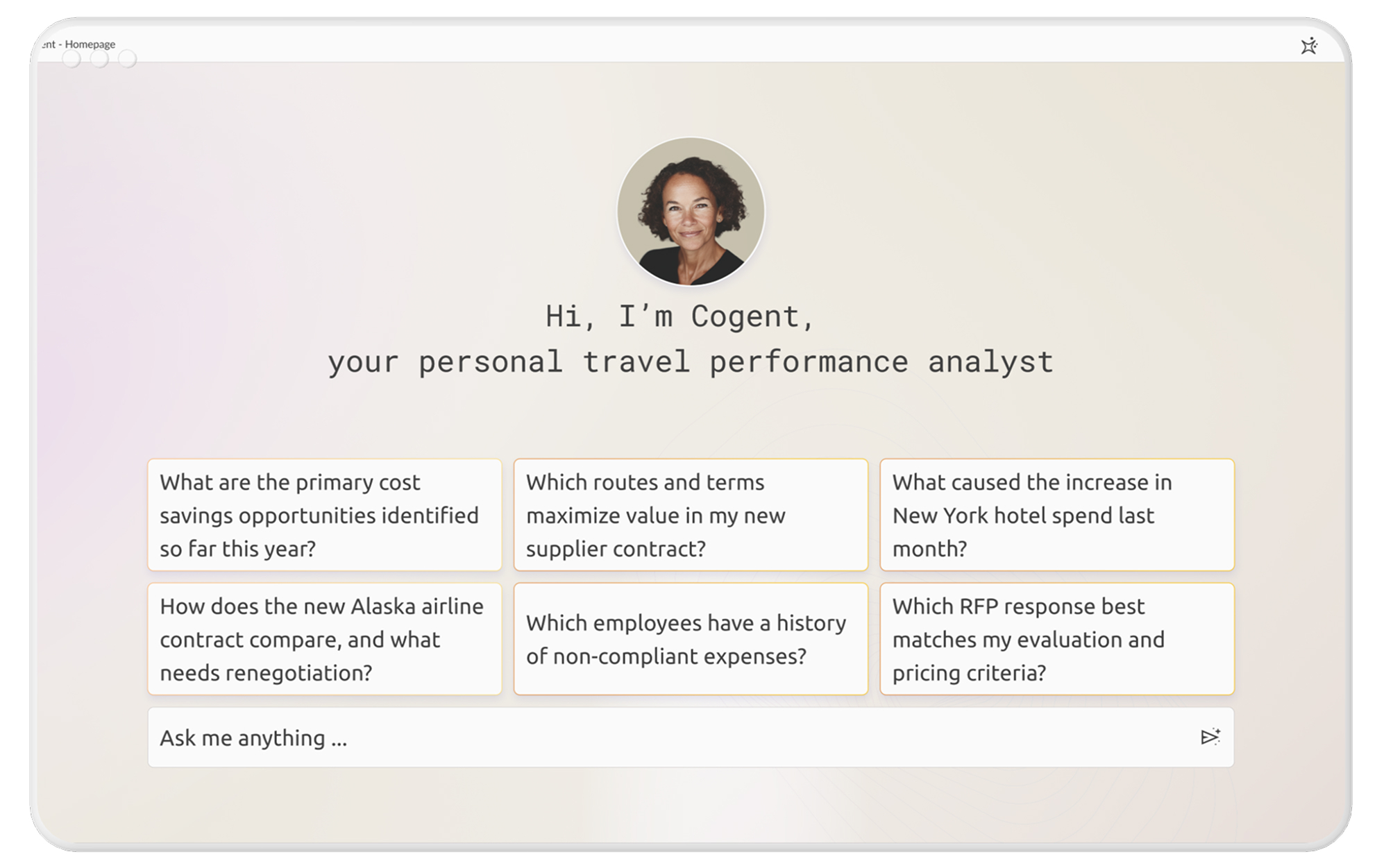
6 Powerful Cogent Use Cases for Travel & Expense (T&E) Reporting, Travel Data & Predictive Analytics with Agentic AI
.webp)
Beyond Dashboards: Cogent - The Agentic AI Revolution in T&E Reporting & Expense Audit
.webp)
Cogent Wins 2025 BTS Europe Innovation Faceoff: Setting a New Benchmark for AI-Driven Travel & Expense (T&E) Solutions
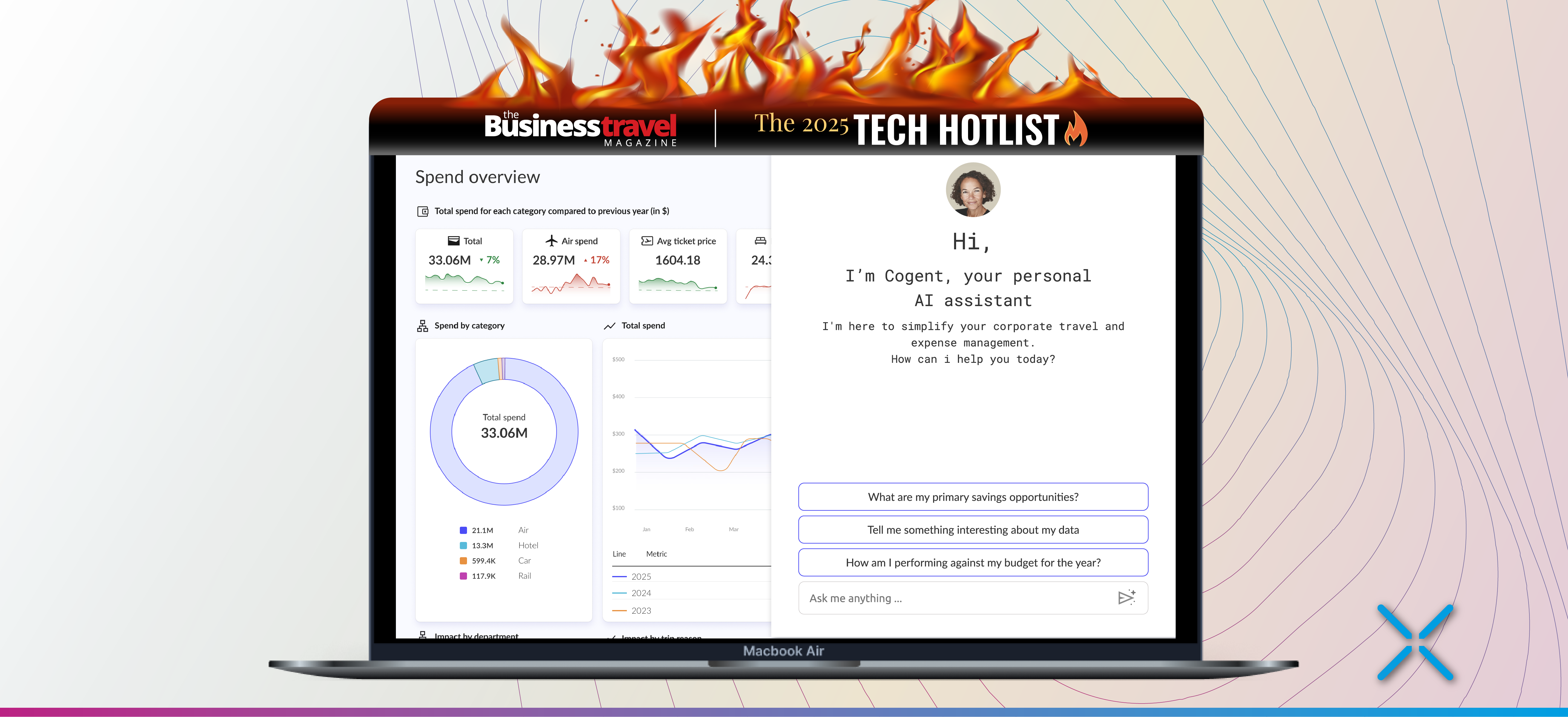
Hot List, Hot News: We've Been Named to the Tech Hotlist for Redefining Corporate Travel with Cogent Agentic AI

How Cogent’s Agentic AI Revolutionizes T&E Reporting with RAG

Mastering the Future of Corporate Travel with Cogent Agentic AI: An Exclusive Interview with PredictX CEO Keesup Choe
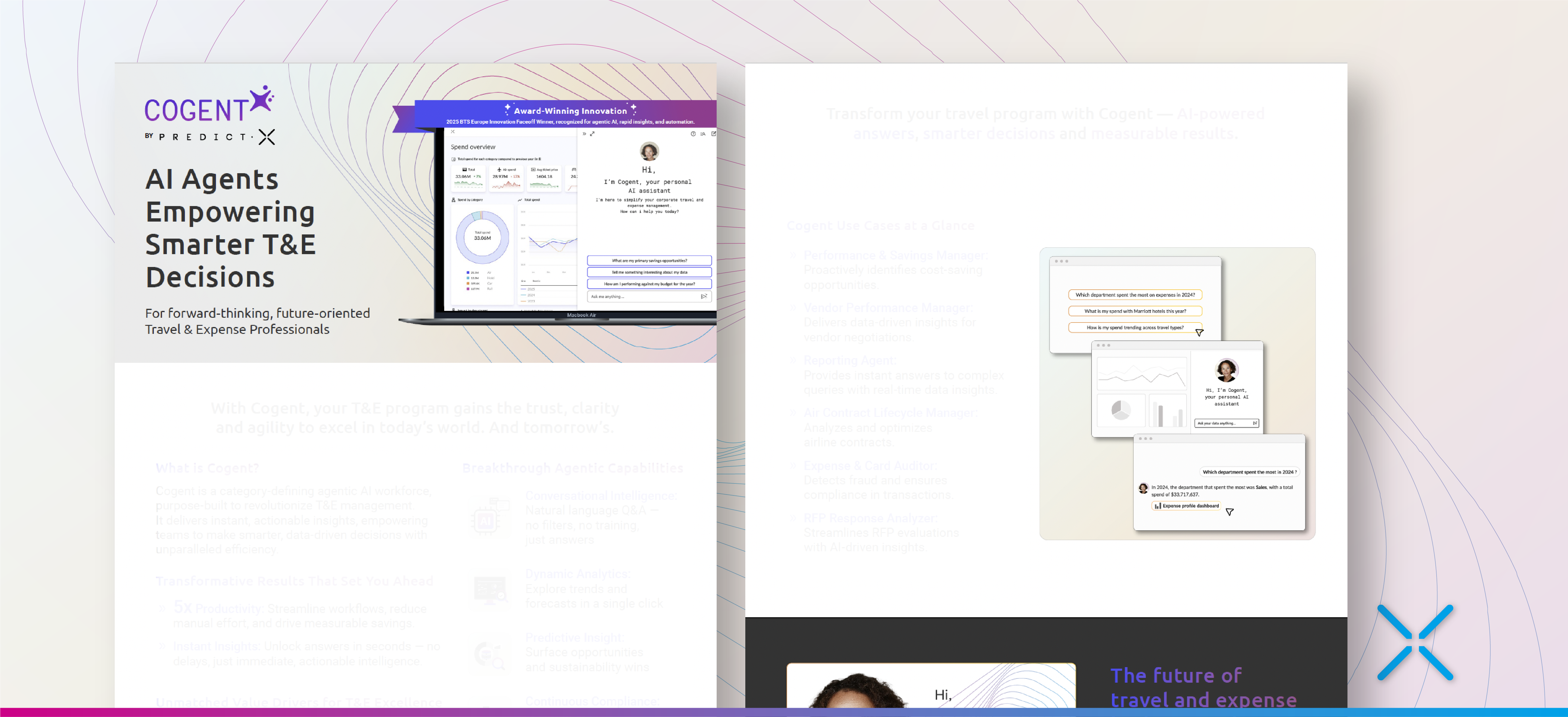
Product Sheet | Cogent - AI-Powered Travel and Expense (T&E) Reporting
Prompt Engineering for T&E: Mastering Cogent Agentic AI to Drive Savings
The Future of T&E Reporting: A Conversation with Our CEO and BTN Group | Cogent Agentic AI
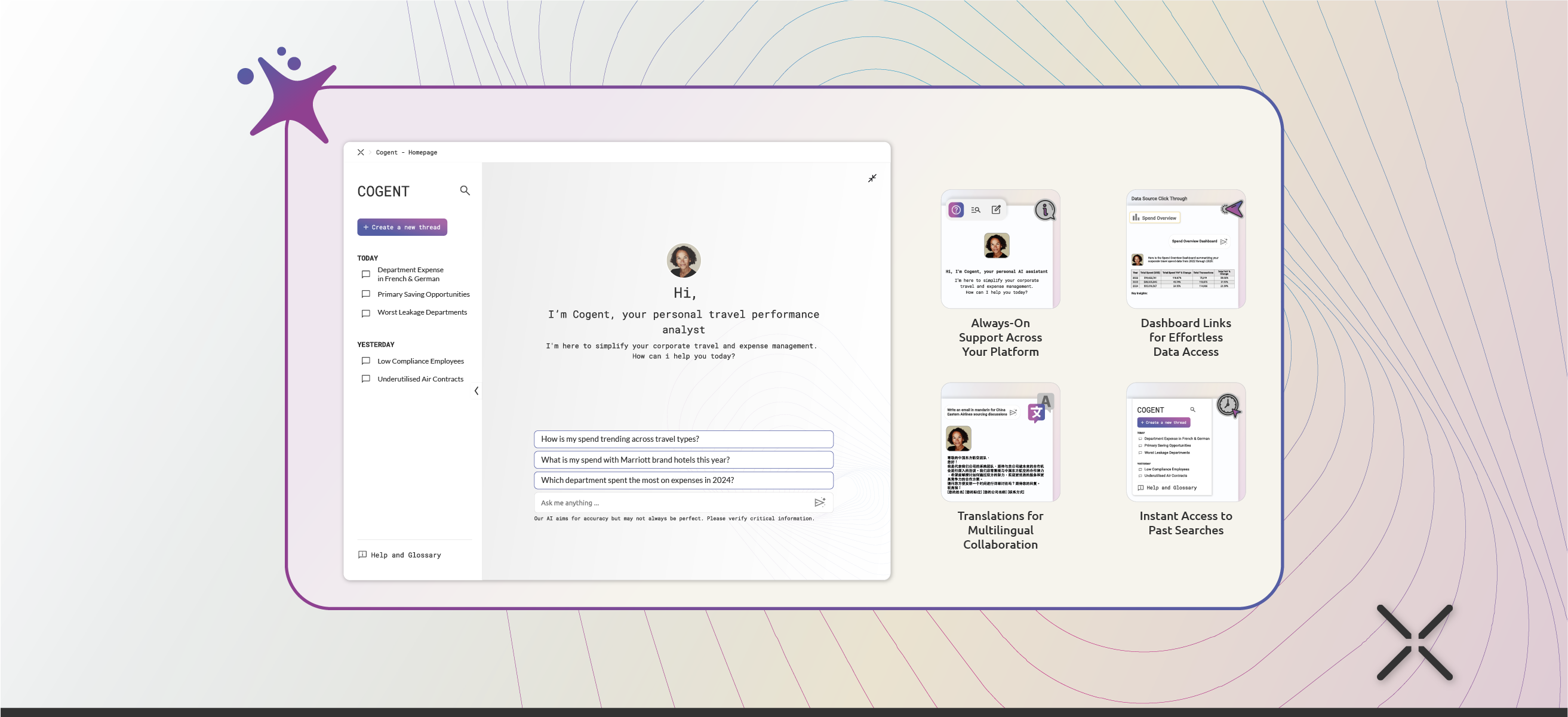
The T&E Manager of Tomorrow: How Cogent Agentic AI is Your Shortcut to Strategic Leadership in Corporate Travel
The Ultimate Guide: What to Ask Your AI for Smarter T&E Reporting | Cogent Agentic AI
