

What is ground transportation in business travel?
Ground transportation is the business travel category covering every leg of a trip that is not a flight: rideshare, taxi, rail, car rental and airport transfer. It is the only major travel category with no single booking system behind it, which makes it the hardest to report on.
Car rental usually comes through a managed booking channel. Rideshare, taxi and much of rail arrive as card transactions and expense claims instead, so a report built on bookings alone undercounts the category.
This guide covers what the category includes, why merchant names and missing location data break the reporting, and how to consolidate card, expense and booking data into one view.
In this article
- Why is ground transportation so hard to see?
- What does ground transportation cover?
- Why do merchant names break the reporting?
- What happens when location data is missing?
- What should ground transport analysis answer?
- How do you consolidate the view?
- Which approach surfaces the whole category?
- Frequently asked questions
- Where to start with ground transportation spend
Why is ground transportation so hard to see?
Ground transportation is hard to see because it has no single system of record. The same ride can arrive as a corporate card transaction, an expense claim or a booking, and a report built on one of those routes misses the other two.
Air has a booking tool. Accommodation has a booking tool. Ground transport has a card statement, a receipt photograph and occasionally a booking, and no two of them agree on what to call the merchant.
The result is a category whose total depends on which table the question reaches. In one deployment at a global pharmaceutical manufacturer, a query for ground transport initially returned nothing at all, because the search was scoped to the car rental table. Widening it to card and expense transactions immediately surfaced the rideshare spend the first query had missed.
Three structural reasons the category stays invisible:
- No system of record: spend arrives through card, expense and booking routes at the same time.
- Merchant name fragmentation: the same provider appears under many local names.
- Missing location metadata: transactions often carry no destination country at all.
What does ground transportation cover?
Ground transportation covers rideshare, taxi, rail, car rental, coach and airport transfer, plus mileage where employees drive their own vehicles. Each element enters the data through a different route, which is why the totals rarely reconcile.
The table shows how each element usually reaches the data, and where it goes missing.
Car rental is the element most programmes can report on, which is why ground transport totals are so often understated.
PredictX's own data shows how much spend bypasses the booking channel. Across 14 large enterprise travel programmes, a median 31.5% of air, hotel, car and rail spend was booked outside the travel management company (TMC) and claimed through expenses in the latest complete year (range 10% to 41%), based on enterprise deployment patterns, individual results vary. Rail ran highest, at a median 62%.
That gap matters beyond cost. Rail and car rental records are the activity data behind ground transport emissions reporting, so a total that misses them understates the footprint as well as the spend.
Why do merchant names break the reporting?
Merchant names break the reporting because the same provider appears under many different names across markets, and no reporting layer resolves them into one vendor unless it is told to.
At a global healthcare group, localised transport merchants appeared under multiple distinct entries written in local scripts across several Asian markets, alongside separate entries for the same global rideshare provider in different markets. Aggregated by merchant string, that one vendor looks like a dozen small ones.
Entity resolution is the process of recognising that differently named records refer to the same real-world entity. It is routine in customer data and rare in travel spend reporting, which is why vendor consolidation questions are so hard to answer.
What happens when location data is missing?
When location data is missing, a fully recorded category becomes almost unusable. At a global pharmaceutical manufacturer, a query breaking rideshare spend down by destination country found that almost all of it carried no location data. That is 99.99% of the category with no geography attached.
The spend was not missing. The context was. Every transaction was present, coded and reimbursed, and not one of them could say where the ride happened.
PredictX does not name a client without its written permission. The deployment figures in this article were produced by Cogent from each organisation's own travel and expense data for the period stated, and are held with their method in our evidence records.
A spend figure with no geography cannot support a sourcing conversation, a sustainability calculation or traveller tracking for duty of care.
What should ground transport analysis answer?
Ground transport analysis should show where the spend goes and who is spending it, whether vendors are consolidating or fragmenting, and what the sustainability profile of the mix looks like.
Each lens produces a different action from the same underlying data:
- Volume by vendor: drives a sourcing conversation about whether to contract centrally.
- Rail against short-haul air: drives a sustainability conversation about modal shift.
- Regional fragmentation: drives a policy conversation about which markets need clearer guidance.
- Trip geography: feeds traveller tracking and the employer's duty of care.
How do you consolidate the view?
Consolidate the view by pulling card, expense and booking feeds together, resolving merchant names to unified vendors, then attributing every transaction to a traveller, a cost centre and a location.
- Widen the source scope: query card and expense tables, as well as the booking and car rental tables.
- Resolve merchant names: map local-language and market-specific entries to one vendor.
- Attribute the transaction: attach traveller, cost centre and, where recoverable, geography.
- Reconcile the total: compare the consolidated figure with what the booking system alone reported.
A frequent ground transport reporting failure is a query scoped to the one table that happens to be tidy. The deployment findings in this article came from questions asked in Cogent, PredictX's agentic AI for T&E reporting, where the fix for the empty car rental result was a second query scoped to card and expense transactions.
Which approach surfaces the whole category?
Only an approach that queries card, expense and booking data together sees the full category. Anything scoped to a single source reports a fraction and presents it as a total.
The table compares four ways of reporting ground transportation spend.
No single feed covers the category, so the consolidation is itself the analysis.
Frequently asked questions
Why does ground transportation look small in travel reports?
Ground transportation looks small because most reports are scoped to booking data, which captures car rental and very little else. Rideshare, taxi and much of rail arrive through corporate cards and expense claims instead, so a booking-based total reports a fraction of the category and presents it as the whole.
Why does the same vendor appear multiple times in our data?
The same vendor appears multiple times because merchant strings differ by market, and no reporting layer resolves them unless it is configured to. Local-language entries, regional subsidiaries and payment-processor variations all produce separate rows for one vendor, so vendor totals stay split until the names are resolved into one entity.
What is transportation cost made up of?
Transportation cost is made up of the fare, plus surge or peak pricing, tolls, waiting time, tips and any booking or service fee. Expense claims often capture only the total, which is why per-ride cost analysis needs the underlying transaction rather than the claim, especially where a programme wants to compare providers.
Why is missing location data a traveller safety problem?
Missing location data is a safety problem because ground transport is where travellers are most exposed and least tracked. A flight has a manifest. A late-night car ride in an unfamiliar city usually leaves a card transaction and nothing else, so an employer meeting its duty of care cannot see where that traveller went.
Can ground transport spend be consolidated without changing our systems?
Yes. Consolidation is an analysis layer over the card, expense and booking feeds that already exist, so nothing needs migrating. The requirement is that the three feeds can be queried together and that merchant names are resolved across them into single vendors, with each transaction attributed to a traveller and cost centre.
Where to start with ground transportation spend
Ground transportation is the only major travel category with no system of record. At one enterprise programme, 99.99% of rideshare spend carried no destination country, making a fully recorded category almost entirely unusable for sourcing, safety or sustainability.
Ask your current reporting for your ground transport total by destination country. The share that comes back unattributed is your answer, and if no answer comes back at all, send us the question.
Related Posts
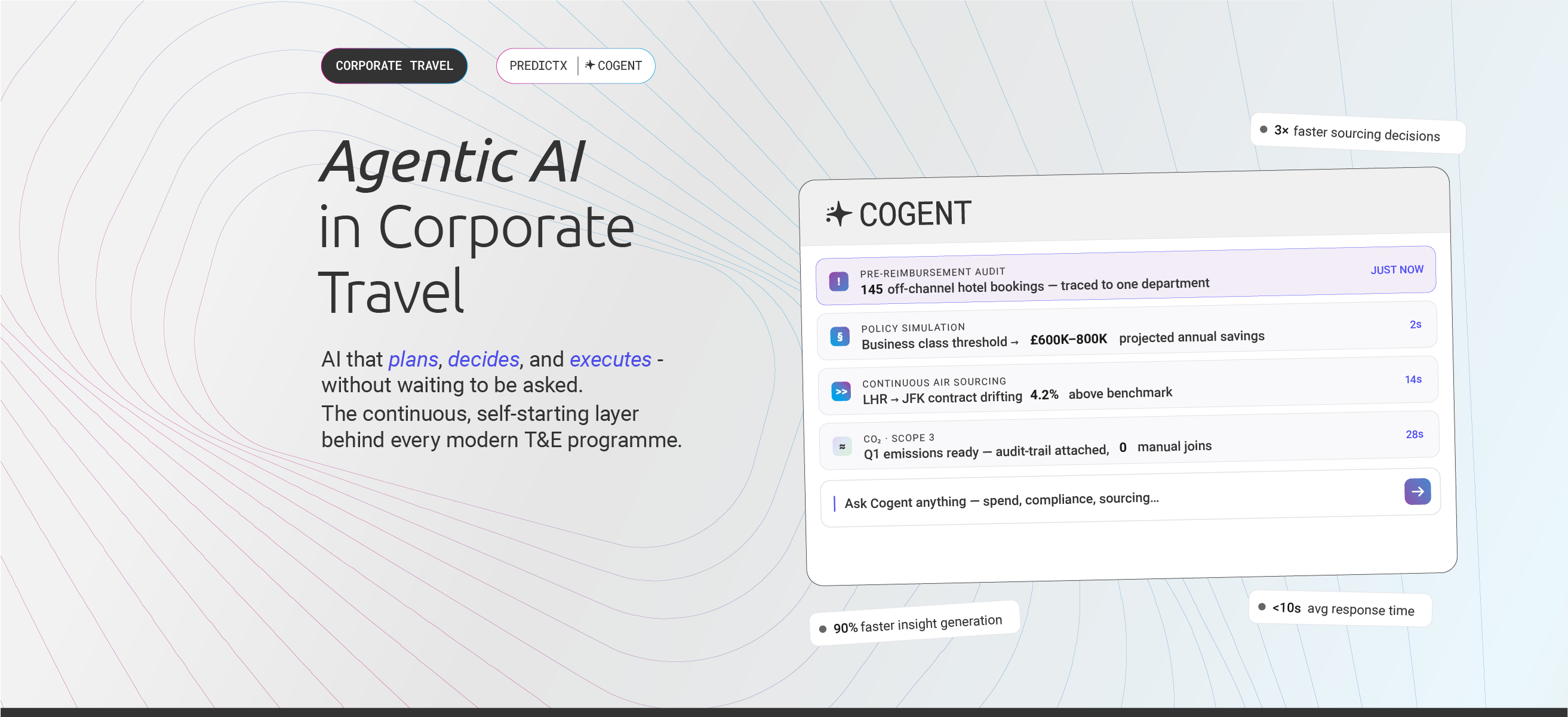
Agentic AI in Corporate Travel: The Complete 2026 Guide
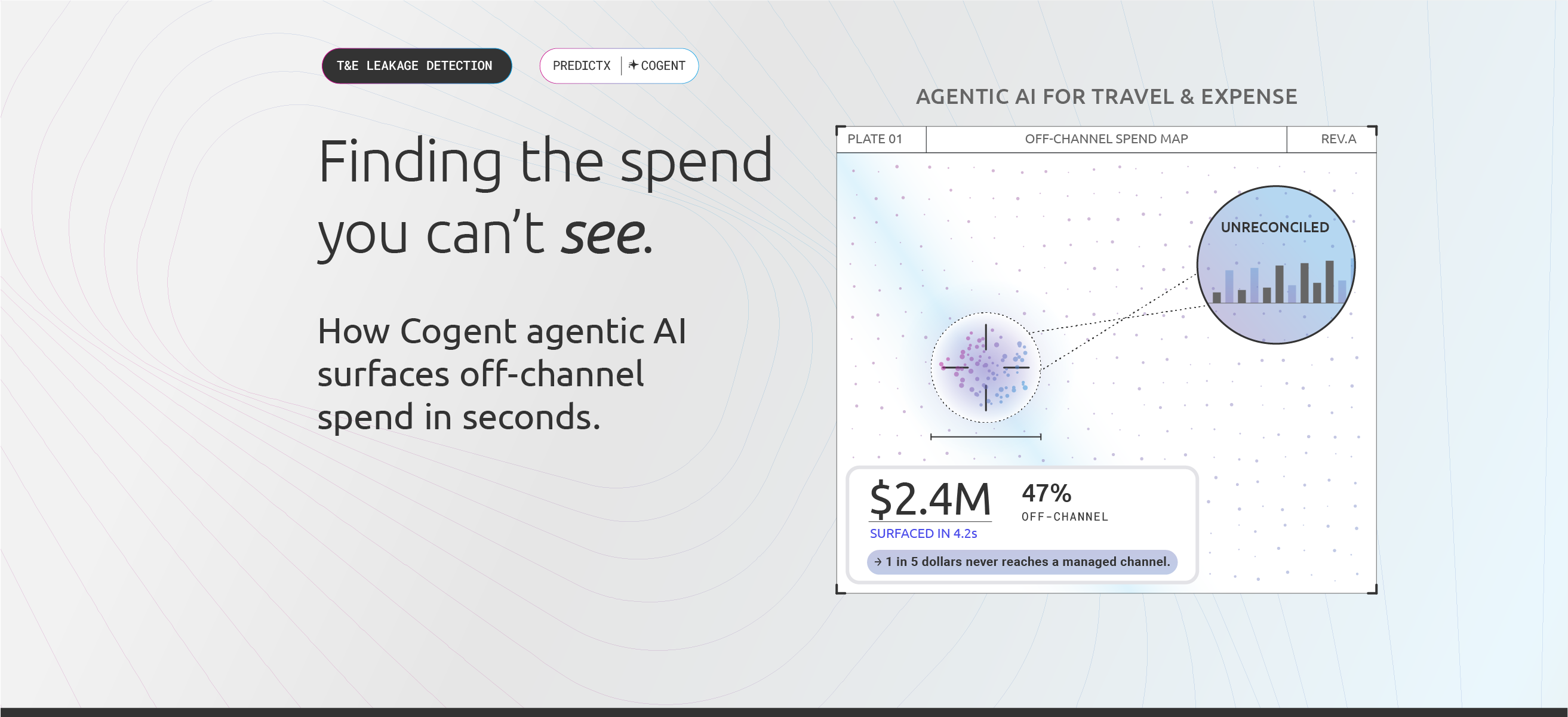
Finding the Spend You Can't See: How Cogent Agentic AI Surfaces T&E Leakage in Seconds
