AI agents for procurement are AI systems that take a sourcing or supplier goal, plan the analysis, gather evidence from spend, contract and market data, check their own work and return a finished, cited deliverable for a person to act on. They prepare the decision. The award, the terms and the supplier conversation stay with the procurement team.
Before a carrier or hotel renewal, a head of sourcing knows the analysis the negotiation deserves: a year of spend by supplier and route, performance against every commitment in the agreement, a fresh read of the market and the exceptions nobody has had time to chase. What usually arrives is part of it, assembled in the fortnight before the first meeting.
The time to build that analysis is getting scarcer. The Hackett Group's 2026 Procurement Key Issues Study, published on 17 March 2026, projects procurement workloads rising by 8% in 2026 even as head count and operating budgets decline. It also found that only 12% of organisations report large-scale AI implementation, with most still running pilots or single-use-case deployments.
The gap between that workload and the people available to carry it is where AI agents for procurement earn their place, and the four-question test below sorts your own task list into what an agent can run, what it can prepare and what stays with you.
In this article
- What are AI agents for procurement?
- Which procurement work suits an AI agent, and which does not?
- What data do procurement AI agents need before they analyse a category?
- How does a team of AI agents prepare a supplier renewal?
- How do AI agents help procurement manage travel as a category?
- Which procurement decisions should stay with people?
- Is AI replacing procurement teams?
- Frequently asked questions
- What would a team of AI agents change for your sourcing function?
What are AI agents for procurement?
An AI agent for procurement is an AI system that takes a goal in plain language, such as preparing a renewal or benchmarking a category, and works out the steps itself. It plans the analysis, pulls the evidence, checks the result and returns a finished document. The person who set the goal keeps every decision that follows.
An AI procurement agent is often described in purchase-to-pay terms: routing requisitions, raising purchase orders and matching invoices. The subject here is the other half, the analytical work that shapes sourcing decisions, such as market analysis, renewal preparation, supplier performance and contract compliance.
That work has always been rationed by analyst time. It is also where an agent that plans its own path for each question behaves differently from a fixed sequence of rules, a distinction set out in how an agentic workflow differs from automation. Two behaviours mark a well-built agent:
- It drafts a plan for the specific question, instead of rerunning a standard report built for a different one.
- It reads spend, contract and market data together, so a finding in one is tested against the others.
Which procurement work suits an AI agent, and which does not?
Procurement work suits an AI agent when its evidence sits in data you can reach, its output can be checked figure by figure, and it stops short of a commitment. Spend analysis, market benchmarking and rate audits pass all three. Awards, negotiations and supplier exits end in promises somebody has to keep, so an agent can only prepare them.
The Run, Prepare or Keep Test
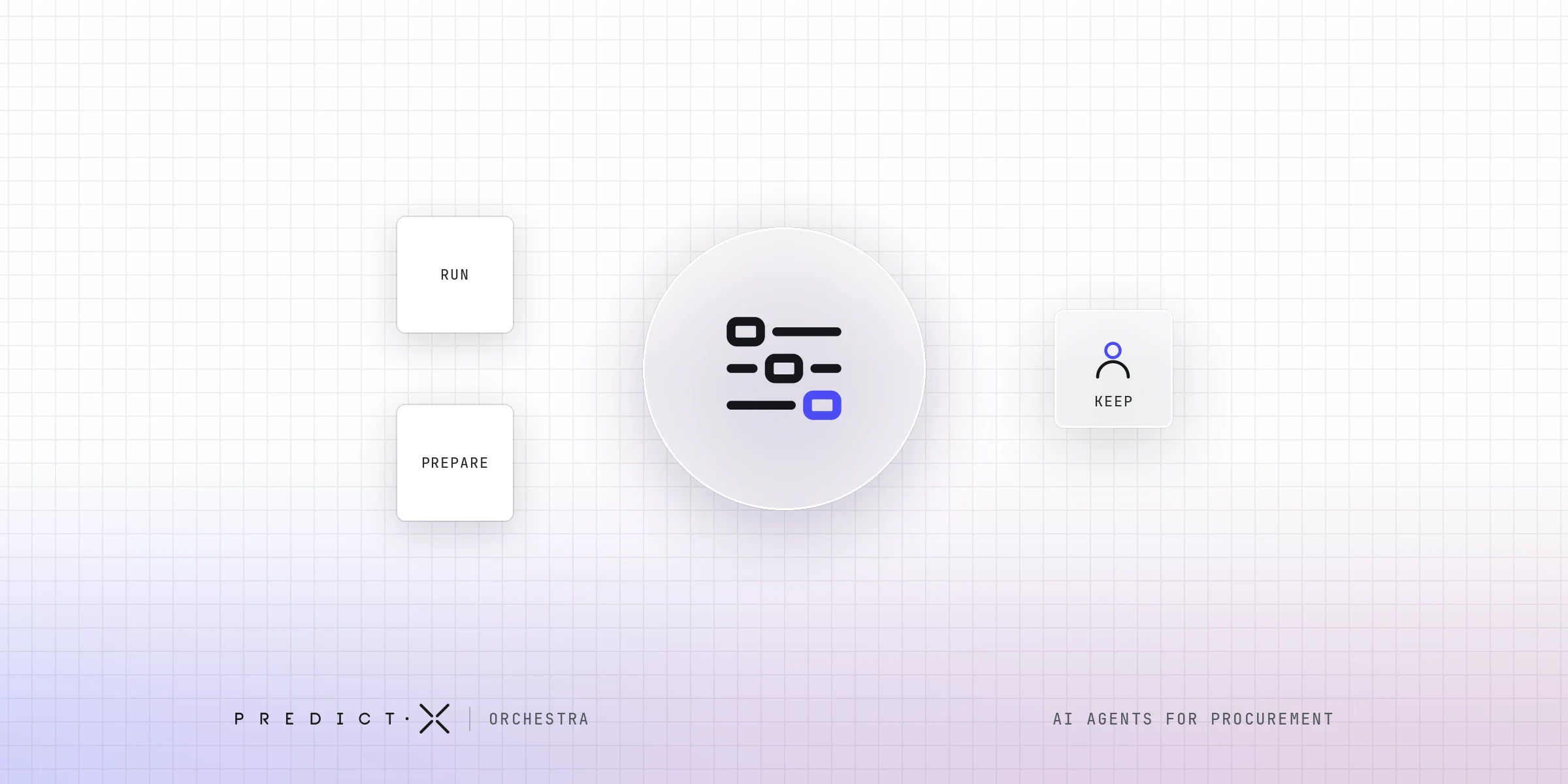
The Run, Prepare or Keep Test, PredictX's check for sourcing teams, sorts procurement work by where preparation ends and commitment begins. Ask four questions of each task on your list:
- Is the evidence in data you can reach? Bookings, invoices, card data, contracts and published market data count, and knowledge held only in people's heads does not.
- Could a reviewer check every figure against its source?
- Does the work end in a commitment, such as an award, a contract term, a change of supplier or anything a supplier will act on?
- Does it turn on a relationship or on context nobody has written down, such as a business unit's history with a supplier?
The answers put each task in one of three lanes:
- Run it: yes to the first two questions and no to the last two. The agent runs the work and a person reviews what comes back.
- Prepare it: yes to the first three and no to the fourth. The agent builds the evidence and the options, and a named person makes the call.
- Keep it: yes to the fourth, whatever the other answers. The team owns the work and uses an agent, at most, to assemble the facts.
Any other task, with a no to either of the first two questions, is not ready for an agent yet. Fix the data or the method first, because software supplies neither.
Applied to eight tasks most sourcing teams carry, the test sorts them like this.
What data do procurement AI agents need before they analyse a category?
Procurement AI agents need four kinds of data to analyse a category: what was spent, what was agreed, what the market charges and what your policy allows. Spend without contracts gives volume with no yardstick. Contracts without market data show whether a supplier kept its word, but not whether the word was a good one.
Each of the four kinds of data usually lives somewhere different:
- Spend sits in booking files, card feeds, invoices and expense claims.
- Agreements, meaning discounts, rate caps, share targets and expiry dates, often sit in contract documents rather than in any system.
- Market data comes from published fares, rate indices and supplier schedules, and it is the only one of the four you do not already own.
- Policy belongs in the set because a saving your own rules forbid will never be banked.
The hard part is joining them. One hotel can appear under several names across a booking file, a card statement and a contract, and its spend only lines up with its agreement once those records agree on who the supplier is.
An agent does not make bad data good. A well-built one says which records it could not match and which conclusions depend on them, before anybody acts on the result. Treat an agent that returns a clean answer from messy data, with no caveats at all, as a warning sign.
How does a team of AI agents prepare a supplier renewal?
An AI agent team prepares a supplier renewal by splitting the analysis: one agent measures performance against the current agreement, one reads the market, one looks for exceptions, and a coordinating agent assembles the negotiation pack. A person approves the plan before any of it runs and sets the position once the pack lands.
The walkthrough below is an illustrative example of the project PredictX sets out in its sheet on airline contract negotiation prepared by an agent team. It describes no customer and carries no figures, because the shape of the work is the point.
- The goal: the category lead asks for a position on renewing the agreement with the programme's largest carrier, which expires in two quarters.
- Scoping: the team asks which routes are in scope and whether moving share between carriers is on the table.
- The plan: a numbered plan names the data, the periods and the comparisons. The category lead removes a route the business is exiting anyway and approves the rest, and nothing runs before that approval.
- The work, in parallel: one agent measures share delivered and discount realised against what the agreement promised, another reads published fares on the same routes, and a third finds bookings made outside the agreement.
- The checkpoint: suppose most of the spend on one route turns out to be booked outside the agreement. The team pauses and asks the category lead whether that is plausible before writing it into the pack.
- The pack: performance against every commitment, the market comparison, three options with the trade-off of each, questions to put to the carrier and a source for every figure.
A good pack means the negotiator walks in knowing something the supplier does not expect them to know.
How do AI agents help procurement manage travel as a category?
AI agents help procurement manage travel by joining booking, card, expense and contract data that normally sits apart, then running the recurring analysis: carrier renewals, hotel programme reviews, rate audits and market checks. Travel suits agents because its evidence is plentiful and its buying cycles repeat on a timetable.
GBTA's Business Travel Index Outlook, published in July 2025, projected global business travel spending at a record $1.57 trillion for 2025, which makes travel a category large enough to run as a programme. Three features set travel apart from most other indirect categories:
- Travellers do the buying, one trip at a time, inside a policy the buyer wrote.
- Prices move daily, so an agreed discount only means something against what the market charged on the day of booking.
- Airline and hotel agreements usually trade share or volume for a discount, so compliance depends on where travellers booked as well as on what was invoiced.
The one travel decision no dataset settles, the trade-off between price and the traveller's time, comfort and safety, stays with whoever will answer for it when a trip goes wrong.
The hotel programme shows the fit most clearly. Each season's RFP brings responses to grade against the programme's criteria, and every stay booked afterwards can be checked against the contracted rate, the pairing that PredictX's project sheet on hotel RFP responses and rate integrity describes.
Which procurement decisions should stay with people?
Every procurement decision that commits the company should stay with a named person: awarding business, accepting or changing contract terms, switching or exiting a supplier, and anything said to a supplier that it will act on. An agent can prepare each of those decisions thoroughly. The choice needs someone who can explain it afterwards.
Two more decisions belong with the same person:
- An exception to a contract or a policy, because it sets a precedent the next request will cite.
- A saving presented to leadership, because whoever presents it will be the one asked where it came from.
Inside the work, that person approves at four points: the plan before it runs, any finding that surprises the agents, anything that commits spend, and the deliverable before anyone relies on it. Where those points belong, and how to stop an approval turning into a formality, is covered in our guide to human in the loop for AI agents.
Is AI replacing procurement teams?
AI is not replacing procurement teams: it is taking on analytical preparation that teams have rarely had the people to do, while decisions, negotiations and supplier relationships stay with the team. The Hackett Group's 2026 Procurement Key Issues Study projects procurement workloads rising 8% in 2026 as head count and operating budgets decline.
The belief to drop is that AI in procurement is a head-count decision. Much of the work an agent team takes on was never done at all, and an agent changes how much analysis happens long before it changes who is employed.
Some roles will change. A job built around assembling the quarterly spend pack will look different once the pack is assembled for it, and the hours move to work the team rarely reached:
- Reviewing and challenging agent-built analysis, a skill teams should train for deliberately.
- Covering more categories properly each year, rather than only the largest few.
- Time with suppliers and budget holders, which is where the value of a sourcing decision is agreed.
Deloitte's 2025 Chief Procurement Officer Survey, published in August 2025 and drawn from more than 250 chief procurement officers across 40 countries, named four barriers: siloed ways of working (57%), competing priorities diluting focus (46%), organisational or technology capability to support execution (40%) and the talent gap (34%). Deloitte ranked all four among the top barriers preventing value delivery, and two of them, capability to support execution and the talent gap, are shortfalls of capacity.
Frequently asked questions
What is agentic procurement?
Agentic procurement applies agentic AI to procurement work: AI agents plan and carry out multi-step tasks towards a goal a person sets, such as preparing a renewal or auditing contracted rates. The agents gather and check the evidence themselves. People approve the plan, review surprising findings and make every decision that commits spend.
How can AI be used in procurement?
AI reaches procurement in three broad ways: assistants that draft documents and answer questions, features built into procurement platforms, and agents that run analytical work from a goal. Built-in features are the commonest route. The Hackett Group's 2026 Procurement Key Issues Study found that 69% of organisations access AI through their existing procurement platforms.
Are AI agents the same as procurement automation?
AI agents are not the same as procurement automation. Procurement automation usually means purchase-to-pay workflows, such as routing requisitions, raising purchase orders and matching invoices, which follow steps designed in advance. AI agents for procurement plan their own steps towards a goal, mostly on analytical work such as renewals and benchmarks, and adapt when the data surprises them.
Can AI agents run a sourcing event on their own?
They can run most of the preparation, but they should not run the event. An agent team can build the requirements from spend data, grade responses against written criteria and flag inconsistencies between bids. The shortlist, the questions sent back to bidders, the negotiation and the award should stay with people, because each one commits the company.
What should you look for in AI agents for procurement?
Look for a plan you approve before anything runs, analysis on your own spend and contract data, a source for every figure, a pause when a finding looks surprising, and output your team can edit. Be wary of any product that cannot show where a number came from, however fluent its answer sounds.
How do you start using AI agents for procurement?
Start with one recurring analysis you already know how to judge, such as the pack for a renewal due in the next two quarters. Run the agent-built version alongside your usual preparation, compare the two and check every figure against its source. Widen the scope only once the team trusts what it is reviewing.
What would a team of AI agents change for your sourcing function?
A team of AI agents would change how much analysis reaches each sourcing decision, while the decisions stay with the people who own them. Renewals would get the full pack instead of the version that fitted into a fortnight, and benchmarks would refresh when the market moves rather than when somebody finds a free week.
Orchestra is PredictX's AI agent team for travel and expense: an AI project manager plans the work, directs nine specialist agents and returns a finished, cited deliverable. Nothing runs until a person approves the plan.
Three of the specialists do the work described here. The Supply Chain Agent covers procurement analytics, sourcing and contract execution, the Research Agent brings market intelligence and policy benchmarks, and the Audit Agent runs continuous auditing and surfaces exceptions.
Surprising findings pause for your review, and the deliverable arrives cited and editable in PowerPoint, Google Slides, Word, PDF or Markdown. Orchestra prepares the analysis and the negotiation pack; the negotiation, and anything that commits spend, stay with a named person. It launched in June 2026 and is deploying across enterprise travel programmes.
Related Posts
Agentic workflows, and how they differ from the automation you run